Why choosing the right ai frontend tool matters more thanyou think
Founders have lost 3 weeks with Cursor without a singledeveloper on their team. Others delivered a Lovable prototype in 2 days, signedthe contract, then discovered they had to rewrite everything for production.
The problem isn't that these tools are bad. It's that theydon't target the same people, or the same stages of a project.
This article presents the 6 tools honestly, with a quickreference table and a clear verdict by profile. No sponsors, no universalranking. Just what works depending on where you are.
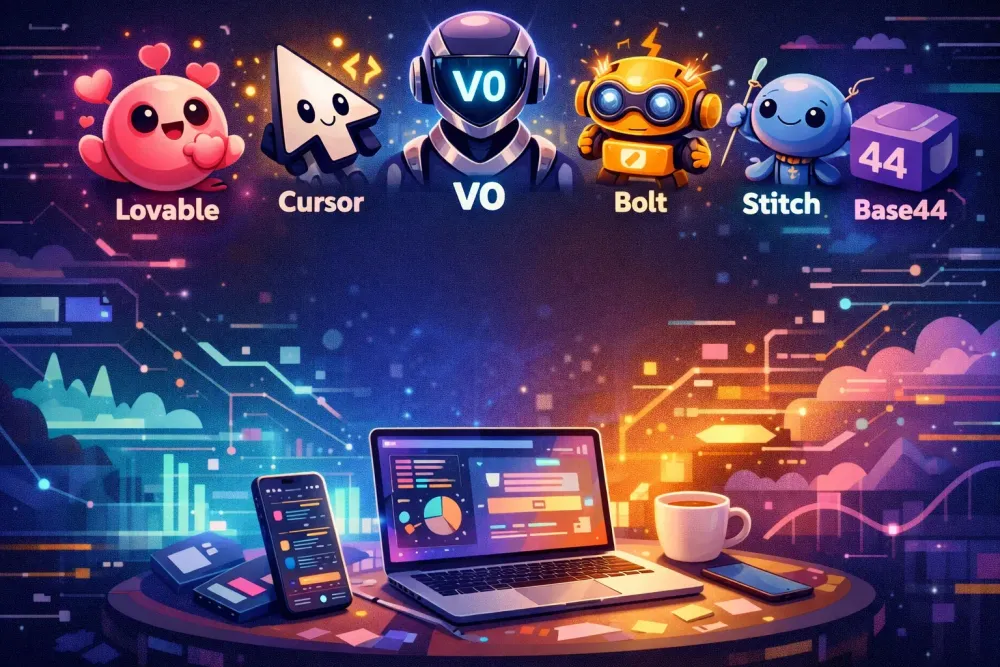
The 6 tools in brief
Before the table and verdicts, here's what each toolactually does.
Lovable is a conversational full-stack builder. You describewhat you want, it generates the interface, connects a Supabase database,handles authentication and deploys in one click. Think of it as a technicalco-founder who codes for you, without needing to explain what an API is.
Cursor is a code editor with integrated AI. It doesn'tgenerate apps from scratch: it helps you write, modify and debug existing code.It's a tool for developers, not founders.
V0 (by Vercel) generates React components in Tailwind CSSfrom a description or image. It produces clean, directly usable code. But itstops at the frontend: no backend, no database.
Bolt is a browser sandbox. You describe an app, it generatesit and lets you experiment in the browser. Great for testing an idea in 20minutes, less suited for production.
Stitch (Google Labs, launched March 2026) transforms textand images into complete interfaces, with code export. It runs on Gemini 2.5Pro, is completely free, and just introduced a voice canvas and "vibedesign" mode. Still in Labs phase, but already impressive.
Base44 (acquired by Wix in 2025) builds full-stack apps fromplain language descriptions, with built-in database and hosting. No externalservices required. Since February 2026, it even allows direct publishing to theApp Store and Google Play.
Comparison table: the criteria that matter
Ease = learning curve for a non-technical profile. 5 =usable on day one.
Which tool for which profile?
Quick answer: if you don't have a developer, start withLovable or Base44. If you do, Cursor. If you just want clean components, V0. Ifyou're testing an idea tonight, Bolt.
You're a Founder or Entrepreneur Without Technical Skills
Choice: Lovable, or Base44 if you want everything in oneplace.
Lovable lets you go from idea to functional app in a fewhours, without writing a line of code. Database, authentication and deploymentare included. It's the tool we use at Kreante to build client prototypes beforeeven signing a contract.
Base44 goes in the same direction, with the advantage ofdepending on no external service. Everything is hosted within it. Thetrade-off: you're tied to Wix infrastructure, which can cause problems if yourproject scales.
Watch out if your app needs to go into production with atechnical team: the code generated by Lovable is hard to take over cleanly.Plan for a migration phase.
You're a Developer on an Existing Project
Choice: Cursor.
Cursor doesn't generate apps from scratch. It assists youinside your editor: smart autocomplete, refactoring, debugging, functiongeneration from a description. On an existing codebase, it saves 30 to 40% oftime according to teams that have adopted it.
Watch out if you're starting from scratch with no codebase:Cursor alone isn't the right starting point.
You're a Designer or Frontend Developer
Choice: V0 for clean component code. Stitch if you're stillin the design phase.
V0 generates React components in Tailwind from a descriptionor screenshot. The code is directly usable in a Vercel/Next.js project. Nobackend, no magic: just quality frontend.
Stitch (Google Labs) goes further on design: you describe aninterface, it explores several visual directions, then exports the code. Free,powered by Gemini 2.5 Pro. Still too recent for production, but formidable forideation.
You're an Agency or Product Team
Choice: Lovable for prototypes, Cursor for development, V0for UI components.
These aren't competing tools at this level. They coverdifferent project phases. At Kreante, the workflow looks like this: Lovableprototype for the client, quick validation, then React/Supabase developmentwith Cursor for production.
What kreante uses in production (and why)
At Kreante, we build low-code and AI applications forstartups, SMBs and large companies since 2020. Over 165 projects across 35countries. We started with pure low-code, and the natural evolution brought ustoward low-code stacks combined with generative AI. That's where these toolscome in.
Lovable sits at the center of our commercial process beforeeven being a development tool.
When a prospect comes with an app idea, we build a Lovableprototype in 2 to 4 hours. Functional, deployable, with a real URL. We share itbefore the end of the week. Most prospects have never seen their idea takeshape this fast, and it completely changes the commercial conversation.
This prototype is free for the client. It serves to validatethe idea, align stakeholders and lay the groundwork for the specification. Oncethe project is signed, we migrate to a React and Supabase stack for production:better code control, scalability, ability for a technical team to take over theproject.
We don't use Lovable to deliver the final version. We use itto win the client's trust before we even start.
For UI components, V0 comes in when we need to quicklygenerate clean React elements. Cursor supports development on the most complexprojects. Stitch and Base44: we're actively testing them, but not yet in clientproduction.
Limitations to know before choosing
These tools are powerful. They also have real blind spots,and ignoring them is costly.
Security: AI-generated code isn't audited code. A 2026Veracode study indicates that 45% of AI-generated code contains exploitablevulnerabilities. This isn't a reason not to use these tools, it's a reason notto use them without a code review on a production project.
Lock-in: Base44 locks you into Wix infrastructure. You can'thost your app on your own servers. If your project grows or you want tomigrate, it will be complicated. Acceptable for an internal tool or MVP. Lessso for a long-term commercial product.
Cursor isn't for everyone. It's a tool for developers.Without an existing codebase and without technical skills, it doesn't generatemuch that's useful. Seeing it as "Lovable for devs" is a commonmistake.
Stitch isn't production-ready yet. It came out of GoogleLabs in March 2026, it's impressive and free, but it remains an experiment.Don't build a client project on it today. In 6 months, maybe.
FAQ
Lovable vs Bolt: which is faster for an MVP?
Bolt starts faster on very simple ideas. Lovable is fasteron anything that requires a backend, authentication or clean deployment. For anMVP that holds up, Lovable wins.
Can V0 handle a backend?
No. V0 generates only frontend React components. If yourproject needs a database, API or authentication, V0 alone isn't enough. Itpairs well with Supabase or Firebase, but you have to manage that partyourself.
Is Stitch free?
Yes, completely free for now. It's accessible atstitch.withgoogle.com and runs on Gemini 2.5 Pro. Google hasn't announced apaid model yet.
Can you combine multiple tools on the same project?
Yes, and it's often the best approach. Stitch to design theinterface, Lovable to build the prototype, Cursor for production development.These tools cover different phases, not identical uses.
Which tool does Kreante recommend for a first $10,000project?
Lovable for the prototype, React and Supabase forproduction. It's the workflow we apply on our projects: we validate the ideafast with Lovable, we build seriously with a robust low-code and AI stack. Ifyou want us to guide you on this path, that's exactly what we do.
Conclusion
There's no universal tool. There's a tool suited to yoursituation: your profile, your budget, your team and your project's stage.
Lovable and Base44 for non-devs who want to move fast.Cursor for developers on existing projects. V0 for clean frontend. Bolt to testan idea tonight. Stitch to design an interface with AI, without payinganything.
At Kreante, we use Lovable to convince, and a solid low-codeand AI stack to deliver. If you want a functional prototype of your app in 48hours, contact us at kreante.co.
This article is the first in a series on AI tools fordevelopment. Coming next: Lovable in depth, Cursor for teams, and tool-by-toolcomparisons.

Accelerating Software Development with Vibe Coding and AI Tools at Kreante

Kreante: Accelerating Your AppDevelopment with Low-Code, AI, and “Vibecoding”


.png)