
 Industry
Vendor Lock-In: Enterprise Risk Guide for IT Leaders
Discover how to navigate vendor lock-in risks and ensure your IT strategy protects against costly disruptions and compliance challenges.
KreanteAugust 12, 2026Read the article
How to evaluate an AI agency in Miami for a B2B project: technical delivery, consulting and coaching, team seniority, local anchoring and portfolio.

Sophie Irles, Head of Sales & Partnerships, Kreante
Published 12 August 2026
An AI agency in Miami combines strategic consulting, team coaching and the development of web and mobile applications with custom AI features. For companies based in Miami or operating from France, Belgium or Switzerland, choosing a partner comes down to its ability to bring together B2B business expertise, hands-on development skills and a credible local and international footing. This article sets out the key criteria for evaluating such an agency before committing.
The case for choosing carefully starts with a sobering set of figures. In McKinsey's State of AI survey published in November 2025, only 39% of organisations reported any enterprise-level EBIT impact from artificial intelligence, and most of those put the contribution below 5%. A preliminary study from MIT's Project NANDA reached a similar conclusion from a different angle, finding that roughly 95% of generative AI pilots produced no measurable impact on profit and loss. Adoption is close to universal; returns are not. What separates the two groups is rarely the model or the tooling. It is whether the use case was scoped against a real business constraint, whether the workflow around it was redesigned, and whether a measurable outcome was defined before anyone started building.
An AI agency in Miami stands out through a dual capability: supporting executives in understanding and adopting artificial intelligence, then translating that strategy into concrete applications. For a B2B company, the challenge is not simply to plug in a one-off tool, but to build a coherent roadmap that connects team coaching, organisational consulting and software development. This approach avoids isolated projects that don't fit into a wider vision, and it is the reason the scoping phase deserves more attention than it usually gets. A pilot that never had a defined success criterion cannot fail visibly, which is precisely why so many of them quietly do.
A recent Kreante engagement shows what the alternative looks like in practice. The project was a vehicle marketplace platform serving a network of around 300 dealerships, used by 133 people and processing roughly 30,000 vehicle photographs per day. Volume at that scale changes the nature of the technical decisions: image handling, storage and automated processing stop being implementation details and become the architecture itself. A team that had only ever built low-volume internal tools would have designed it differently, and worse, because the constraints that matter at 30,000 images a day are invisible at 300. That is the practical argument for examining an agency's portfolio before signing anything, and for looking at the variety of what it has built rather than the headline count.
The core strength of a specialised agency lies in its ability to design web and mobile applications in which AI is not bolted on at the surface but built into the architecture from the outset. This calls for expertise in full-stack development, language model integration and the design of conversational interfaces suited to real business use cases. To explore this technical dimension further, it's worth reviewing the dedicated offering of an AI agency in Miami specialising in the development of web and mobile applications with integrated AI features.
Developing an application isn't enough if internal teams don't know how to use it. B2B coaching in AI aims to train staff, structure decision-making processes and establish clear governance around the tools deployed. This human dimension complements the technical side and often determines whether an enterprise AI project succeeds or fails.
Beyond technical skill, an agency's ability to embed itself in a business ecosystem matters. Membership of the French Chamber of Commerce in Miami, for instance, signals more than a logo on a website: it reflects an established local network, familiarity with the practices of French-speaking companies operating in Florida, and access to a community of members who can vouch for the work delivered. For a company in France, Belgium or Switzerland looking to develop a project on American soil, or the reverse, that bridge shortens the distance considerably.
The composition of the team weighs just as heavily. An agency bringing together people from different countries and backgrounds, with senior-level expertise across project management, commercial strategy and development, is better equipped to handle a project end to end than one built around a single specialism. Project management keeps deadlines and deliverables under control, the commercial dimension keeps the solution aligned with real business objectives, and the development side turns the whole thing into working software. At Kreante, that spread has translated into 265 projects delivered across 35 countries.
This international spread also has a practical consequence that is easy to overlook: time-zone coverage and the ability to work in several languages make remote collaboration genuinely fluid rather than merely possible. And when a project calls for it, whether that means a workshop to frame requirements, a training session or a delicate delivery milestone, a physical presence in Miami means meetings can also take place face to face. The choice between virtual and in-person then rests on what the project needs, not on what the agency is limited to.
An agency's expertise can be measured against markers that are verifiable from the outside. Speaking at technology conferences, running webinars, publishing technical content or contributing to professional communities all indicate a team that follows developments in the field closely enough to explain them to others. In a domain moving as fast as artificial intelligence, that willingness to be evaluated publicly is a useful signal, because it is difficult to sustain a public position on a fast-moving subject without keeping up with it.
Client feedback published openly belongs in the same category: Kreante currently holds a rating of 4.9 out of 5 across 31 reviews. None of these markers proves technical quality on its own. Taken together, they show whether an agency is accountable to anyone beyond its own sales page, which is the question a prospective client is really asking.
Track record deserves the same scrutiny, though the number of projects delivered says less than their variety. An agency that has worked across different sectors, formats and technical constraints, from an internal automation tool to a customer-facing mobile application, a document search system or an AI feature grafted onto an existing platform, demonstrates an adaptability that a portfolio of near-identical projects cannot. That breadth suggests a team capable of starting from a business problem rather than reapplying a single familiar solution.
The distinction matters at the proposal stage, because an agency with one repeatable offer will tend to describe your problem in terms of that offer. A useful test during a first conversation is to ask what the agency would advise if the answer turned out not to involve building anything at all.
Before committing, it's useful to compare agencies against objective criteria rather than sales promises alone.
| Criterion | What to check |
|---|---|
| Technical expertise | Proven capability in web and mobile development and AI integration |
| Consulting support | Presence of a strategic and educational dimension, not just execution |
| Team composition | Senior-level skills across project management, commercial strategy and development |
| Local anchoring | Membership of local bodies such as the French Chamber of Commerce in Miami |
| Availability in person | Ability to work remotely as standard and meet face to face when the project requires it |
| Recognised expertise | Conference talks, webinars, published content, professional community involvement |
| Portfolio diversity | Range of project types and sectors, not just the total number delivered |
| Sector fit | Understanding of the B2B challenges specific to the client's industry |
| Methodological transparency | Clear explanation of stages, deliverables and responsibilities |
| Geographic reach | Ability to serve clients in France, Belgium or Switzerland remotely |
A successful AI project generally follows a logic made up of several phases: scoping requirements, training teams, technical design, then progressive rollout. This structure helps avoid rushed decisions and makes it possible to verify, at each stage, that the solution being developed genuinely meets the original business objectives.
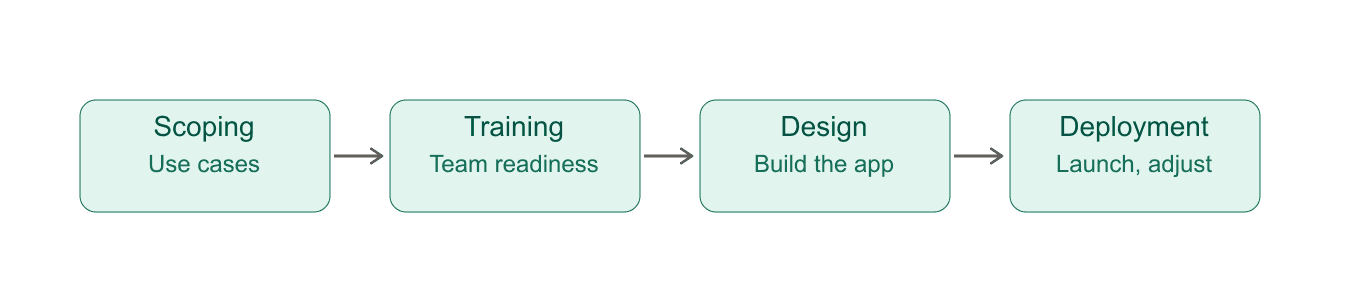
By combining consulting, coaching and technical development, an AI agency in Miami can support a B2B company across its entire transformation journey, from strategic thinking through to the concrete implementation of an application with artificial intelligence features tailored to its challenges.
An AI agency in Miami supports companies in adopting, designing and integrating artificial intelligence solutions. It can work on strategy, team training, workflow automation, AI agents, as well as the development of web or mobile applications with built-in AI functions. The right partner should connect business objectives to the appropriate technologies, rather than offering a generic solution disconnected from the company's operations.
A specialised agency can offer AI coaching and training, strategic consulting, outsourced AI product leadership, process automation and the development of custom solutions. It can also connect tools such as CRMs, collaborative workspaces or document repositories to assistants and retrieval-augmented search systems. The scope depends on the needs, the data available and the company's level of digital maturity.
Start by assessing its experience on comparable projects, its ability to understand your industry and the clarity of its working method. Ask how it defines objectives, selects tools, protects data and measures the quality of the solution delivered. Also check whether the team can handle consulting, development and technical integration alike. An initial conversation should make it possible to clarify the scope, the responsibilities and the terms of the project.
It often does. Membership of organisations such as the French Chamber of Commerce in Miami indicates an agency embedded in a verifiable professional ecosystem, accustomed to working with French-speaking companies and answerable to a community of peers. For a European company launching a project in the United States, that network can also open doors well beyond the technical scope of the engagement.
Yes. Most AI projects can be run remotely, from initial scoping through to deployment, provided the agency has the tools and working habits to support it. An international team spread across several time zones and languages makes that mode of collaboration more comfortable. That said, having a team physically present in Miami means certain moments, such as framing workshops, training sessions or key delivery milestones, can take place in person when a project benefits from it.
Look for evidence available outside the sales conversation: talks given at technology conferences, webinars run, technical articles published, involvement in professional communities. Then examine the portfolio for variety rather than volume, meaning different sectors, different project types and different technical constraints. An agency that has adapted to varied contexts is better placed to handle yours than one that has repeated the same engagement many times over.
Yes, an agency can design an integration between AI and existing tools, in particular a CRM, a collaboration suite, a knowledge base or a line-of-business system. The goal may be to retrieve information, automate tasks, generate responses or help teams make decisions. Feasibility depends on APIs, access rights, data quality and security requirements. A technical audit makes it possible to identify constraints before development begins.
Security rests on several elements, notably access management, permission restrictions, encryption where relevant, environment separation and traceability of actions. The agency should also explain where data is processed, what information is sent to the models and how sensitive content is controlled. Before starting, the company should define its confidentiality rules, its regulatory obligations and the terms of use of its AI providers.
Outcomes should be framed as measurable objectives tied to a specific operation. This might mean reducing a manual task, improving access to information, speeding up a sales process or creating a new feature within an application. Also define the users concerned, the data required, the quality criteria and the acceptable limits. This preparation helps the agency propose a proportionate solution and makes the project easier to evaluate once implemented.
Choosing an AI agency in Miami depends less on the technology on offer than on the discipline applied before any code is written. The McKinsey and MIT figures point the same way: what separates the projects that pay off from the ones that quietly stall is the framing, meaning a real business constraint, a redesigned workflow and a success criterion agreed before the build starts.
The criteria set out above can all be checked before signing anything: proven technical delivery, a genuine consulting and coaching dimension, a senior international team, verifiable local anchoring and a portfolio broad enough to demonstrate adaptability. An agency that answers them clearly is also one that can tell you what it would not build for you, which is often the more valuable answer.
If you are weighing up a web or mobile project with AI features, whether you are based in Miami or working from France, Belgium or Switzerland, the quickest way to find out whether the fit is there is a first conversation about your actual constraints.
Web & mobile app development services | Kreante
Get a recommendation tailored to your situation on this topic.
Go further
Don't let your tech watch stop here. Explore our other resources to master your technology stack.
IndustryDiscover how to navigate vendor lock-in risks and ensure your IT strategy protects against costly disruptions and compliance challenges.
 Industry
Discover a practical roadmap for achieving SOC 2 compliance in your SaaS business, ensuring data security and trust with enterprise clients.
 Industry
Compare the best AI agencies in France by model: consulting firms, technical studios, training bodies and full-coverage partners measured on ROI.