
 Industry
Best AI Agencies in France: B2B Comparison 2026
Compare the best AI agencies in France by model: consulting firms, technical studios, training bodies and full-coverage partners measured on ROI.
KreanteAugust 10, 2026Read the article
Discover a practical roadmap for achieving SOC 2 compliance in your SaaS business, ensuring data security and trust with enterprise clients.

SOC 2 is an AICPA attestation of your operational controls against the Trust Services Criteria. For a SaaS company, that translates to one thing: proving to enterprise buyers that the controls protecting their data actually work. If you’re reading this to figure out where to start, here are the four moves that matter right now:
Your cloud infrastructure (AWS, Azure, GCP) already has its own SOC reports you can reference, but those cover the provider’s controls, not yours. The boundary between what they own and what you own is exactly what auditors scrutinize.
SOC 2 for SaaS requires scoping your customer-data systems, selecting the right Trust Services Criteria, generating audit-grade evidence throughout the observation period, and mapping cloud shared responsibility before the auditor arrives.
| Point | Details |
|---|---|
| Type 1 vs. Type 2 | Type 1 is a point-in-time snapshot; Type 2 covers a 3–12 month observation window and is required by most enterprise buyers. |
| Security criterion is mandatory | All other Trust Services Criteria (Availability, Processing Integrity, Confidentiality, Privacy) are optional and scoped to your product and data types. |
| Cloud shared responsibility | AWS, Azure, and GCP SOC reports cover the provider’s layer only; you must document and evidence the controls you own. |
| Evidence starts at day one | Log retention, access reviews, and change records must cover the full observation period; retroactive evidence collection is not possible. |
| Kreante builds audit-ready SaaS | Kreante delivers SaaS products with IAM, logging, and CI/CD traceability built in, reducing remediation time and audit friction. |
SOC 2 is a formal attestation report, not a certificate. A licensed CPA firm examines your controls against the AICPA Trust Services Criteria and issues an opinion under the SSAE 18 attestation standard. No badge, no certificate, no expiry sticker. What you get is an auditor’s written opinion that your controls were designed (Type 1) or operating effectively (Type 2) during the examination period.
That distinction matters operationally. ISO 27001, by contrast, is a certification issued by an accredited certification body against a published standard. You can hang an ISO 27001 certificate on your website. A SOC 2 report is a confidential document you share under NDA with customers who request it. The two frameworks overlap significantly in control areas, but they serve different procurement contexts.
The AICPA Trust Services Criteria organize controls into five categories. Security is the only mandatory one. Every SOC 2 report covers it. The other four (Availability, Processing Integrity, Confidentiality, and Privacy) are optional and scoped based on your product and the data you handle. A typical SOC 2 report contains three components: a description of your system written by management, the auditor’s testing procedures and results, and the auditor’s opinion. That opinion is what enterprise procurement teams are actually reading.
Stat to know: The expected global cost of cybercrime continues to rise year over year through 2027, which is precisely why enterprise security teams now treat a SOC 2 Type 2 report as a procurement prerequisite rather than a nice-to-have.
SOC 2 removes procurement friction, and running a free AI content optimization audit can help ensure your public documentation and policy pages are discoverable and clear for customer review. That’s the short version. For North American enterprise buyers, a SOC 2 Type 2 report is often the single document that moves a deal from security review to signed contract.
The commercial reality is straightforward. Enterprise security and procurement teams run vendor risk assessments before approving any new SaaS tool. Without a SOC 2 report, your team answers the same 150-question security questionnaire for every prospect, and the answers are only as credible as the word of whoever filled them out. A Type 2 report replaces that process with an independent auditor’s opinion. SaaS-focused guides consistently show that SOC 2 accelerates enterprise sales cycles and simplifies vendor onboarding.
The business benefits stack up quickly:
Consider a typical scenario: a mid-market SaaS company lands a pilot with a Fortune 500 customer. The pilot goes well. Then the enterprise’s security team sends a vendor assessment request. Without SOC 2, the deal sits in review for two to four months while the SaaS team assembles evidence manually. With a current Type 2 report, that review often closes in under two weeks.
Practitioners who sell into both US and international markets often start with SOC 2 for North American pipelines and add ISO 27001 later for European or government tenders, because the control work overlaps substantially. If your primary market is the US, SOC 2 is the right first investment.
Pick Type 1 if you need a fast snapshot to unblock a deal. Pick Type 2 if your customers require evidence that controls worked consistently over time. Most enterprise buyers want Type 2, but a Type 1 can serve as a credible interim step while you accumulate the observation period for Type 2.
| Dimension | SOC 2 Type 1 | SOC 2 Type 2 |
|---|---|---|
| What it covers | Control design at a single point in time | Control operating effectiveness over an observation period |
| Observation window | None (point-in-time) | Typically 3–12 months |
| Evidence volume | Moderate (design documentation) | High (logs, access reviews, change records over full period) |
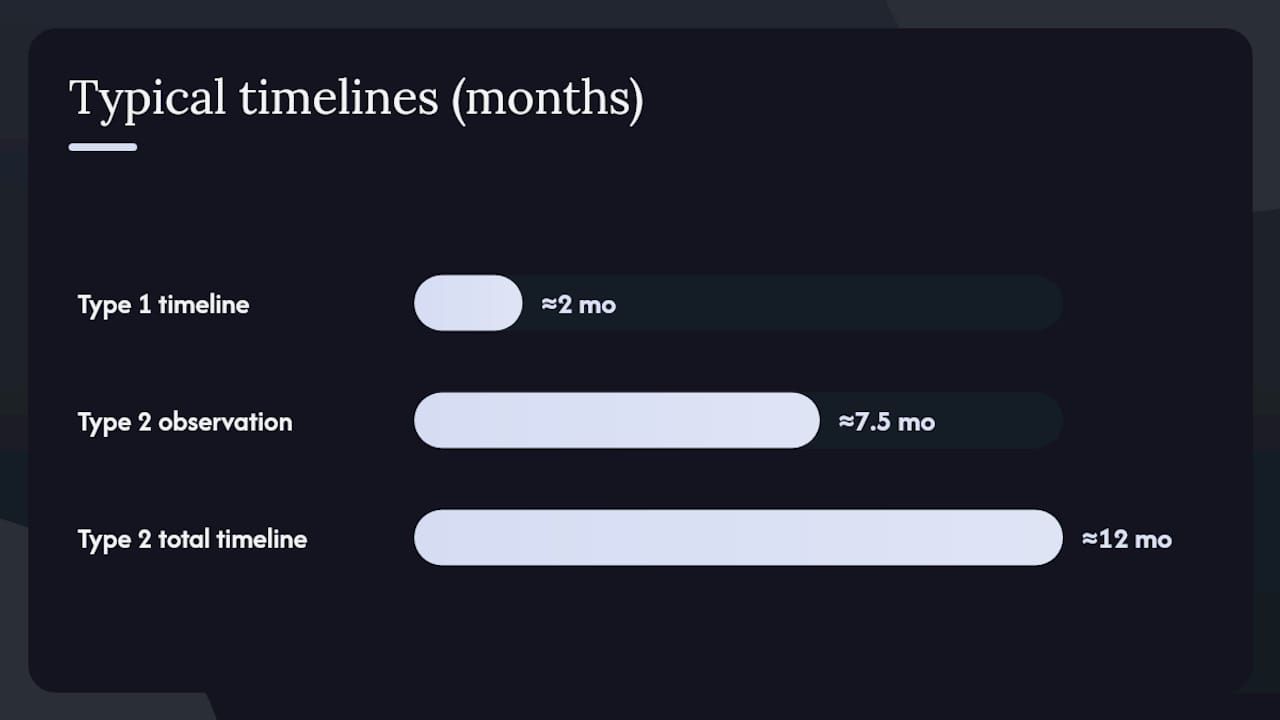
| Typical timeline | 4–12 weeks from readiness to report | 6–18 months total (observation + audit) |
| When it unblocks sales | Useful for early-stage deals or interim credibility | Required by most enterprise procurement teams |
| Renewal cycle | Annual re-examination recommended | Annual re-examination standard |
SOC 1 covers controls relevant to financial reporting, not data security. If your SaaS product processes payroll or financial transactions that affect a customer’s financial statements, SOC 1 may be relevant in addition to SOC 2. It is not a substitute.
SOC 3 is a public-facing summary of a SOC 2 examination. It carries the same auditor opinion but omits the detailed control descriptions and test results. Some companies publish a SOC 3 on their trust page as a marketing signal. It does not replace the SOC 2 report for procurement purposes.
Security is required. Every SOC 2 report includes it. The other four criteria are optional, but the right selection depends on what your product does and what data it handles. Choosing too few criteria leaves gaps that enterprise buyers will notice. Choosing too many adds audit scope without proportional benefit.
Security covers logical and physical access controls, system monitoring, change management, and risk assessment. For a SaaS product, this means enforcing multi-factor authentication (MFA) across all production access, maintaining role-based access control (RBAC), logging authentication events, and running a formal vulnerability management program. Evidence artifacts include MFA enrollment reports, access provisioning tickets, firewall configuration exports, and penetration test results.
Availability applies if your product has uptime commitments in customer contracts or SLAs. Controls include disaster recovery (DR) runbooks, backup schedules and restoration tests, incident response procedures, and capacity monitoring. Evidence: DR test records, backup completion logs, uptime monitoring exports, and incident post-mortems.

Processing Integrity is relevant when your product performs calculations, data transformations, or financial processing that customers rely on for accuracy. Controls focus on input validation, error handling, and output reconciliation. Evidence: automated test results, data validation logs, and reconciliation reports.
Confidentiality applies when you handle data that customers classify as confidential under contract. Controls include data classification policies, encryption at rest and in transit, and data retention and disposal procedures. Evidence: encryption configuration exports, data classification policy documents, and disposal records.
Privacy applies when you collect, use, or share personal information. If your SaaS product handles end-user personal data, this criterion is worth including. Controls align closely with GDPR and CCPA requirements: consent management, data subject request procedures, and privacy notices. SaaS vendors that also handle protected health information should map these controls to HIPAA requirements as well.
When selecting criteria, map your product features and data types first. A B2B analytics platform that processes only aggregated, non-personal data probably needs Security and Availability. A healthcare SaaS that stores patient records needs Security, Confidentiality, and Privacy at minimum.
The audit process has four practical phases: scope definition, readiness and remediation, observation (Type 2 only), and auditor examination with report delivery. Sprinto’s SaaS-focused breakdown confirms this structure and adds that most SaaS teams underestimate the evidence-collection burden in phases two and three.
Phase 1: Scoping. Define which systems, services, and people are in scope. This means identifying every component that stores, processes, or transmits in-scope customer data. Your scope boundary should be tight enough to be manageable and broad enough to satisfy auditor scrutiny. Owner: security lead or compliance manager.
Phase 2: Readiness and remediation. Run a gap assessment against the Trust Services Criteria you’ve selected. Document every control gap, prioritize by audit impact, and remediate before the observation window opens. Owner: security lead with engineering and IT support.
Phase 3: Observation (Type 2 only). During the observation period, your controls must operate consistently. The auditor will sample evidence from across this window. Owner: all teams responsible for in-scope controls.
Phase 4: Auditor examination and report delivery. The CPA firm reviews your system description, tests controls against sampled evidence, and issues a report. Expect multiple evidence request rounds. Owner: compliance manager coordinates responses.
The table below maps common controls to the exact evidence artifacts auditors typically request:
| Control Area | Specific Control | Evidence Artifact | Typical Retention |
|---|---|---|---|
| Access control | User access provisioning | Provisioning tickets, HRIS exports | 90 days minimum |
| Access control | Quarterly access reviews | Access review completion records | Full observation period |
| Authentication | MFA enforcement | MFA enrollment report, IdP logs | 90 days minimum |
| Change management | Code deployment approvals | Pull request approvals, CI/CD logs | Full observation period |
| Incident response | Incident handling | Incident tickets, post-mortems | Full observation period |
| Vulnerability management | Patch management | Patch status reports, scan results | 90 days minimum |
| Backup and recovery | Backup completion | Backup job logs, restoration test records | Full observation period |
| Monitoring | Security event logging | SIEM exports, alert logs | 90 days minimum |
Management responses to auditor findings are part of the formal record. If the auditor identifies an exception, your team documents the root cause and remediation. That exchange is included in the final report. Confidentiality handling varies by firm, but most SaaS companies share SOC 2 reports under a mutual NDA.
You must document the boundary between your controls and those of your cloud vendors. You cannot inherit a cloud provider’s SOC 2 report and call it your own. What you can do is reference it to demonstrate that the infrastructure layer your product runs on has been independently examined.
AWS, Azure, and GCP each publish SOC 2 Type 2 reports covering their infrastructure services. Microsoft documents its SOC 2 Type 2 examination periods and issues bridge letters for new services that haven’t yet completed a full annual cycle. AWS and GCP publish similar reports through their respective compliance portals (AWS Artifact and Google Cloud Compliance Reports Manager).
Practical steps for mapping shared responsibility:
Typical provider artifacts you can re-use in your submission:
One practical note: if you use a managed service that handles data processing (a third-party email provider, a payment processor, a sub-processor), you need their SOC 2 report too. Auditors will ask for a vendor management list and evidence that you reviewed each critical vendor’s attestation.
Type 1 can be completed in as little as four weeks from the end of readiness work. Type 2 requires a 3–12 month observation window on top of readiness and audit time, putting total elapsed time at six to eighteen months for a first cycle.
| Milestone | Type 1 | Type 2 (first cycle) | Type 2 (renewal) |
|---|---|---|---|
| Readiness assessment | 2–4 weeks | 2–4 weeks | 1–2 weeks |
| Remediation | 2 weeks | 2 weeks | Ongoing |
| Observation window | None | 3–12 months | 12 months |
| Auditor examination | 2–6 weeks | 4 weeks | 4 weeks |
| Report delivery | 1–2 weeks | 1–2 weeks | 1–2 weeks |
| Total elapsed time | 6–20 weeks | 6–18 months | several months |
Cost ranges vary significantly by team size, existing control maturity, and auditor selection. Common cost drivers for a first-cycle SaaS audit:
Auditor selection matters more than most teams expect. A CPA firm with SaaS-specific experience knows which evidence formats are acceptable, asks fewer clarifying questions, and moves faster. A generalist firm may require more explanation of cloud-native architectures and CI/CD workflows, adding weeks to the examination phase.
Prioritize controls with the highest probability of customer questions: access control, incident response, and change management. Those three areas generate the most audit exceptions for SaaS teams and the most friction in enterprise security reviews.
High-impact controls (address first):
Medium-impact controls (address before observation window opens):
Evidence artifacts by control area:
Pro Tip: Automate evidence collection from day one. Connect your IdP, cloud provider, and ticketing system to your compliance platform so logs and access review exports generate automatically. Teams that integrate evidence collection into CI/CD and ticketing early have materially lower remediation time during audits.
Remediation triage: Categorize gaps as quick fixes (a missing policy document, an unconfigured MFA setting), medium (a process that exists but isn’t consistently followed), or major (an architectural gap like unencrypted data at rest). Quick fixes should be closed before the observation window opens. Medium issues need a documented remediation plan with a completion date. Major issues may require a phased approach with compensating controls documented for the auditor.
Exceptions usually come from three sources: missing evidence, inconsistent processes, and misunderstood scope. The good news is that all three are preventable with preparation.
Undocumented controls. A control that exists in practice but has no written policy or procedure is invisible to an auditor. Fix: document every control before the observation window opens, even if the documentation is brief. A one-page procedure beats a verbal explanation every time.
Inconsistent access reviews. Quarterly access reviews that are completed for some systems but not others, or completed late, are one of the most common sources of exceptions. Fix: schedule access reviews in your project management tool with a defined owner and a hard deadline. Export completion records immediately after each review.
Inadequate log retention. Auditors request logs covering the full observation period. If your log retention is set to 30 days and your observation window is six months, you have a gap you cannot close retroactively. Fix: set log retention to at least 12 months before the observation window starts. Cloud-native logging services (AWS CloudWatch, Azure Monitor, Google Cloud Logging) make this straightforward.
Mis-mapped third-party responsibilities. Claiming that a cloud provider’s control covers something you actually own is a scope error that auditors catch quickly. Fix: document your shared-responsibility mapping explicitly and have it reviewed before the auditor arrives.
Incomplete incident records. An incident that occurred during the observation period with no ticket, no post-mortem, and no documented resolution is an exception waiting to happen. Weak incident response handling has real consequences, as reporting on high-profile data incidents consistently shows. Fix: require a ticket for every security event, even minor ones, and document the resolution and any process changes.
Scope creep during the audit. Adding systems or services to scope after the observation window opens creates evidence gaps. Fix: finalize scope before the observation window starts and treat any additions as a scope change requiring auditor discussion.
Tooling speeds evidence collection and reduces audit time, but it does not replace process ownership. A platform that automatically pulls access logs from your IdP still needs a human to review those logs and document the outcome.
Control automation platforms (Vanta and Sprinto are the most commonly cited in SaaS contexts) connect to your cloud providers, identity providers, code repositories, and ticketing systems. They map collected evidence to Trust Services Criteria, flag gaps, and generate audit-ready evidence packages. The primary benefit is reducing the manual effort of evidence collection during the observation period. The limitation is that they cannot create controls that don’t exist. If your change management process is inconsistent, the platform will surface that gap, but fixing it requires process work.
Integration patterns that matter:
Decision factors for tooling selection:
Penetration testing services are a separate category. Most auditors expect a third-party pen test conducted within the past 12 months. Providers range from boutique SaaS-focused firms to large managed security service providers. Scope the pen test to match your SOC 2 scope.
For teams building on no-code or low-code backends, platform choice affects what evidence is available. Enterprise-grade no-code tools vary significantly in their logging and audit trail capabilities, which directly affects what you can export for auditor review.
Embed controls into dev workflows and treat audit-grade evidence as a byproduct of engineering practices, not a separate compliance project. That framing changes everything about how much the audit costs and how disruptive it is.
The teams that struggle most with SOC 2 are those that treat it as a one-time project owned by a compliance manager. The teams that move through audits efficiently treat control automation as part of the product backlog. Access provisioning workflows, logging configurations, and change approval gates are engineering tasks. When they’re built into the product from the start, the evidence exists automatically.
Specific practices that pay off:
Kreante has delivered over 265 projects across 35 countries, including SaaS products where audit-grade logging, IAM architecture, and CI/CD traceability were built into the initial delivery. The pattern is consistent: teams that invest in auditable architecture early spend a fraction of the time on SOC 2 readiness compared to teams that retrofit controls after the fact.
The standard SOC 2 playbook tells you to pick your criteria, run a gap assessment, fix the gaps, and hire an auditor. That’s accurate but incomplete in a way that costs teams months of unnecessary work.
The gap that most guides skip is the evidence-generation problem. Compliance platforms like Vanta and Sprinto are genuinely useful, but they surface what you have, not what you need. If your engineering team hasn’t built logging, access review workflows, and change approval gates into the product, no compliance platform fixes that. The platform just shows you the gap faster.
The second thing most guides understate is the shared-responsibility mapping. SaaS teams routinely assume that running on AWS or Azure covers more than it does. The provider’s SOC 2 report covers the physical data center, the hypervisor, and the managed service layer. Your encryption key management, your IAM role assignments, your network segmentation, and your application-layer access controls are yours. Auditors know this boundary cold. Teams that haven’t mapped it explicitly before the audit starts spend the first two weeks of the examination explaining their architecture instead of delivering evidence.
The third underrated move is starting with Type 1. Many founders resist it because they’ve heard that enterprise buyers only want Type 2. That’s true for mature procurement processes. But a Type 1 report, issued quickly, signals operational seriousness and unblocks deals while the Type 2 observation window runs. It also gives your team a dry run of the evidence collection process before the stakes are higher.
The practical priority order: map your shared responsibility first, build evidence generation into your engineering workflows second, and then run the readiness assessment. Most teams do it in reverse and pay for it in remediation time.
Getting to SOC 2 readiness is faster when the architecture is built for it from the start. Kreante’s senior engineering team designs and delivers SaaS products with auditable IAM, structured logging, and CI/CD traceability built in, so that evidence collection during your audit observation period is a byproduct of normal operations rather than a scramble.
For teams already in production, Kreante runs scoping and gap analysis, builds or retrofits the controls auditors require (access provisioning workflows, log retention configurations, change approval gates), and packages evidence for auditor submission. The work is scoped per engagement with fixed quotes, no open-ended retainers. With AI-powered development services and more than 265 projects delivered across 35 countries, Kreante brings the delivery speed and security architecture depth that SaaS compliance timelines demand. To discuss your SOC 2 readiness sprint, reach out through the Kreante website for a scoped engagement.
The following resources are worth bookmarking for auditor submissions and framework reference:
For bridge letters specifically: if your cloud provider’s current SOC 2 report doesn’t cover the full period of your audit observation window, request a bridge letter directly from the provider’s compliance team. Microsoft, AWS, and GCP all issue these for qualified customers. Include the bridge letter in your auditor submission alongside the most recent full report.
SOC 2 is an attestation report issued by a licensed CPA firm under the AICPA’s Trust Services Criteria, confirming that a company’s controls protect customer data. It applies directly to SaaS companies because they store and process customer data on behalf of their clients.
SOC 2 is an attestation, not a certification. A Type 1 report typically takes 6–20 weeks from the start of readiness work. A Type 2 report requires a 3–12 month observation window plus audit time, putting total elapsed time at 6–18 months for a first cycle.
Type 1 assesses whether controls are designed correctly at a single point in time. Type 2 assesses whether those controls operated effectively over an observation period of 3–12 months. Enterprise procurement teams almost always require Type 2.
SOC 2 is a CPA attestation report used primarily in US enterprise procurement. ISO 27001 is a formal certification against an international standard, more commonly required for European or government contracts. The control frameworks overlap significantly, and many global SaaS vendors pursue both.
No. Cloud provider SOC 2 reports cover the provider’s infrastructure layer only. You must independently evidence the controls you own, including IAM configurations, encryption key management, application-layer access controls, and incident response. Provider reports can be referenced in your auditor submission to cover the infrastructure layer they control.
Go further
Don't let your tech watch stop here. Explore our other resources to master your technology stack.
IndustryCompare the best AI agencies in France by model: consulting firms, technical studios, training bodies and full-coverage partners measured on ROI.
 Industry
The rise of AI powered apps and innovative tools has made it possible for developers and tech profesionals to build solutions without technical expertise
 Industry
Outcome first AI audit for business leaders in 2–3 weeks. Rank use cases by Cost per Outcome and Return on Change. Get a prioritized roadmap.