Start or Hire an AI Automation Agency in 90 Days With ROI First
ROI first plan for founders and business leaders: when to hire or start an AI automation agency in 90 days, with pricing, timelines, and a delivery checklist.
Development
KreanteSeptember 14, 20267 hours ago
An AI automation agency designs, builds, and operates AI-driven workflows and agents that save hours or drive measurable revenue. Hire one when you need results fast and lack the in-house team to build them. Start one only if you can consistently prove ROI for clients, because that’s the only pitch that survives past the first project. The real work runs in four steps: audit, prototype, build, and maintain.
TL;DR:
Most AI automation projects should start with a clear diagnosis of workflows to identify tasks with measurable ROI, rather than jumping straight to building. Automation is most effective for tasks with recurring bottlenecks, such as sales qualification, customer service triage, or invoice matching, where hours or costs are substantial. Pricing varies based on system complexity, data quality, and custom development, with reliable models including fixed-price, prototype-build, retainers, and success fees. A successful agency should deliver a prototype within weeks, ensure proper system ownership, and focus on measurable outcomes like hours saved or revenue gained. Starting an AI agency involves narrowing your niche, offering a quick-to-build prototype, assembling a small multi-disciplinary team, and leveraging low-code platforms to win early clients.
Kreante
Find Where AI Pays Off
Kreante maps your workflows, identifies high return opportunities, and builds the smallest AI system that moves revenue, margin, or hours saved.
Strip away the marketing language and an AI automation agency sells three things: a diagnosis of where AI pays off in your business, a working system that does the work, and the ongoing care that keeps it running. That’s it. Everything else is delivery detail.
The diagnosis phase usually looks like a short audit: someone maps your current workflows, flags the repetitive or error-prone steps, and estimates what automating them is worth in hours or dollars. Consultancies like Slalom describe this as the front end of a longer program that moves from strategy to ongoing AI operations, and that framing holds at smaller scale too. You don’t skip the diagnosis just because the project is modest.
From there, the deliverables tend to fall into a few buckets:
A prioritized roadmap ranking automation opportunities by expected return, not just technical feasibility.
A working prototype, usually built on low-code tools, that proves the concept on real data within weeks.
Production integrations connecting the automation to your CRM, ERP, or finance systems.
AI agents that handle multi-step tasks, not just single-response chatbots.
Documentation and training so your team can operate and adjust the system after handoff.
The delivery model varies more than the deliverables do. Pure consulting engagements hand you a roadmap and expect your team (or another vendor) to build it. Build-focused agencies do the engineering themselves, often combining low-code platforms like Make or n8n with custom code where the low-code stack hits a wall. Managed services go a step further and keep operating the system after launch, which matters if you don’t have anyone internally who wants to own uptime and retraining.
No-code and low-code tooling makes sense when the workflow is well-defined and the integrations are standard. Once you’re dealing with proprietary data models, heavy compliance requirements, or performance at real scale, custom engineering earns its cost. A good agency tells you which situation you’re in before you sign anything.
Which Businesses Benefit Most From AI Automation?
The buyers who get the most out of an AI automation agency aren’t the ones chasing a trend. They’re the ones with a specific, recurring bottleneck that’s expensive to keep solving with people.
That tends to describe a handful of profiles: a services business drowning in lead qualification, a support team fielding the same twenty questions daily, a finance department manually matching invoices, or an HR team re-answering onboarding questions every hiring cycle. If you can name the exact task eating hours every week, you’re a good candidate. If your pitch is “we want to use AI somewhere,” you’re not ready yet.
Here’s where the highest-value use cases tend to cluster:
Sales routing and qualification. Agents score and route inbound leads so reps spend time on prospects worth closing, not every form submission.
Customer service triage. AI handles first-response categorization and simple resolutions, escalating only what actually needs a human.
Finance and invoice automation. Automated matching and exception flagging cut manual reconciliation time significantly.
HR onboarding. New hires get instant answers to policy and process questions instead of waiting on a person.
Operations reporting. Data pulled from multiple systems gets summarized automatically instead of assembled by hand each week.
To estimate impact before you spend a dollar, run a simple calculation: multiply the hours currently spent on the task per week by the fully loaded hourly cost of the person doing it, then multiply by 52. That’s your annual cost of the status quo, and it’s the number any serious proposal should beat.
How Much Does an AI Automation Agency Charge?
Pricing in this space still varies wildly, mostly because the work itself varies wildly. A workflow connecting two SaaS tools costs a fraction of what a custom agent handling regulated financial data costs, and any agency quoting a flat number without seeing your systems first is guessing.
Four pricing models dominate the market:
Fixed-price projects. A defined scope, defined deliverable, defined price. Best for well-understood automations with clear boundaries.
Prototype-plus-build. You pay a smaller fee for a working proof of concept, then a larger fee for the production build if you proceed.
Retainers. Ongoing monthly fees for maintenance, monitoring, and incremental improvements after launch.
Success fees. Pricing tied to a measurable outcome, like a percentage of revenue lifted or costs saved. Rare, but it exists for agencies confident in their numbers.
The cost drivers that push a quote up are predictable once you know what to look for: the number of systems you’re integrating, the state of your underlying data, how much custom code the project needs beyond off-the-shelf automation, and any compliance requirements around data handling. Integration complexity in particular gets underestimated constantly. Sources tracking enterprise automation projects consistently point to system integrations and data readiness as the primary drivers of both cost and timeline, more than the AI component itself.
Pro Tip:Ask any agency whether their prototype fee is refundable against the full project cost if you proceed. Structuring pricing that way signals they’re confident enough in their diagnosis to put money behind it, and it removes a lot of friction from the decision.
To judge ROI in a proposal, ignore vague language like “significant efficiency gains” and demand a number: hours saved per week, cost per transaction before and after, or revenue per lead before and after. One partner analysis found AI-driven workflows can produce a 3.2x return with measurable productivity gains when agencies apply automation to routine research and content tasks. That’s the kind of specific, checkable claim worth comparing across proposals, not a general promise of transformation.
How Do You Choose the Right AI Automation Agency?
Most bad hires in this space come down to one thing: the agency talked about AI capability instead of your business outcome. A good evaluation framework flips that immediately.
Four criteria matter more than the rest combined. First, outcome focus: can they tie the project to a number you actually track, like revenue, margin, or hours? Second, demonstrable delivery: have they shipped something similar before, and can they show it working, not just describe it? Third, data and systems expertise: do they understand your specific CRM, ERP, or database well enough to scope integration risk honestly? Fourth, ownership and service terms: do you own the code at the end, and what happens if something breaks at 2 a.m.?
Ten questions worth asking on a discovery call:
What specific business metric will this project move, and by how much?
Can you show a comparable project and its actual result?
Who owns the code and IP after delivery?
What’s your prototype timeline, and what does the prototype actually prove?
How do you handle data cleanup if our systems are messy?
What’s your maintenance plan, and is it priced separately?
What happens if the automation makes a wrong decision in production?
Which systems have you integrated with before that match ours?
What’s your rollback plan if the launch doesn’t go as expected?
How do you handle model or workflow retraining over time?
Watch for red flags that show up more often than buyers expect: ROI numbers with no methodology behind them, no maintenance plan mentioned until you ask, and any hint of vendor lock-in where you can’t take the code and walk away. Our guide to choosing an AI development agency goes deeper into the technical due diligence side of this if you want the longer checklist.
How to Start an AI Automation Agency in 90 Days
Starting one isn’t a technology problem first. It’s a positioning problem, and most founders get this backward.
Pick a business model and a narrow niche. “AI automation” is not a pitch. “Invoice reconciliation automation for mid-size logistics companies” is. Narrow niches close faster because your prospect immediately understands what you fix.
Productize a one-week prototype offer. Rather than pitching a full custom build up front, sell a fixed-price, fixed-timeline prototype. This mirrors what industry guides call the prototype-first approach: it lowers the buyer’s risk and gives you a proof point fast.
Assemble a lean team. A workable starting structure is one senior engineer for architecture, one automation designer for process mapping, one account lead for client relationships, plus a fractional AI engineer brought in as projects demand it. You don’t need ten people to deliver real work.
Build your tooling stack. Low-code platforms like Make or n8n paired with OpenAI’s API cover a large share of early client needs without custom engineering. Our breakdown of building AI workflows with Make and OpenAI walks through exactly that stack.
Win your first three clients through direct outreach, not ads. Cold outreach to a specific niche with a specific offer converts better than broad marketing at this stage, because you’re selling a diagnosis, not a product.
Price your prototype low enough to say yes to, and your build phase priced to match the value delivered. Track every hour saved and every dollar recovered so your second pitch has real case-study numbers behind it.
What Happens During a Typical AI Automation Project?
Every serious engagement follows a similar shape, even when the branding around it differs. Discovery and a data audit come first: someone maps your workflows and checks whether your underlying data is clean enough to automate against. Skipping this step is the single most common cause of blown timelines.
A prototype follows, usually within two to four weeks, built to prove the concept on a narrow slice of real data rather than a demo. If the prototype holds up, the team moves into the full build: production integrations, testing against edge cases, and monitoring setup. IBM’s consulting practice describes this as designing, building, and operating solutions in production with governance built in from the start, and that principle scales down to smaller projects too.
After launch, the responsibilities that keep a system useful include:
Regular retraining or prompt updates as your data and business context shift.
Pipeline health checks to catch silent failures before they cost you money.
Observability dashboards so someone can see what the automation is actually doing.
A clear handover of code and documentation, so you’re not dependent on the original team forever.
Ask upfront who owns the code. Any agency unwilling to hand over full ownership at project close is building a leash, not a solution.
Kreante’s Track Record in AI Automation Delivery
Kreante has delivered 265-plus projects across 35 countries, built around a simple rule: only ship AI when it moves a number that matters to the business, whether that’s revenue, margin, or hours saved.
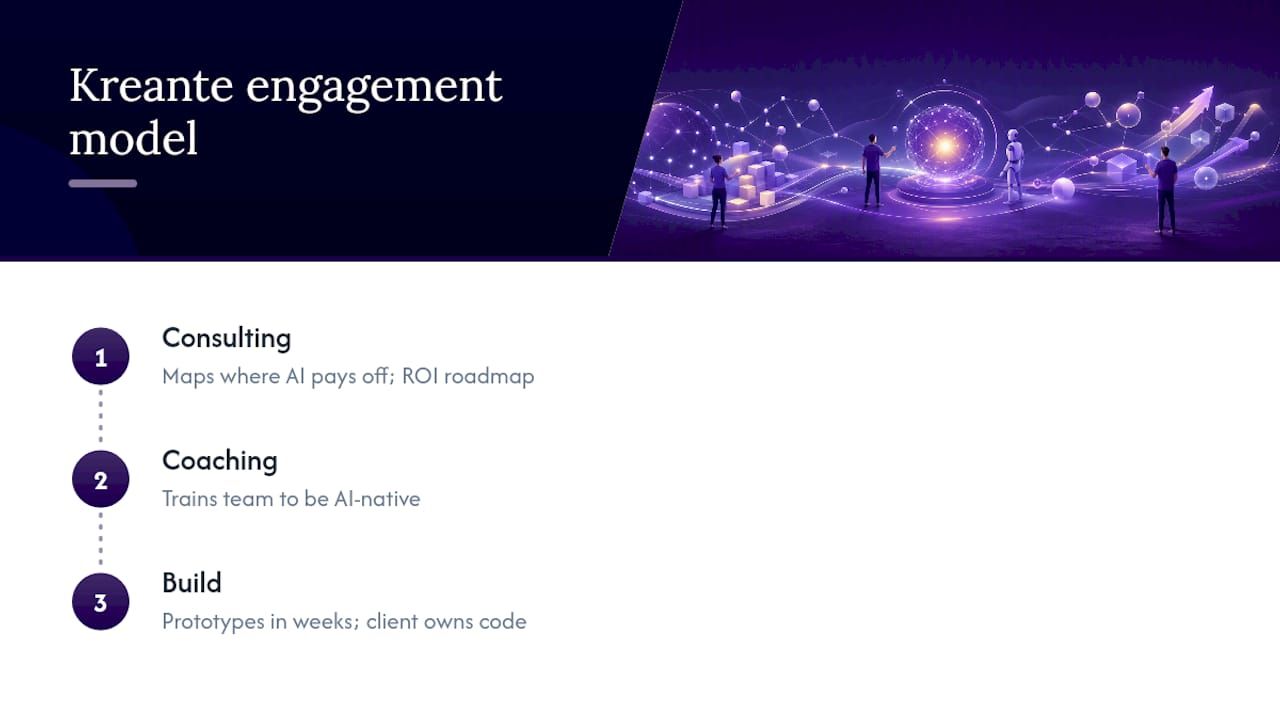
The engagement model runs consulting first, then coaching, then build, in that order. Consulting maps where AI actually pays off and hands over a roadmap with an expected return per initiative. Coaching trains your team to work AI-native so the capability stays in-house instead of leaving with the vendor. Build produces the actual applications, agents, and automations, using senior engineers paired with low-code tooling to get a working prototype in weeks, not months. Clients own the code outright, and the agency stays on after launch rather than disappearing at handover.
What Founders and Buyers Both Get Wrong About This Market
The recommendation is simple: hire an agency when you need a proven outcome quickly, and only start one if you can repeat that outcome across clients without your quality collapsing. Most people treat this as a technology decision. It’s a delivery discipline decision.
Three lessons stand out from how these projects actually go. Prototypes de-risk everything, for buyer and builder alike, so distrust any agency that skips straight to a six-month build. Data readiness kills more projects than model quality ever does. And the durable advantage isn’t the AI itself. It’s the process redesign and institutional knowledge around it, which is exactly why coaching your own team matters more long-term than any single automation.
— Jorge Del Carpio
Ready to Find Where AI Actually Pays Off in Your Business?
Kreante runs the same process this article just walked through: audit, prototype, build, maintain, in that order, with a number attached to each step instead of a vague promise. If you’re weighing whether to hire an agency at all, that clarity is the real difference. You get a roadmap ranked by expected return, not a stack of AI use cases nobody asked for.
If you already know your bottleneck, an AI implementation engagement gets you from prototype to production system with code you own outright. If you’re still mapping where the return actually is, an AI consulting audit is the right starting point, and it hands you a roadmap ordered by return rather than a slide deck. Book a call, share your biggest recurring bottleneck, and find out within one conversation whether it’s worth automating this quarter.
It audits your workflows, builds AI-driven automations and agents to handle repetitive or complex tasks, and integrates them into your existing systems, with many agencies also handling ongoing maintenance and monitoring after launch.
Yes. AI automation agencies operate across the United States, ranging from boutique shops focused on specific industries to larger firms; Kreante works with US-based companies on consulting, coaching, and build engagements delivered remotely.
Pricing depends heavily on integration complexity and data readiness, with models ranging from fixed-price prototypes to full custom builds priced by scope, plus optional monthly retainers for maintenance.
Pick a narrow niche, productize a one-week prototype offer, build a lean team of two to four people, and use low-code tools paired with senior engineering oversight to win and deliver your first few client projects.


 Development