Ship a Live URL in Days: Lovable vs Claude Design for Founders
Pick Lovable to get a hosted, Supabase backed live app fast. Pick Claude Design when engineering teams need code first prototypes and tighter code control.
Tools
KreanteSeptember 15, 202610 hours ago
Pick a Lovable-style full-stack builder if you need a live URL, a working database, and a real user within days. Pick a Claude Design–style design-to-code loop if you already have developer capacity and want tighter control over the codebase from day one. The tradeoff is simple: Lovable trades some system control for managed hosting and persistence, while Claude Design trades convenience for higher-fidelity handoff into a real engineering workflow. Everything below breaks that choice down by the criteria that actually matter once money and deadlines are on the line.
TL;DR:
Lovable offers native hosting and persistent project state, making it suitable for non-developers needing a live product within days, while Claude Design requires external deployment setup. Claude Design produces high-fidelity prototypes rapidly with a structured brief, but relies on your team to handle backend integration and ongoing code ownership. For teams with no technical support, Lovable’s all-in-one deployment and database support can save time, whereas Claude Design favors those with engineering capacity focused on control and long-term code handoff. Cost efficiency varies based on scope; a well-structured Claude Design brief can be cheaper than multiple iterative rounds in Lovable, especially when controlling overall expenses. Future tool reliance should prioritize clear code ownership and seamless handoff over convenience, as persistent storage and deployment pipelines will determine real productivity gains.
Kreante
kreante.co
Move From Prototype To Production
Kreante helps companies turn AI prototypes into web apps, mobile apps, agents, and automations built around measurable business outcomes.
Lovable vs Claude Design: Comparing the Criteria That Matter
Both tools claim to turn a prompt into a shippable interface. They get there through different mechanics, and those mechanics decide who should use which one.
Claude Design, built by Anthropic on Claude Opus 4.7, works as a visual canvas that hands its output straight to Claude Code for further development, according to Appwrite’s breakdown of the launch. It’s built for teams that already think in terms of components, tokens, and git branches. Lovable, by contrast, is a full-stack app builder. It generates a working application, deploys it, wires up a database through Supabase, and keeps the project’s state persistent across sessions, based on hands-on testing from 02UI.
Ease of use and onboarding split along the same line. A founder with no engineering background can open Lovable, describe an app, and get three lightweight HTML and Tailwind previews to react to before committing to a full build, per Lovable’s own design guidance documentation. Claude Design assumes more fluency. It rewards someone who can write a structured brief and knows what to do with the code it produces.
Code quality and design output is where the comparison gets interesting rather than obvious. 02UI’s side-by-side test found Claude Design can produce a full working redesign quickly when fed a well-structured DESIGN.md, with output often suitable for moving into Figma for refinement. Lovable was faster to start and more polished right out of the box for someone without a design background, but it leaned more heavily on its own visual defaults.
Iteration and workflow reveal the real philosophical split. Lovable operates on rounds of conversation. You describe a change, it regenerates, you approve or push back, and you can request up to six rounds of refinement before locking in a direction. Claude Design works more like a developer’s edit. Because it hands artifacts to Claude Code, changes tend to be targeted at specific files and components rather than regenerated wholesale, according to MindStudio’s comparison.
Deployment is the single most consequential difference for a founder without a technical cofounder. Lovable ships with one-click hosting built in. Claude Design does not; it hands you a prototype, and assembling the path to a live URL, including hosting, a database, and a deployment pipeline, is on you or your engineering team, per MindStudio’s analysis.
Backend and database support favors Lovable for anyone building something that needs to remember data between visits. Its native Supabase integration and persistent project state mean auth, storage, and a real database are available without leaving the tool. Claude Design assumes you’ll bring your own backend once the design work is handed off.
Token efficiency and cost depend on how you use each tool. Claude Design’s model, tuned for design-system ingestion, tends to reward one well-structured brief over many small back-and-forth prompts. Lovable’s conversational loop can burn more cycles if you’re vague about direction upfront, though its guided design questions exist specifically to cut that waste before the build stage even starts.
Quick summary of the practical differences:
Best for: Lovable suits non-developer founders needing a live product; Claude Design suits teams with engineering capacity who want design-system fidelity.
Primary output: Lovable produces a deployed full-stack app; Claude Design produces a prototype handed to Claude Code.
Persistence: Lovable retains project state across sessions natively; Claude Design relies on the downstream code workflow to persist anything.
Deployment: Lovable includes one-click hosting; Claude Design requires you to assemble hosting yourself.
Backend: Lovable integrates Supabase directly; Claude Design has no built-in backend.
Pricing pattern: Lovable bills around credits/tokens tied to app generation and hosting; Claude Design’s cost tracks your existing Claude usage tier plus whatever hosting you add on top.
How Do You Choose Between Lovable and Claude Design?
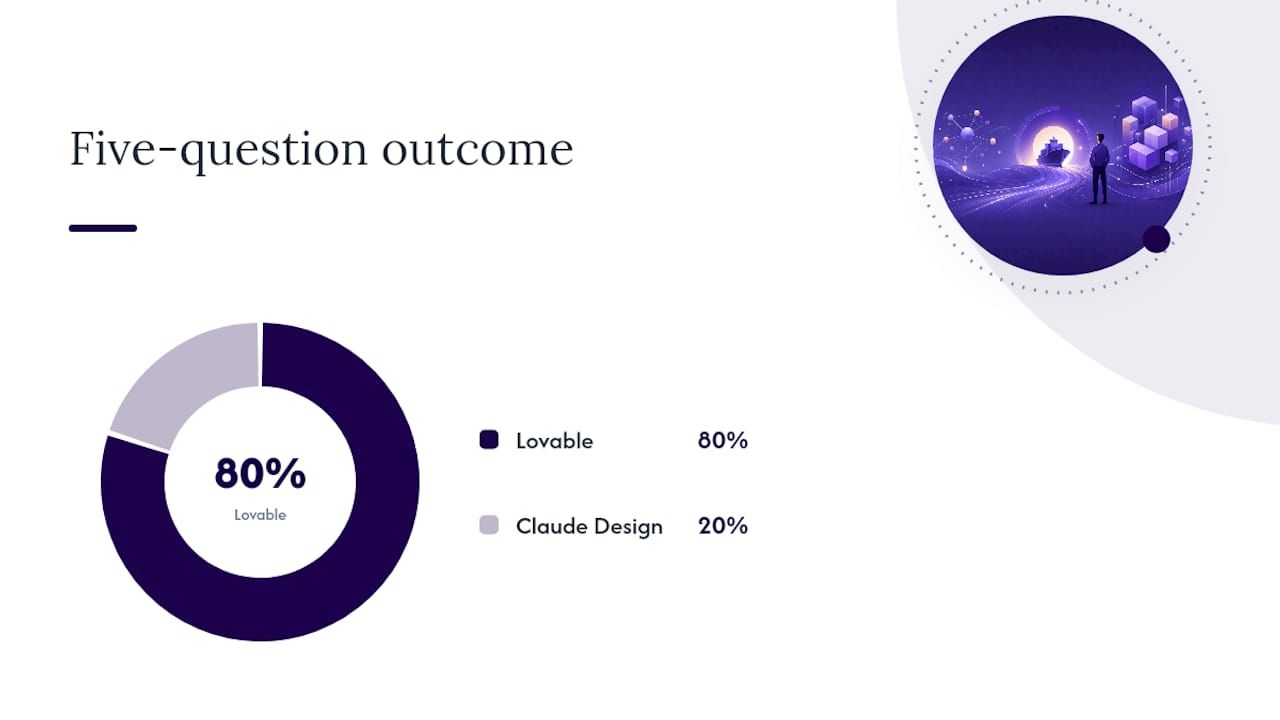
Run through five questions before you write a single prompt.
Do you have a technical team on standby? If nobody on your team can pick up a handed-off codebase and finish the job, Claude Design’s workflow will stall halfway. Lovable’s managed path avoids that dependency entirely.
Do you need a live URL this week, or is this exploratory? A launch deadline points toward Lovable’s built-in hosting. A design exploration phase, where nothing ships yet, favors Claude Design’s speed at prototyping.
Does the product need real backend features now? Auth, a database, webhooks, or realtime updates push you toward Lovable’s native Supabase support. If the backend is someone else’s problem for now, Claude Design’s narrower scope is fine.
How much do you care about owning and controlling the codebase long term? Teams planning years of custom development often prefer starting closer to raw code, which is where Claude Design’s handoff to Claude Code has an edge.
How sensitive is your budget to token usage? If cost predictability matters more than iteration speed, a single well-structured Claude Design brief can be cheaper than dozens of conversational rounds in Lovable.
If your answers land mostly on “no technical team,” “need it live now,” and “backend required,” pick Lovable. If they land on “team ready to build,” “exploring direction,” and “code ownership matters most,” pick Claude Design and plan for the handoff work upfront.
Pro Tip:Start every Claude Design brief with a real DESIGN.md file, not a paragraph of loose adjectives. Tests show the quality of the structured brief is often the single biggest lever on output quality, and a scattered prompt produces scattered code no matter how good the model is.
For teams that outgrow a prototype fast, the minimal graduation plan looks like this: build the first pass in whichever tool matches your stage, export or hand off the code into a repository you own, then wire up CI/CD and a production backend around it rather than continuing to regenerate inside the original tool indefinitely.
What Practitioners Learn Moving Prototypes to Production
Delivering AI solutions raises these three questions on every project: what’s the job to be done, can the team brief an AI well, and who owns the result.
A common delivery pattern is consult, coach, build, in that order. Consulting determines which approach truly pays off for the product. Coaching focuses on developing team skills to create effective AI briefs, so the capability remains internal. Build delivers a prototype evolving into a maintained product with a real backend, proper CI/CD, and independence from any single vendor’s roadmap.
An advisable operational approach is to prototype quickly with the appropriate tool, export the code into a repository controlled by your team, then proceed with standard engineering practices instead of relying indefinitely on conversational AI tools. Wrapper tools like Lovable buy real speed for validation and early revenue. Integrated design-to-code loops like Claude Design save money over time once a team commits to assembling its own deployment pipeline, as Appwrite notes.
Org-level risks worth checking before you commit either way:
Ownership: confirm you can export a portable codebase, not a proprietary format locked to one platform.
Security: verify who controls auth, secrets, and data residency once the backend is live.
Maintenance: decide upfront who patches dependencies and handles scaling once the prototype has real users.
Where This Category Is Headed Next
The tools that win the next 12 to 18 months won’t be the ones with the flashiest generation model. They’ll be the ones that solve persistence and handoff cleanly, because that’s the friction point every team hits the moment a prototype needs to become a product. Hosting-ecosystem plugins are already starting to close the gap that made all-in-one builders like Lovable attractive in the first place, and once Claude Code style workflows plug directly into managed hosting, the “convenience versus control” tradeoff gets a lot less binary. Reviewers already frame this as a both-and situation rather than an either-or, with one comparison concluding that most teams end up using a fast exploration tool alongside a separate production path.
My advice for teams planning tool adoption: prioritize code ownership over convenience from the start, set a clear guardrail for when you’ll migrate off a wrapper tool, and track total cost of ownership, not just the sticker price of the subscription tier you’re on today.
How Kreante Helps You Move From Prototype to Production
Picking between Lovable and Claude Design is really a question about your team’s job to be done, and that’s exactly where a lot of founders get stuck. Kreante works through this with clients in three stages: Consulting maps where an AI-assisted toolchain actually pays off for your specific product, with an expected return attached to each option. Coaching trains your team to brief these tools well, so the skill stays in-house instead of leaving when you switch vendors. Build takes the validated direction and turns it into production software with a real backend, proper CI/CD, and code you own outright.
If you’re staring at a prototype that needs to become a real product, or you’re not sure which toolchain fits your team’s skill level and budget, that’s the point to bring in outside eyes. Kreante’s AI implementation service is built for exactly this handoff, and the AI consulting engagement gives you a roadmap with a number attached before you commit engineering time to either path. Book a discovery call and walk away with a plan, not another tool to evaluate.
No. Lovable is an independent full-stack app builder with its own generation engine, hosting, and Supabase integration; Claude Design is Anthropic’s own tool, built on Claude Opus 4.7, and hands its output to Claude Code.
Lovable bundles deployment, a persistent project state, and native database support in one place, so a founder without engineering support can go from prompt to live URL without assembling a separate hosting and backend pipeline.
Yes, particularly for brief-driven prototypes. Testing found it can produce a working redesign in under 10 minutes when given a structured DESIGN.md, with output clean enough to bring into Figma for further refinement.
For someone without a technical team, Lovable’s guided design questions and built-in hosting typically get a usable product live faster, since Claude Design assumes you have somewhere to send the code it generates. For production delivery once you’ve outgrown either tool’s prototype stage, a partner like Kreante can carry the project the rest of the way with a codebase you own.


 Tools
Tools