
 Development
First Steps to Successfully Publish Your App
Embarking on the journey to publish your mobile app on the Apple App Store is an exciting moment
KreanteJanuary 8, 2025Read the article
Discover how Decathlon's Spare Parts Locator revolutionizes sports equipment maintenance through innovative NoCode development using WeWeb and Xano.
Published on February 03, 2025
Written by Jaren Hidalgo · 11 minute read
Searching for spare parts for your sports gear? Decathlon’s Spare Parts Locator has you covered. This tool simplifies the process of finding and ordering parts, promoting sustainable practices. Discover how Decathlon is enhancing customer convenience and supporting eco-friendly repairs.
In the sustainability-focused retail landscape, product repair and maintenance play a pivotal role in circular economy initiatives. Businesses are increasingly adopting innovative solutions to reduce waste and extend product life cycles. Our recent collaboration with Decathlon SE, a global leader in sporting goods, exemplifies how modern NoCode technology can transform the complex task of spare parts identification into an opportunity for enhanced customer experience and environmental responsibility.
Finding the exact spare part for your bicycle or gym equipment with just a few clicks became Decathlon’s vision. They sought a digital solution to simplify the spare parts identification process for their vast product range, a complex task that NoCode technology adeptly addressed.
This blog post will explore the Spare Parts Locator project, detailing Decathlon’s vision for sustainability, the challenges faced, the development process using NoCode tools, and the significant impact achieved.
We’ll dive into the technical aspects of the project, customer experience enhancements, and the ongoing partnership that continues to drive innovation. Whether you’re a business leader, developer, or sustainability advocate, this journey offers valuable insights into how NoCode technology can support sustainable retail practices.
NoCode technology has revolutionized the way we build and launch websites, apps, and internal tools. Gone are the days when creating software required extensive coding skills and a deep understanding of complex programming languages. With the rise of no-code platforms, individuals and businesses can now leverage visual programming interfaces to bring their ideas to life.
This democratization of technology means that anyone, regardless of their technical background, can build apps and launch websites. NoCode tools streamline the development process, allowing for rapid prototyping, testing, and deployment. This not only accelerates time-to-market but also reduces the barriers to entry for innovation. By eliminating the need for traditional coding, NoCode technology empowers more people to participate in the digital economy, fostering creativity and entrepreneurship.

Decathlon’s commitment to sustainability is central to the Spare Parts Locator project. The company emphasizes product repair and waste minimization, encouraging innovative solutions for environmental responsibility. By adopting eco-design principles, Decathlon develops products using renewable, recycled, and recyclable materials, thus reducing their ecological footprint.
Initiatives like the Spare Parts Locator enhance circular economy solutions by providing online access to spare parts for product repair and maintenance. This promotes resource efficiency and helps retailers adapt to changing consumer expectations.
Regular audits of suppliers ensure compliance with safety and environmental standards, further reinforcing Decathlon’s dedication to sustainability.
The retail industry is navigating a landscape of unprecedented challenges, from shifting consumer behaviors to heightened competition. To thrive in this environment, retailers must adopt sustainable solutions that enhance efficiency, reduce costs, and improve customer experience. This is where NoCode technology comes into play.
NoCode platforms enable retailers to build and launch customized solutions without the need for extensive coding knowledge. By leveraging these tools, retailers can create powerful apps that streamline operations, integrate APIs for seamless data flow, and automate workflows to boost productivity. This approach not only reduces the reliance on traditional coding but also allows for more agile and responsive business practices. In an era where sustainability is paramount, NoCode technology offers a pathway for retailers to innovate and stay competitive while minimizing their environmental footprint.
Decathlon SE sought to expand their circular economy solutions by developing a digital tool to simplify finding spare parts for sports equipment. Given their vast product range, from bicycles to gym equipment, this task demanded an innovative approach.
Traditional spare parts identification was cumbersome and error-prone, which frustrated customers and increased support inquiries. Decathlon required a solution capable of managing their product range’s complexity while offering an intuitive and efficient user experience.
This challenge led to the development of the Spare Parts Locator, a tool aimed at simplifying spare parts identification and enhancing customer satisfaction.

The Spare Parts Locator project is a testament to Decathlon’s commitment to sustainability. Focusing on product durability and repair, Decathlon aims to reduce its ecological footprint and promote sustainable retail practices. This initiative integrates technology to support sustainable product lifecycle management, meeting consumer demand for eco-friendly shopping options.
The project underscores the importance of product repair and maintenance in sustainability. By developing a digital tool for easy spare part searches, Decathlon modernizes its retail practices and contributes to a more sustainable future.
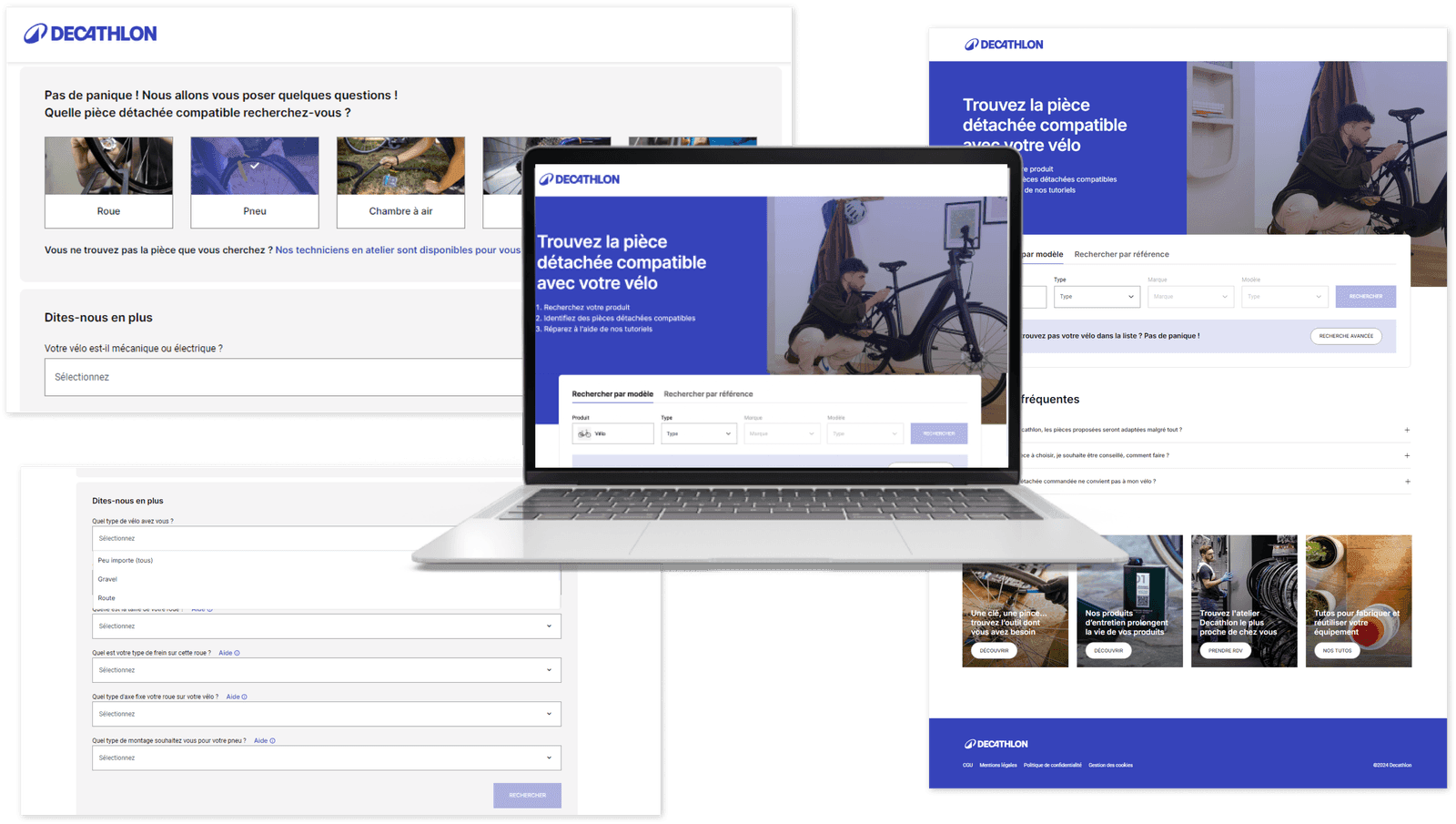
The Spare Parts Locator boasts features aimed at enhancing user experience and streamlining repairs. A key feature is its ability to help users quickly identify the correct part on the first attempt, reducing errors. Multiple search options—by model, description, part number, or hierarchy—make the process efficient and user-friendly.
All model information, including images, specifications, and maintenance instructions, is accessible from a single location, simplifying repairs. Interactive diagrams on the platform allow technicians to explore model and part compatibility across various assemblies, offering a comprehensive view.
The visual layout helps consumers navigate efficiently through assembly thumbnails and drawings, enhancing parts discovery. Additionally, the Spare Parts Locator features a Smart Search System for known and unknown products, with an interactive questionnaire and progressive filtering, ensuring users find what they need.

Developing the Spare Parts Locator showcased the power and efficiency of no code tools. Using WeWeb for frontend development and Xano for backend support, the project demonstrated how no code tools streamline building apps and creating sophisticated applications without extensive coding. This approach allowed rapid development, letting the team focus on refining user experience and functionality.
The development process included key phases: initial planning, development, and quality assurance. Each phase ensured the final product met Decathlon’s high standards for usability and performance, aligning with their sustainability goals.
The initial planning phase was critical for defining business requirements and creating the application’s broad design. This phase involved close collaboration between Decathlon and our development team to ensure the final product met the needs of both the business and its customers.
We identified key features and functionalities essential for the Spare Parts Locator, including the integration of WeWeb for frontend development and Xano for backend support, setting the stage for a seamless and efficient development process.
WeWeb was integral to the frontend development of the Spare Parts Locator. Its intuitive user interface and responsive layouts ensured accessibility and user-friendliness across all devices. Custom component development facilitated seamless navigation flows, enhancing the overall user experience.
Integration with Decathlon’s online store was another key aspect of WeWeb’s role. This integration allowed users to easily access spare parts information and make purchases directly from the application, streamlining the repair process and enhancing customer satisfaction.
Xano provided the robust backend support for the Spare Parts Locator. Its powerful database architecture and complex query handling capabilities ensured efficient management of large data volumes, leveraging advanced business logic to build on top of existing frameworks without the need for writing code.
API endpoint management and secure data processing were critical components of Xano’s role in integrating apis. Its scalable infrastructure allowed the application to grow and evolve with Decathlon’s needs, ensuring long-term usability and performance.
The Spare Parts Locator development phases included prototyping, testing, and iteration. No-code prototyping allowed quick visualization and testing of ideas, facilitating faster iterations and refinements. Unlike traditional wireframes, no-code prototyping involves building a functional app version, providing a more accurate final product representation.
Governance checks ensured the application complied with external regulations and internal policies before release. This thorough approach helped ensure the final product met all necessary standards and was ready for launch.
Quality assurance was a continuous process throughout development. Utilizing a no code platform allowed for rapid development and easier adjustments based on feedback from stakeholders and users at every stage. This approach helped align the application with their needs and expectations, ensuring the final product was both functional and user-friendly.
Rigorous testing ensured the application met usability and performance standards before launch. This included testing visual tools and components to ensure they functioned correctly and met user expectations, guaranteeing a high-quality user experience.

Integrating the Spare Parts Locator with Decathlon’s e-commerce platform was critical. This integration allowed Decathlon sellers to push product listings, making them visible in both their e-commerce systems and Decathlon’s marketplace.
The integration also supported real-time synchronization of inventory and product data between e-commerce platforms and Decathlon, ensuring accurate product information across all channels through native integrations. This seamless connection allowed Decathlon to maintain up-to-date information and provide a consistent user experience.
Implementing the Spare Parts Locator significantly improved the overall customer experience by facilitating easier access to repair parts. The application’s self-service capabilities allowed customers to find information independently, reducing support inquiries and improving satisfaction.
The feedback program played a crucial role in optimizing the online experience. Gathering insights on website usability and customer satisfaction enabled Decathlon to make data-driven decisions to enhance the application’s functionality and user experience.
User experience is a critical factor in the success of any application, and NoCode platforms are designed with this in mind. These platforms prioritize intuitive interfaces and user-friendly design, making it easy for users to adopt and utilize the technology effectively. With NoCode, users can create customized workflows, automate repetitive tasks, and integrate various APIs, all without requiring extensive coding knowledge.
This focus on user experience has led to increased adoption rates, as users quickly recognize the value of NoCode technology in enhancing their workflows and productivity. By simplifying complex processes and providing accessible tools, NoCode platforms empower users to take control of their digital projects, leading to higher satisfaction and better outcomes. The ability to quickly see tangible results from their efforts encourages more widespread use and integration of NoCode solutions in various business contexts.
The Spare Parts Locator significantly impacted Decathlon’s business. Quick access to spare parts through digital means reduced downtime and boosted customer productivity, leading to increased spare parts sales and higher customer loyalty.
The convenience of digital ordering also decreased customer support queries, as users could easily find the parts they needed. Promoting product repair over replacement positively impacted the environment, aligning with Decathlon’s sustainability goals.
The Spare Parts Locator is a shining example of how NoCode technology can drive innovation in the retail sector. By leveraging NoCode workflows and integrating various APIs, Decathlon created a customized solution that significantly improved customer experience and operational efficiency.
Customers can now quickly find the parts they need, reducing wait times and enhancing overall satisfaction. This streamlined process not only boosts customer loyalty but also reduces the burden on support teams, allowing them to focus on more complex inquiries. The Spare Parts Locator also demonstrates the cost-saving potential of NoCode technology, as it eliminates the need for extensive coding and development resources.
By showcasing the practical benefits of NoCode in a real-world application, Decathlon’s Spare Parts Locator highlights the transformative power of technology in retail. It serves as a model for other retailers looking to enhance their sustainability efforts and improve customer service through innovative digital solutions.
The ongoing partnership between Decathlon and our development team ensures the Spare Parts Locator continues to evolve and improve. Real-time user feedback is integrated into the application to enhance the quality and accuracy of parts and service content.
Decathlon is committed to regular updates and refinements based on user interactions, ensuring the application remains aligned with customer preferences and industry standards. This data-driven development approach helps maintain high functionality and user satisfaction.

Our work with Decathlon represents a significant advancement in NoCode development. Combining WeWeb and Xano enabled us to create a sophisticated solution that handles complex queries and delivers results instantly, all while maintaining a user-friendly interface.
This project showcases NoCode technology’s potential in addressing complex business challenges. Leveraging a visual programming interface and No-Code workflows, we build powerful applications without extensive coding skills, demonstrating NoCode platforms’ versatility and efficiency.
At Kreante, we specialize in NoCode development, helping organizations bring their visions to life without extensive coding. Our expertise in NoCode tools like WeWeb and Xano ensures our projects are efficient and high-quality, aligning with our clients’ business goals.
If you’re looking to drive sustainability initiatives through innovative digital solutions, contact Kreante today. Our NoCode approach can help you achieve your goals while maintaining high standards of functionality and user experience.
The success of Decathlon’s Spare Parts Locator demonstrates NoCode technology’s potential in promoting sustainability. As more retailers embrace circular economy initiatives, tools like this will become increasingly valuable in supporting sustainable consumer behavior.
Ready to transform your sustainability initiatives with innovative digital solutions? Contact Kreante to learn how our NoCode expertise can bring your vision to life while maintaining high standards of functionality and user experience.
The Spare Parts Locator is a fantastic digital tool by Decathlon that makes it easy to find and order spare parts for sports equipment, encouraging repair and sustainability. It's a win-win for both you and the planet!
The Spare Parts Locator significantly enhances customer experience by providing multiple search options and interactive diagrams, making it easy to find and order the right spare parts. This reduces errors and minimizes the need for support, ensuring a smooth and satisfying purchasing process.
The development of the Spare Parts Locator was powered by WeWeb for the frontend and Xano for the backend, resulting in a strong and user-friendly application. It's exciting to see such NoCode tools enabling innovative solutions!
Go further
Don't let your tech watch stop here. Explore our other resources to master your technology stack.
DevelopmentEmbarking on the journey to publish your mobile app on the Apple App Store is an exciting moment
 Development
Conversion first playbook that fixes message match, hero, form, speed, and testing in order. Includes Kreante rapid prototype checklist.
 Development
Most AI automation projects show no measurable result. A Kreante project manager explains the sequence that works, with pricing and a real case study.