AI consulting means paying an outside team to find where AI actually pays off in your business, then building and often operating the system that captures it. Hire one when you lack the internal data science bench or need an outcome-ordered roadmap fast; build in-house when the use case is narrow and your engineering team already ships models. Kreante and firms like it, guided by practitioners such as Jorge Del Carpio, structure this work around a single question: does this move revenue, margin, or hours saved?
TL;DR:
Most AI projects stall after the prototype stage due to skipped or incomplete operations and handoff planning, which are crucial for long-term success. Ownership of code, data, and documentation must be clarified before project initiation to prevent vendor lock-in and support issues later. Effective consulting emphasizes production system delivery, MLOps maturity, and outcome-based contracts tied to measurable KPIs rather than just pilot results or presentations. Hiring outside help is best when data is scattered, a quick turnaround is needed, or cross-departmental change management is required; in-house building suits narrow, well-understood use cases with established data infrastructure. Real value comes from starting with a focused, revenue or cost-impacting outcome, and crafting a roadmap ordered by expected return rather than vague frameworks or maturity assessments.
What Does AI Consulting Actually Cover?
AI consulting spans everything from picking the right first use case to running the machine learning operations (MLOps) pipeline that keeps a model reliable in production. The best firms treat AI strategy consulting and delivery as one motion, not two separate contracts. Slalom’s consulting practice frames this well: firms that combine strategy, data engineering, and delivery under one roof deploy AI across an organization instead of running isolated pilots that never scale.
A typical engagement produces a specific set of deliverables, not a slide deck:
A prioritized roadmap ranking initiatives by expected return, not by novelty
A working prototype tied to one measurable KPI
A production system with monitoring, retraining triggers, and access controls
Governance documentation covering data use, model risk, and audit trails
Training sessions or playbooks that transfer the skill to your internal team
The people doing this work matter as much as the deliverables. A serious AI implementation guidance team includes someone who has shipped models into production before, someone who understands your specific data infrastructure, and someone senior enough to say no to a flashy but low-value idea. If every person on the call is under three years into their career, ask who is reviewing the architecture decisions. Cheap teams are often cheap because nobody senior is checking the work.
How Do Consulting Engagements Typically Progress?
Most AI consulting services move through three distinct phases, and skipping one is the most common reason projects stall after a promising demo.
Strategy and diagnosis. The consultant audits your data, workflows, and existing tools, then ranks candidate use cases by expected value against effort. This phase should also flag governance and compliance requirements early, not as an afterthought once a model is already built.
Build and prototype. A working version gets built against one narrow, measurable target. BCG’s AI @ Scale practice notes that end-to-end providers typically pair this build phase with architecture decisions that anticipate production scale, not just a demo that impresses a steering committee.
Operate and scale. The prototype moves into production with monitoring, retraining schedules, and clear ownership. “Operated” services mean the vendor (or your own team, post handoff) is watching for model drift, data pipeline failures, and usage patterns that signal the tool needs retuning.
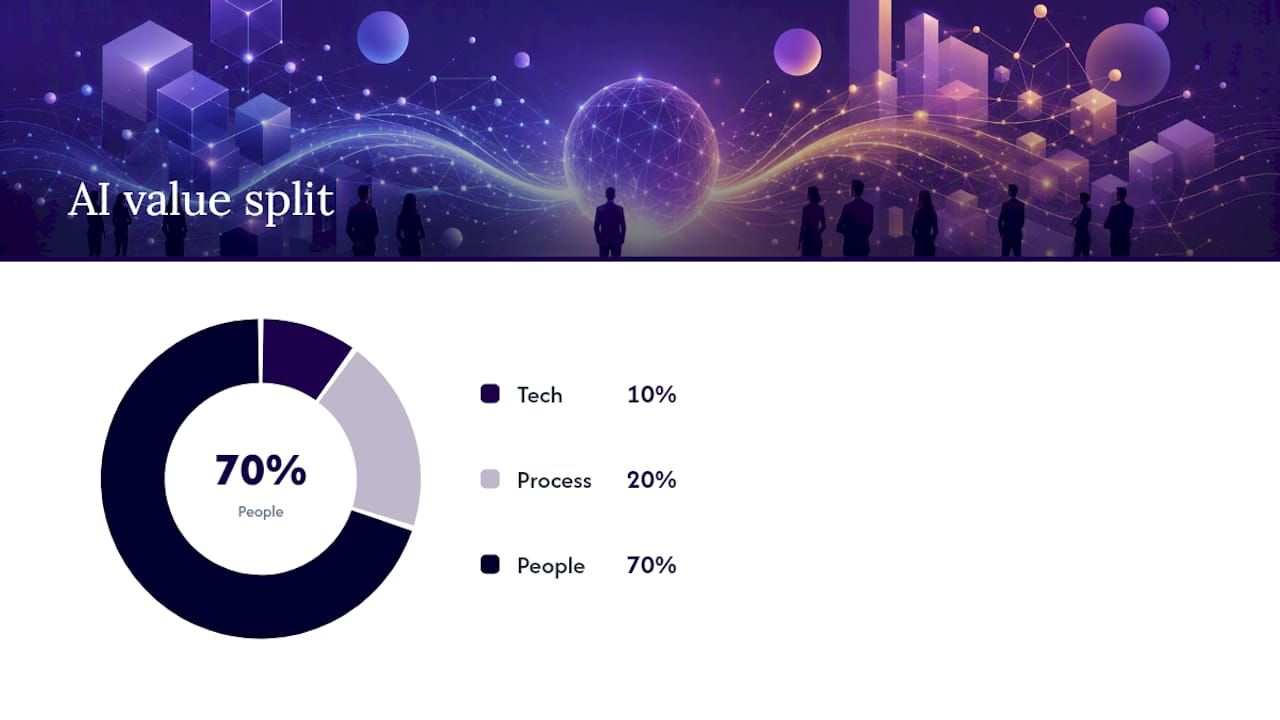
Change management has to start in phase one, not phase three. Waiting until a model is built to ask “will our team actually use this” is how good prototypes die in a drawer. BCG’s research puts rough weight on this: algorithms and technology account for a smaller share of AI value than the people and process changes wrapped around them, in a widely cited 10-20-70 split.
Pro Tip:Ask any prospective consultant to name the exact handoff artifact they deliver when a prototype graduates to production. If they cannot describe a specific document, runbook, or transferred repository, the “operate” phase is likely undefined, and you will be stuck paying for support indefinitely.
The build to production jump is where most in-house teams and mid-tier vendors both stumble. A prototype that works on a clean sample data set behaves differently once it hits your messy production logs, and that gap is exactly what a firm with real deployment history should have already planned for.
Should You Hire a Consultant or Build In-House?
The decision usually comes down to three questions: how ready is your data, how urgent is the timeline, and how deep is your internal skills gap.
Signals that point to hiring outside help:
Your data lives in three disconnected systems and nobody owns cleaning it up
Leadership wants results this quarter, not after a year of internal hiring
You have no one on staff who has taken a model from prototype to production before
You need an objective party to rank ten competing AI ideas without internal politics
The initiative touches multiple departments and needs a change management plan, not just code
Signals that point to building in-house:
The use case is narrow, well understood, and close to work your engineers already do
You have budget for permanent headcount and a 12+ month horizon
Your data infrastructure is already clean and centralized
A hybrid path exists too. Many organizations bring in a consultant for the strategy and first build, then pair that with coaching so the capability stays with the internal team instead of walking out the door when the contract ends. Independent advisory guidance makes a point worth repeating here: not every problem needs machine learning. Part of what you are paying a good consultant for is the discipline to say a rules-based script solves your problem cheaper than a model would.
How Should You Evaluate an AI Consulting Partner?
Score every candidate against six axes before you sign anything: track record of outcomes, production delivery history, data and MLOps capability, governance and ethics practices, seniority of the actual team assigned to you, and whether pricing lines up with the value at stake.
Ask these questions directly in the interview or RFP process, and treat vague answers as a red flag:
“Show me three production systems you’ve deployed, not prototypes. What KPI moved, and by how much?”
“Who specifically will be on our account day to day, and what is their production experience?”
“What happens to the code, data pipelines, and model artifacts if we end the engagement? Do we own them outright?”
“What SLAs govern uptime, retraining cadence, and incident response once this is live?”
“Can I speak to a reference client whose project matured past six months?”
Independent advisory research recommends weighting production delivery and MLOps maturity above almost everything else in vendor scoring, because a slide deck full of promising pilot results tells you nothing about whether a firm can operate a system reliably at scale.
Red flag checklist: No named production case studies. No answer on code ownership. Pricing based purely on hours with no tie to outcomes. A team that cannot describe their monitoring or retraining approach in plain language.
Outcome-linked or milestone-based contracts can align incentives well, but they only work when both sides agree on a precise, measurable KPI up front. A firm that resists defining that KPI before the contract is signed is telling you something about how they plan to be evaluated later.
What Do AI Consulting Engagements Cost and How Long Do They Take?
Pricing shapes vary more than most executives expect walking in. Fixed-price contracts suit well-scoped prototypes with a clear deliverable. Time-and-materials billing fits open-ended strategy work where scope will shift. Outcome-linked contracts tie a portion of fees to a KPI hitting target, and retainers cover ongoing operated services once something is live.
Timelines follow a rough pattern across the industry:
Discovery and strategy: a few weeks
Prototype build: several weeks
Production deployment: multiple months, depending on integration complexity
Several factors push cost and timeline up fast. Legacy system integrations add weeks because nobody documented the old API. Messy or siloed data means the consultant spends the first month just building a reliable pipeline before any model work starts. Regulated industries (health care, finance, anything touching personal data) add compliance review cycles that a simple e-commerce recommendation engine never faces.
A narrow pilot scoped around one measurable KPI, like cutting manual processing time by a defined percentage, substantially raises the odds that the project survives past the prototype stage instead of dying quietly when budget season comes around.
What Results Has Kreante’s AI Consulting Delivered?
Kreante has run 265+ AI and software projects across 35 countries, working from a simple premise: start from the business number you want to move, then build the smallest system that gets you there. That order matters. Consulting comes first to find where AI pays off and attach an expected return to each initiative. Coaching follows, so the capability stays with your team instead of leaving with the vendor. Build comes last, once the roadmap is clear.
The DAVCO AI project shows this model in practice: rather than shipping an AI feature for its own sake, the engagement targeted a specific operational bottleneck and built the smallest tool that removed it, with the client’s team trained to run and extend the system after launch.
That prototype-to-production path is deliberate. Kreante’s consulting service hands clients a roadmap ordered by expected return, not a generic slide deck, and the senior team behind it uses low-code and AI-assisted tooling to get a working prototype into a client’s hands in weeks rather than quarters.
Pro Tip:Before you sign with any AI consulting firm, ask whether you own the code outright after launch. Vendor lock-in through proprietary platforms is one of the quietest ways a “successful” AI project turns into a permanent subscription you can’t leave.
The build pillar covers web apps, mobile apps, AI agents, and automation meant to replace SaaS tools a business is overpaying for, backed by a quality guarantee and support that continues after launch rather than ending at delivery.
How Do You Get Started With an AI Consulting Engagement?
Six steps take you from “we should probably do something with AI” to a signed, scoped engagement:
Write down the specific business number you want to move (revenue, margin, hours saved) and by how much.
Audit what data you already have and how clean or scattered it is.
List three to five candidate use cases and rank them by expected effort versus payoff.
Draft a short RFP brief: the target KPI, current data state, timeline constraint, and budget band.
Interview two or three candidate firms using the questions from the evaluation section above.
Select a partner, agree on the handover terms in writing, and set the first checkpoint no more than six weeks out.
Your RFP brief does not need to be long. State the outcome, the constraint, and the minimum acceptance test (what the prototype has to prove before you approve moving to production). Firms that need forty pages of context before they can quote you a rough range are telling you something about how they scope work.
If you choose to bring a consulting partner into that process, the first conversation is a diagnostic, not a sales pitch: mapping where AI pays off in your specific business before anyone talks about a build.
What Ethical and Compliance Issues Come Up in AI Projects?
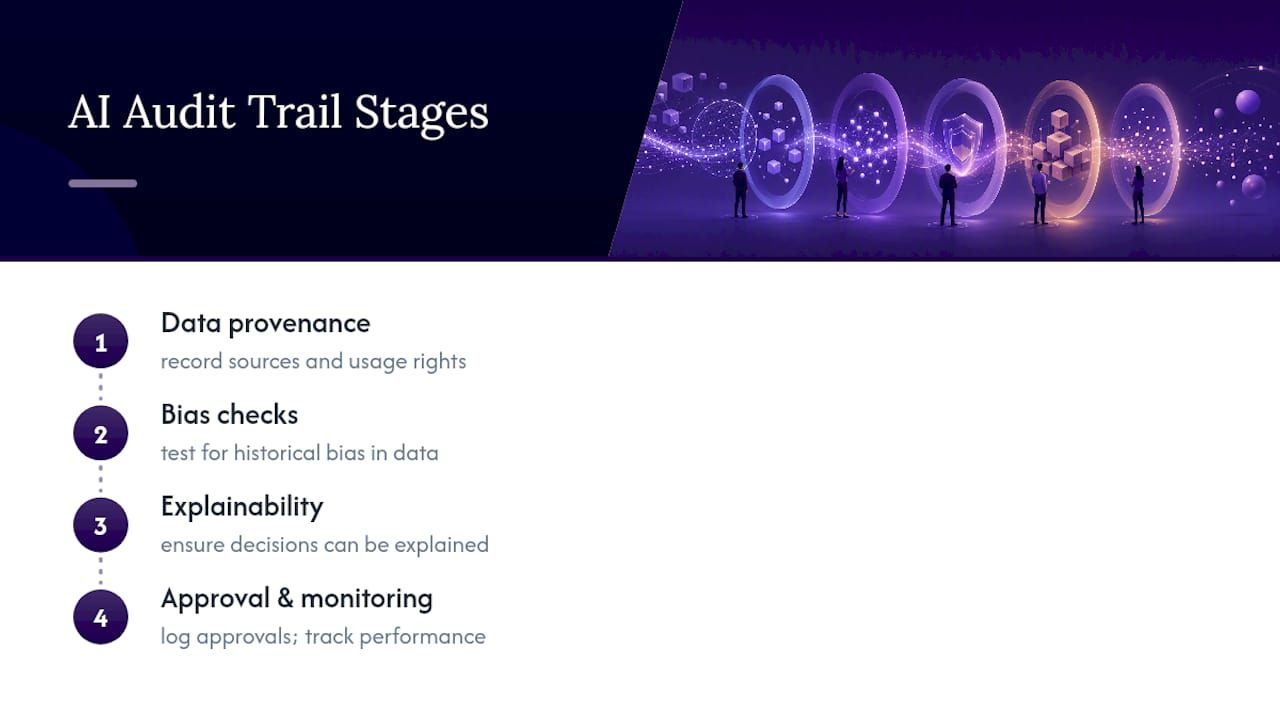
Governance can’t be a phase you add later. Data privacy, bias in training data, and explainability requirements all need to be part of the initial diagnosis, especially if your industry is regulated or your model touches customer-facing decisions like pricing, hiring, or credit.
Ask your consultant directly how they handle data provenance: where did the training data come from, do you have the right to use it, and does the model risk reproducing bias baked into historical decisions? A hiring tool trained on past hiring data will often replicate whatever bias shaped those past decisions unless someone deliberately checks for it.
Explainability matters more in some contexts than others. A recommendation engine suggesting products can stay something of a black box. A model influencing loan approvals or medical triage generally cannot, both for regulatory reasons and because your team needs to be able to explain a decision to the person it affected.
Build an audit trail from day one: who approved the model going live, what data trained it, and how performance is monitored over time. Retrofit that documentation after a regulator or a customer complaint arrives, and you’re doing it under much worse conditions than doing it upfront.
What Are the Biggest Risks of Hiring an AI Consultant?
The most common failure mode isn’t a bad model. It’s a good prototype that never makes it to production because nobody planned the handoff.
Watch for these specific risks:
Vendor lock-in through proprietary platforms or undocumented code is the quiet killer of long-term AI value. If a firm builds on a closed system you can’t access or modify without them, you’ve traded a one-time project fee for an indefinite subscription.
Scope creep is the second-biggest risk. AI projects tend to reveal new possibilities as they progress, and without a firm KPI anchor, a six-week prototype can drift into a six-month fishing expedition with no clear finish line.
Talent turnover on the consulting side matters too. Ask who specifically is staffed on your project, not just who pitched you. A firm’s brand reputation doesn’t help if the two senior people who built their case studies aren’t the ones touching your codebase.
Finally, watch for the gap between pilot success and production reality. A model that performs beautifully on a clean sample dataset can behave very differently against your live, messy production data, which is exactly why production delivery track record should outweigh a polished pitch deck in your evaluation.
How Does AI Consulting Fit With Your Existing IT Strategy?
AI consulting works best when it plugs into decisions your IT and business teams have already made, not when it arrives as a parallel initiative competing for the same budget and attention.
Start by mapping the new work against your existing technology stack. If your data already lives in a modern cloud warehouse, an AI initiative should build on it, not duplicate it with a separate system nobody maintains. If your IT team is mid-migration to a new platform, that’s a reason to sequence the AI project after the migration stabilizes, not a reason to skip planning altogether.
Business strategy alignment matters just as much as technical fit. An AI roadmap that ignores your company’s three-year growth plan risks solving a problem nobody in leadership actually prioritizes. The strongest engagements start with the same question a good implementation partner should ask on day one: which of your current strategic priorities does this initiative actually serve?
Cross-functional buy-in is the piece most technical teams underweight. IT needs to sign off on architecture and security. Operations needs to sign off on workflow changes. Finance needs the expected return in terms they can track. Skip any of those three, and the project either stalls in review or ships without the support it needs to survive contact with daily use.
What Happens After the Consulting Engagement Ends?
A consulting engagement that ends the moment the invoice clears has failed at half its job. Knowledge transfer needs to be planned, not assumed.
At minimum, expect three things in writing before a project closes: documentation covering how the system works and why key decisions were made, a runbook for common issues and how to resolve them, and a named point of contact for questions that come up in the first few months of live use.
Training sessions matter more than most contracts account for. A workshop where your team watches a consultant demo the system is not the same as your team running it themselves with an expert watching and correcting mistakes. The coaching approach that pairs hands-on enablement with real work, rather than a generic tutorial, is what actually keeps a capability in-house after the vendor leaves.
Code and data ownership terms should be settled before the contract is signed, not negotiated after the relationship sours. Confirm you own the repository outright, understand any third-party licensing baked into the build, and have admin access to every system the consultant touched.
Post-launch support terms vary widely across the industry, from a firm 30-day warranty period to ongoing retainer-based monitoring. Whatever the term, get the specific scope and response time in writing, not a vague promise of “we’ll be here if you need us.”
The Take: Stop Buying AI Strategy Decks
Most AI consulting advice tells you to build a governance committee, run a maturity assessment, and shortlist five vendors before touching a single use case. That advice isn’t wrong exactly. It’s just backwards for most companies, and it’s how a lot of AI budget gets spent on documents nobody reads twice.
The research on this is consistent: value comes overwhelmingly from people and process change, not from the model itself, and the firms worth hiring are the ones who can point to production systems, not pilot decks. If your first conversation with a prospective consultant is about frameworks and maturity curves instead of your actual revenue or cost problem, that’s a signal, not a good sign of rigor.
Prioritize one measurable outcome, staff it with someone who has shipped a model into production before, and insist on owning what gets built. Everything else in this guide, the RFP questions, the pricing shapes, the red flags, exists to protect that one priority. Skip the maturity assessment. Start with the number you want to move.
— Jorge Del Carpio
Get a Roadmap Ordered by Return, Not a Slide Deck
If this guide leaves you with one question, it’s probably “where does AI actually pay off in my business, specifically?” That’s the question Kreante starts with. Instead of pitching a generic AI feature, Kreante audits how your business runs today and hands you a roadmap ranked by expected return per initiative, so you know exactly which project to fund first and what it should return.
That roadmap is only the first pillar. If your team needs to run AI-native day to day rather than depend on an outside vendor indefinitely, coaching and enablement transfers the skill directly to your staff through hands-on work on real tasks. And when it’s time to build, Kreante’s implementation team turns a working prototype into a production system in weeks, with a quality guarantee and code you own outright, not a platform you rent forever.
If you’re an executive weighing whether AI consulting is worth the spend, the next concrete step is a conversation about your specific numbers. Start with Kreante’s AI consulting service and leave with a roadmap and a figure, not another deck.
An AI consultant audits your data and workflows, identifies which use cases will move a business metric, and builds (or oversees the build of) the prototype and production system that captures that value. The strongest engagements also include training so your internal team can run the system independently.
Compensation varies widely by seniority, region, and whether the consultant works independently or inside a larger firm, and no single figure applies across the industry. Senior consultants with production deployment experience command significantly more than junior analysts running strategy workshops alone.
The market ranges from large systems integrators and strategy consultancies to specialized boutiques like Kreante that focus on outcome-first roadmaps paired with rapid prototyping and build. The right fit depends less on brand size than on production track record, team seniority, and whether pricing ties to a measurable KPI.
Roles built almost entirely on repetitive, well-defined tasks with little judgment or human interaction, such as basic data entry, are the most exposed. Jobs requiring negotiation, complex judgment calls, or hands-on physical skill tend to be far more resistant, since AI still struggles to replicate context-heavy decision-making reliably.
AI consulting focuses on strategy and prioritization, deciding which initiatives to pursue and in what order based on expected return. AI implementation guidance covers the actual build, deployment, and operation of the system, and the strongest engagements combine both under one accountable team rather than splitting them across vendors.


 Insights & Tips