
 Tools
ToolsSubscription Billing Platforms: The 2026 Shortlist
Compare Chargebee, Recurly, Stripe Billing, Zuora and Maxio, and pick the subscription billing platform that fits your biggest operational risk.
KreanteAugust 7, 2026Read the article
Transform your organization with AI coaching by blending human expertise and innovative tools. Discover strategic steps for effective implementation.

Start with the right move: adopt a blended pilot that pairs human coaches with AI tools, governed by the ICF AI Coaching Standard before you sign any vendor contract. Peer-reviewed analysis published in 2024 identifies four application areas for AI coaching in organizations: coach emulation, coach support, coach education, and coaching analytics; it also recommends caution about bias and the need for scaled trials before full deployment. For organizations that need tight data controls or deep HRIS integrations, Kreante builds custom AI coaching features from the ground up.
Three immediate next steps:
AI coaching delivers measurable value when it is governed by clear standards, deployed in the right use cases, and paired with human oversight for anything emotionally complex or high-stakes.
| Point | Details |
|---|---|
| Start with the ICF standard | Require vendors to demonstrate alignment with the ICF AI Coaching Framework before signing any contract. |
| Blended models outperform standalone AI | A triadic model (human coach + AI assistant) preserves ethical oversight while scaling access across large populations. |
| Pilot with behavioral KPIs | Measure pre/post behavioral outcomes and performance signals, not just session completion rates. |
| Custom builds suit specific conditions | Data sensitivity, deep integrations, or proprietary coaching logic justify commissioning a custom solution over off-the-shelf tools. |
| Kreante for custom AI coaching | Kreante delivers full-stack AI coaching systems with enterprise data ownership and HRIS/LMS integrations tailored to your workflow. |
Artificial intelligence coaching refers to any system that uses AI to deliver, support, or analyze a coaching interaction. The term covers a wide range of delivery models, and conflating them is one of the most common mistakes organizations make when evaluating vendors.
The ICF AI Coaching Framework defines four application types:
The model that most experts recommend for organizational rollouts is the triadic or blended model: a human coach leads the process and handles ethical judgment, while an AI assistant provides always-on nudges, session summaries, and behavioral analytics between sessions. HR Executive describes this as a three-tier coaching stack where AI democratizes access rather than replacing the human relationship.
In practice, the blended model looks like this: the human coach sets goals and holds the developmental relationship; the AI system sends habit nudges, captures reflection responses, and surfaces progress data; the client interacts with both, depending on the task. The AI never replaces the coach’s judgment on sensitive or high-stakes moments.
Key capabilities to look for across all delivery models:
The ICF AI Coaching Standard is the closest thing the industry has to a universal benchmark. It maps AI capabilities to ICF Core Competencies and sets minimum requirements for accessibility, data protection, and the critical distinction between coaching and therapy. Any vendor that cannot demonstrate alignment with this framework is a procurement risk.
Use this list as a minimum bar before shortlisting any AI coaching provider:
Microsoft’s data privacy documentation for Azure Cognitive Services and OpenAI integrations is a useful benchmark for what vendor-level transparency looks like in practice. If a coaching vendor cannot produce documentation at a similar level of specificity, that is a red flag.
Pro Tip: Add a model-provenance clause to your contract. Require the vendor to notify you within 30 days if they change the underlying foundation model powering the coaching system. Model swaps can change output behavior, tone, and safety characteristics without any visible change to the product interface.
Vendor questions to include in your RFP:
Korn Ferry’s analysis of the AI-enabled coach frames AI as an augmentation tool, not a replacement, and that framing holds up in practice. The clearest ROI tends to appear in high-volume, structured scenarios where consistency and availability matter more than depth.
| Use Case | AI Delivery Model | Expected Outcome | Human Coach Still Needed? |
|---|---|---|---|
| New hire onboarding | Interactive / nudge-based | Faster ramp-up, consistent messaging | For complex culture questions |
| Manager-as-coach training | Conversational + role-play | Skill practice at scale | For feedback calibration |
| Habit formation and follow-through | Scheduled nudges + reflection prompts | Improved goal completion rates | Periodic check-ins |
| Executive development | Coach-assist analytics | Richer session data for human coach | Yes, fully human-led |
| 1:many L&D coaching | Interactive / summarization | Democratized access across large populations | For escalations |
Limitations are real and worth naming plainly:
Early ROI tends to appear first in onboarding and habit-nudging programs, where the cost of scaling human coaching is prohibitive and the interaction depth required is lower. Executive coaching and high-stakes development work remain firmly in human territory, at least until the evidence base for AI in those contexts is substantially stronger.
The market splits into three categories: general-purpose LLM platforms that require configuration, purpose-built coaching or meeting-intelligence tools, and content and voice generation tools that support coaching program design. Kreante sits in a fourth category: custom development for organizations that need none of the above to fit their existing stack.
| Tool | Best For | Key Features | Pricing Band | Integrations | Data Handling | Customization | Human-Blend Support | Admin Controls |
|---|---|---|---|---|---|---|---|---|
| Kreante | Custom coaching logic, tight data controls, HRIS/LMS integration | Full-stack AI development, custom agents, analytics | Project-based quote | Zoom, Slack, LMS, HRIS, calendar (custom) | Full data ownership, no third-party model training | APIs, fine-tuning, custom adapters | Designed for human+AI workflows | Enterprise-grade, client-defined |
| ChatGPT Pro | Conversational coaching flows, rapid prototyping | Strong language model, memory, summarization | ~$20/mo (Plus) / $200/mo (Pro) | API-based; Zapier, Slack via integrations | OpenAI data policy; enterprise tier available | API, GPT Builder, fine-tuning | Standalone; can be embedded in blended flows | Limited native admin |
| Claude | Safety-focused coaching dialogues | Constitutional AI, long context, controlled outputs | Free / Pro ~$20/mo | API; third-party via Zapier | Anthropic privacy policy; enterprise tier | API, system prompts | Standalone; suited for constrained workflows | Moderate |
| Google Gemini Advanced | Multimodal coaching content, Google Workspace users | Multimodal, long context, Workspace integration | Included in Google One AI Premium (~$20/mo) | Google Workspace, Drive, Meet | Google data policy; Workspace enterprise controls | API (Gemini API) | Standalone; blends with Workspace workflows | Strong within Workspace |
| NotebookLM | Evidence-based coaching content, source synthesis | Source grounding, audio overviews, citation | Free (Google Labs) | Google Drive, Docs | Google data policy | Limited | Standalone research tool | Basic |
| Perplexity | Evidence-backed coaching materials, rapid sourcing | Real-time web search, citation, summarization | Free / Pro ~$20/mo | API; limited native integrations | Perplexity privacy policy | API | Standalone | Basic |
| Grok | Exploratory coaching content, real-time context | Real-time X/web data, long context | Included with X Premium+ | X platform; API | xAI data policy | API | Standalone | Basic |
| Fathom | Automated session summaries from Zoom/Meet | Call recording, AI summaries, action items | Free / paid tiers | Zoom, Google Meet, HubSpot, Slack | Session data stored per policy; export available | Limited | Designed for human+AI (coach reviews AI notes) | Moderate |
| Willow Voice | Voice-based check-ins, spoken role-play | Voice-first interface, mobile usability | Not publicly listed | Mobile-first | Vendor policy | Limited | Blended voice interactions | Basic |
| ElevenLabs | Personalized audio nudges, guided exercises | High-quality TTS, voice cloning | Free / Starter ~$5/mo | API; embeds in custom apps | ElevenLabs data policy | API, voice cloning | Content creation tool | Moderate |
| Midjourney | Visual coaching assets, microlearning images | Generative image creation | Basic ~$10/mo | Discord-based; API in development | Midjourney ToS | Prompt-based | Content creation tool | Basic |
| Captions | Video coaching content, AI-generated captions | Auto-captions, video editing, AI avatars | Free / Pro tiers | Mobile app, export | Captions data policy | Moderate | Content creation tool | Basic |
| AI Carousel | Coaching content carousels for social/LMS | Carousel generation from text | Free / paid tiers | Export to social platforms | Standard SaaS policy | Limited | Content creation tool | Basic |
A note on ChatGPT Pro vs. ChatGPT Plus: ChatGPT Pro ($200/month) unlocks o1 pro mode and higher usage limits, making it relevant for organizations running intensive coaching simulations or summarization pipelines. For most coaching use cases, the Plus tier is sufficient.
For organizations already in the Google Workspace ecosystem, NotebookLM deserves a closer look than it typically gets in coaching discussions. Upload a coaching framework document, a set of session transcripts, or a competency model, and it generates grounded summaries and audio overviews that coaches can use for preparation or client-facing content. It does not replace a conversational coaching system, but it fills a real gap in evidence-based content creation.
Fathom is the most underrated tool on this list for coaching programs that run over Zoom or Google Meet. It converts sessions into structured notes and action items automatically, which means coaches spend less time on documentation and more time on the next session. The free tier is genuinely useful.
For voice-based coaching interactions, Willow Voice and ElevenLabs serve different needs. Willow Voice handles the conversational side; ElevenLabs handles audio content production, such as personalized nudge messages or guided reflection exercises delivered in a coach’s own cloned voice. Understanding AI content tools more broadly can help L&D teams design richer coaching content ecosystems around these platforms.
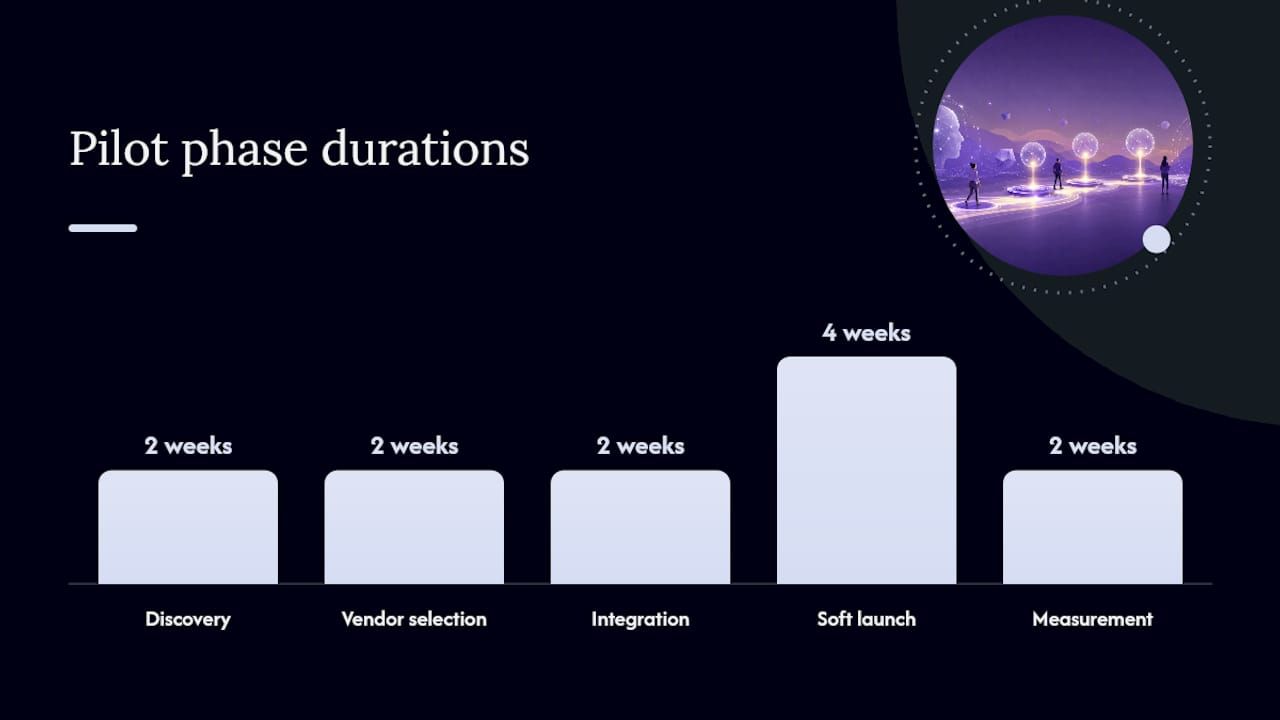
A pilot that lacks defined success criteria is just an expensive experiment. Structure it in phases, with clear go/no-go checkpoints.
| Phase | Duration | Key Activities |
|---|---|---|
| Discovery and scoping | Weeks 1–2 | Define use case, population, KPIs, and stop criteria |
| Vendor evaluation and selection | Weeks 3–4 | RFP, security review, data processing agreement |
| Integration and configuration | Weeks 5–6 | Connect to Zoom/Slack/LMS, configure admin controls |
| Soft launch (closed pilot) | Weeks 7–10 | 20 users, structured feedback loops |
| Measurement and analysis | Weeks 11 and 12 | KPI review, qualitative interviews, go/no-go decision |
Sample questions to ask vendors during evaluation:
Behavioral data and nudge design matter as much as the AI model itself, as a well-designed nudge sequence with a mediocre model will outperform a sophisticated model with poorly timed prompts.
Pro Tip: Ask vendors for case studies that report pre/post KPIs, specifically behavioral outcomes and performance signals, rather than usage statistics. Korn Ferry’s research makes the point clearly: usage metrics alone are weak evidence of coaching impact.
Off-the-shelf tools cover most standard use cases. Custom development makes sense when the gap between what a vendor offers and what your organization needs is large enough to justify the investment. The signals that typically justify a custom build:
Kreante’s delivery approach follows exactly this sequence. The DAVCO AI project is one example of a delivered AI solution built with enterprise data ownership and custom integration requirements at its core. Across more than 265 projects in 35 countries, the pattern is consistent: organizations that define their data governance requirements before architecture decisions are made end up with systems they can actually maintain and audit.
Typical project phases for a custom AI coaching build:
Budget expectations vary significantly by scope. A focused MVP with one coaching flow and one integration typically takes 10–16 weeks. Full-scale platforms with multiple integrations, custom analytics, and enterprise security requirements run longer. For organizations exploring whether implementing AI in their business warrants a custom build or a configured off-the-shelf solution, the discovery phase is the right place to make that call.
The loudest voices in this space tend to argue one of two positions: AI coaching is either a cost-cutting shortcut that will hollow out the profession, or it is a democratizing force that will finally make quality coaching available to everyone. Both framings miss the point.

What the evidence actually supports is narrower and more useful. AI coaching works well in structured, high-volume scenarios where consistency and availability matter more than depth. It works poorly, and carries real risk, when deployed in emotionally complex or high-stakes situations without human oversight. The triadic model, where a human coach retains process leadership and ethical judgment while AI handles the scalable, routine layer, is the most defensible approach given the current evidence base.
The organizations that get this right are not the ones with the most sophisticated AI. They are the ones that defined their governance model before they selected a vendor, set KPIs that measure behavioral outcomes rather than session counts, and built escalation paths to human support before anyone logged in for the first time.
Most AI coaching tools are designed for the average organization. If your requirements include custom data controls, proprietary coaching logic, or integrations with existing HRIS and LMS platforms, off-the-shelf solutions will leave gaps that matter.
Kreante’s AI solutions development services cover the full delivery cycle: discovery, architecture, MVP, pilot, and production deployment, with enterprise data ownership and custom integrations built in from the start. The team has delivered more than 265 projects across 35 countries, including AI systems with strict data governance requirements and complex integration stacks. If you are scoping a custom AI coaching build or evaluating whether a custom solution fits your organization’s needs, a discovery call is the right first step.
An AI coach delivers structured coaching interactions, such as goal check-ins, habit nudges, reflection prompts, and session summaries, through conversational or interactive AI systems. It works best alongside a human coach rather than as a standalone replacement.
Off-the-shelf AI coaching tools range from free tiers (Fathom, NotebookLM) to approximately $20 per month for general-purpose platforms like ChatGPT Pro or Claude. Custom-built AI coaching systems are priced per project scope; a focused MVP typically takes 10–16 weeks to deliver.
ChatGPT can simulate coaching conversations and is useful for goal-setting, reflection prompts, and accountability check-ins, but it lacks the ethical oversight, session memory across platforms, and escalation protocols that professional coaching requires. For organizational use, it works best as a configured component within a governed coaching program, not as a standalone coach.
The ICF AI Coaching Framework and Standard defines four AI application types (scheduling, data processing, interactive, conversational) and sets minimum requirements for data protection, accessibility, and the distinction between coaching and therapy. It is the primary benchmark for evaluating AI coaching vendors in the United States and internationally.
Go further
Don't let your tech watch stop here. Explore our other resources to master your technology stack.
ToolsCompare Chargebee, Recurly, Stripe Billing, Zuora and Maxio, and pick the subscription billing platform that fits your biggest operational risk.
 Tools
ToolsImplementing AI in a business requires a practical roadmap that addresses real operational challenges. This article presents 25 actionable strategies informed by experts in the field, covering everything from marketing automation.
 Tools
ToolsSince 2024, we've been using AI daily at Kreante: in building every application, for all our clients. Today, whether or not the products we develop embed AI, the whole team benefits from our mastery of these tools.