
 Industry
What Is a Two-Sided Marketplace? A Founder’s Playbook
Explore how to build a successful two-sided marketplace by ensuring liquidity and matching supply with demand effectively.
JarenAugust 22, 2026Read the article
Outcome first AI audit for business leaders in 2–3 weeks. Rank use cases by Cost per Outcome and Return on Change. Get a prioritized roadmap.

A business-focused AI audit is a consultancy-led assessment that maps how your company runs, finds where AI will move revenue, margin, or hours, and hands you a prioritized roadmap with expected returns attached. You need one now if you’re staring at a pile of AI options with no way to rank them, or if a pilot already stalled without a clear reason. Skip it only if you already know your top three high-value use cases and have the data to prove it.
TL;DR:
An AI audit assesses current workflows and data readiness, focusing on initiatives that directly improve revenue, margins, or reduce manual hours.
It produces a prioritized roadmap, a use-case scorecard, a data readiness grade, and a phased implementation plan to guide investment decisions.
High-impact use cases should have a green data readiness score attached; scoring without data validation often indicates guesswork.
The typical audit duration is two to three weeks, with quick wins achievable within a few months and longer projects over six to twelve months.
External audits are recommended when internal teams lack resources or objectivity to map workflows or compare impact metrics effectively.
An AI audit, in the sense that matters to a business leader, is anchored to outcomes: revenue gained, margin protected, hours no longer spent on manual work. It is not a survey of your tech stack for its own sake.
The core activities look like this: mapping how work actually flows through your teams (not how the org chart says it should), structured interviews with the people doing the work, a review of what data you actually have versus what you think you have, and scoring every candidate use case before anything gets built. The output is a roadmap, not a slide deck.
Worth being precise about scope: this is different from a technical or compliance audit of a model’s fairness, security, or regulatory posture. That’s a separate exercise with a separate audience. A business-focused audit asks one question at every step: will this move a number leaders actually track?
A serious audit produces a small set of concrete artifacts, not a report you skim once and file away. Here’s what a completed engagement typically hands you:
The roadmap is the part leaders actually use. It tells you which project to staff first, what it should cost, and what result justifies the spend. Without it, most companies default to whichever use case got the loudest internal advocate, which is a poor way to allocate an AI budget.
The method behind a good audit is more procedural than people expect, and that’s the point. Guesswork is exactly what it’s designed to remove.
Analytical AI use cases (forecasting demand, flagging fraud, optimizing routes) tend to score cleanly here because the financial return attaches directly to a number you already track. Generative AI use cases (drafting, summarizing, customer replies) usually improve speed or quality first, which means someone still has to do the work of translating that gain into financial impact before it shows up on the scorecard.
Pro Tip: Push back hard on any use case scored “high impact” with no data readiness check attached. That combination usually means someone is guessing at the impact number.
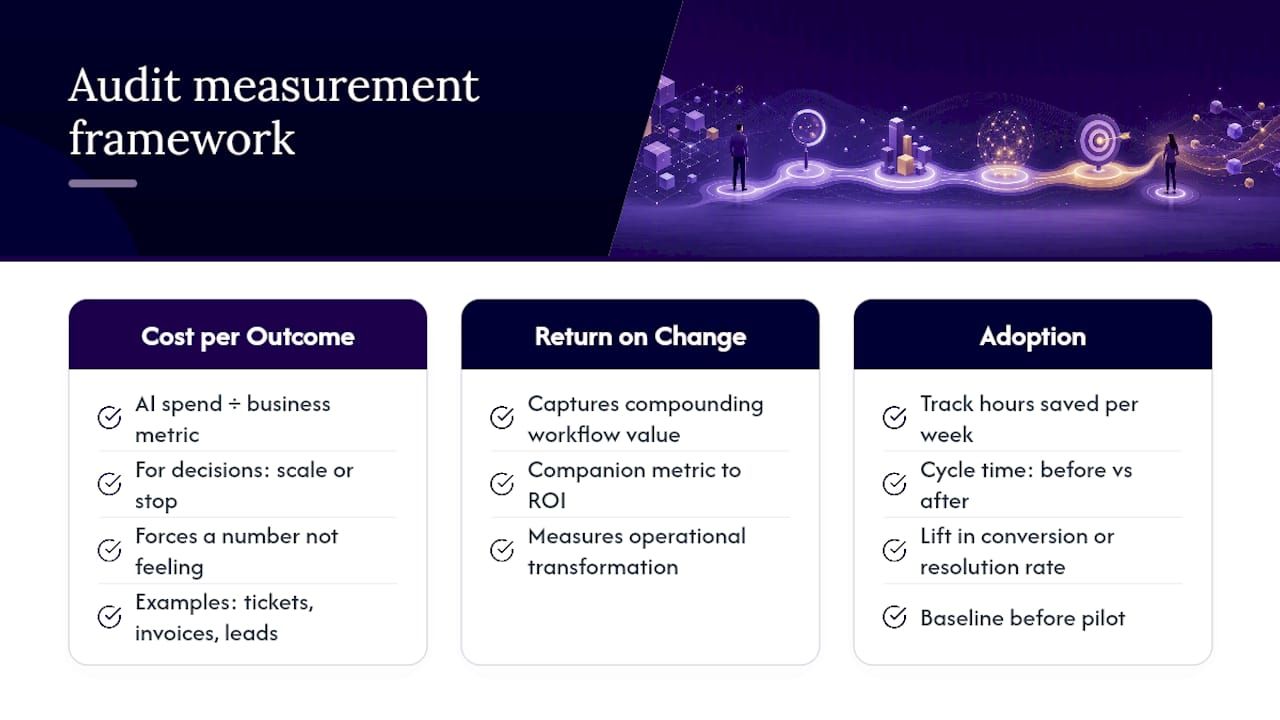
The metric leaders should demand first is Cost per Outcome: total AI spend on an initiative divided by the business value metric it’s supposed to move, whether that’s tickets resolved, invoices processed, or leads converted. AWS Cloud Financial Management frames this as the repeatable basis for scale or stop decisions, and it works because it forces a number instead of a feeling.
Cost per Outcome alone misses something, though: the compounding value of a workflow that gets faster every month as people adopt it. That’s what Return on Change (ROC) is built to capture. BDO’s framing treats ROC as a companion metric to ROI, tracking how much an operational process actually transforms, not just what it cost.
Alongside those two, track adoption directly: hours saved per week, process cycle time before and after, and any lift in conversion or resolution rate. Set your baseline before the pilot starts, review monthly for the first quarter, then quarterly after that. Skip the baseline and you’ll be arguing about whether AI “worked” with no number to point to.
Most audits run two to three weeks, tight enough that a focused, structured process surfaces the highest-value opportunities without dragging into a multi-month consulting engagement. What follows breaks into three phases:
Cost drivers cluster around a few things: data cleanup for anything scored yellow or red, integration work to connect systems that were never designed to talk to each other, model licensing, and engineering hours. A short audit up front is cheap insurance against the alternative: buying a tool that doesn’t integrate or solving a low-impact problem, which is where most failed AI budgets actually go.
An audit moves faster when the right people show up prepared. You need an executive sponsor who can approve the roadmap, an operations lead who knows where the real bottlenecks live, someone from data or IT who can speak honestly about system access, and the subject-matter experts actually doing the work day to day.
Bring process maps, sample datasets, a system inventory, and the KPIs you already track. Block real time for interviews, not fifteen-minute drive-bys, and leave room to react to an early prototype. One red flag worth watching for: if nobody in the room can answer where a given dataset actually lives, expect more data work than the initial estimate assumed.
An outcome-first audit ends in a prioritized roadmap with expected returns attached to each initiative, a data readiness grade for every use case, and a phased plan splitting quick wins from longer strategic builds. Nothing gets recommended without a number behind it.
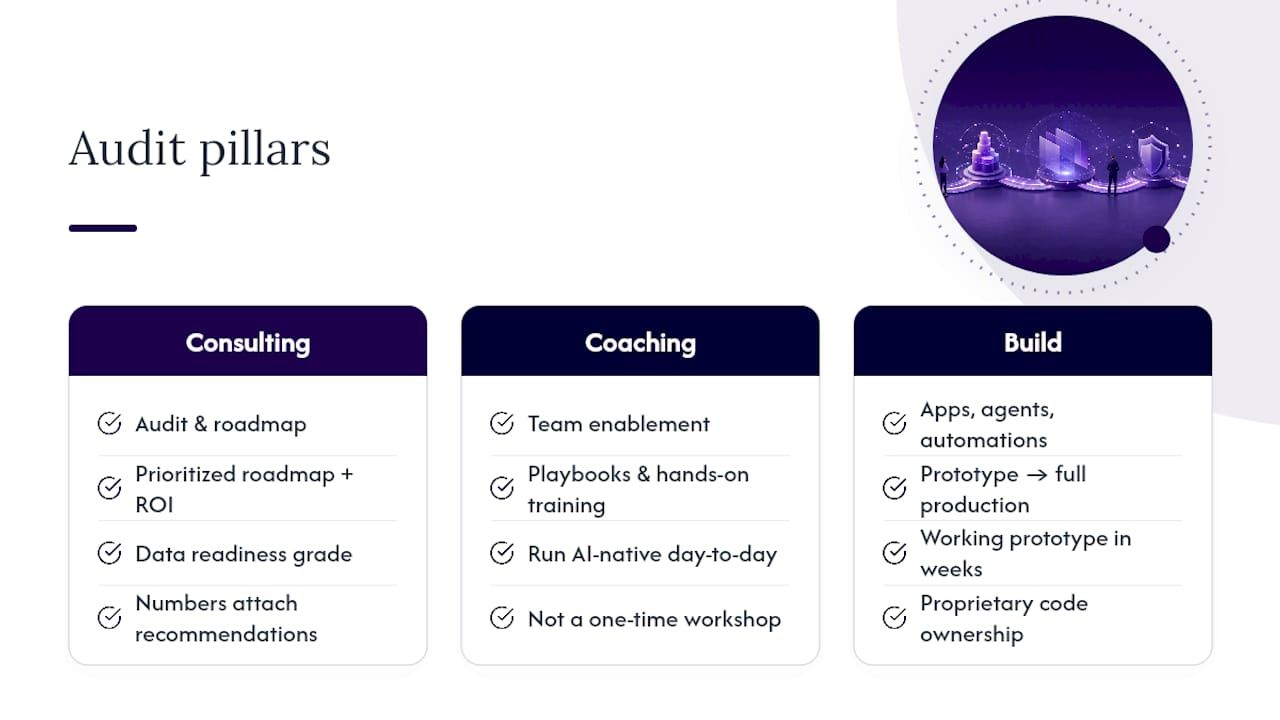
The audit sits inside a broader structure built around three pillars. Consulting covers the audit and the roadmap itself. Coaching trains your team to run AI-native day to day, through hands-on enablement and playbooks rather than a one-time workshop, so the capability stays in-house instead of leaving with the vendor. Build covers the actual apps, agents, and automations, moving from a working prototype in weeks to a full production system with proprietary code you own outright.
Many projects have been delivered across multiple countries, with the audit step designed to prevent the two failure modes that waste the most budget: building the wrong thing, and building the right thing without anyone knowing how to run it afterward.
Hire an outside audit when your team lacks the bandwidth to map every workflow objectively, or when you genuinely don’t know how your numbers compare to companies solving similar problems. An internal team almost always overweights the use case someone is already excited about, which is exactly the bias a structured scoring process is built to correct.
Internal pilots can work fine when your data is clean, one person already owns operations end to end, and the automation itself is simple enough that impact is obvious within a few weeks. My practical rule: name your top three time-consuming workloads, and force yourself to calculate a real Cost per Outcome number for at least one of them inside a single quarter. If you can’t produce that number without outside help, that’s your answer.
— Jorge Del Carpio
An audit is only worth running if it ends in a roadmap someone actually executes, and that’s the part most consultancies skip. A partner runs the audit, ranks every use case by expected return and data readiness, and stays through the build so the roadmap doesn’t sit in a folder collecting dust.
If you’re weighing a cloud cost optimization review alongside an AI audit, the two questions overlap more than you’d think: both come down to knowing exactly what you’re spending against what it’s actually returning. Consulting engagements start there, score candidate use cases, and hand clients a prioritized plan with a number attached to each item, then build the first prototype in weeks once ready to move. Request an AI audit proposal and get a roadmap with expected returns instead of another slide deck.
It’s a consultancy-led assessment that maps your operations, scores candidate AI use cases by impact, feasibility, and data readiness, and delivers a prioritized roadmap with expected returns for each initiative.
Most structured audits run two to three weeks, with implementation split into quick wins over zero to three months, medium-term projects over three to six months, and strategic initiatives over six to twelve months.
Cost per Outcome divides AI spend by a specific business value metric to guide scale-or-stop decisions on one initiative, while ROI and Return on Change (ROC) capture broader financial and operational transformation across a portfolio.
Not necessarily, but an audit still catches whether your data is ready (green, yellow, or red) and whether that use case actually outranks others you haven’t considered on impact and feasibility.
Kreante pairs the audit and roadmap with hands-on coaching and an in-house build phase, so your team retains the capability and owns the resulting code instead of depending on the vendor after launch.
Go further
Don't let your tech watch stop here. Explore our other resources to master your technology stack.
IndustryExplore how to build a successful two-sided marketplace by ensuring liquidity and matching supply with demand effectively.
 Industry
How to evaluate an AI agency in Miami for a B2B project: technical delivery, consulting and coaching, team seniority, local anchoring and portfolio.
 Industry
Discover how to navigate vendor lock-in risks and ensure your IT strategy protects against costly disruptions and compliance challenges.