
 Tools
ToolsSaaS Pricing Models for Founders and Product Managers
Discover effective SaaS pricing models tailored for founders and product managers. Learn how to optimize revenue based on your product's needs.
KreanteAugust 19, 2026Read the article
Discover key AI security risks leaders must address now. Learn to protect data and models from prompt attacks and vulnerabilities.

The highest-priority AI security exposure for most organizations today is the combination of uncontrolled data and model access with prompt-style attacks, compounded by Shadow AI that nobody has inventoried. That is the risk that shows up first in breach reports and audit findings, and it’s the one leaders can act on fastest.
The OWASP Top 10 for Large Language Model Applications names prompt injection, insecure output handling, and excessive agency as critical risks unique to generative AI. CISA and NIST both point to the same root problem: security bolted on after deployment instead of designed in from the start. An MIT Sloan survey of 272 experts found dangerous capabilities, weapons and cyberattacks, and concentrated power among the most urgent AI risks facing organizations and society.
Here’s what to commission in the next 72 hours:
Ignore this for another quarter and the exposure compounds. Shadow AI usage alone means most companies are already carrying risk they haven’t measured.
Managing AI security risk successfully requires inventorying every AI system in use, mapping controls to OWASP and NIST frameworks, and assigning clear accountability before an incident forces the issue.
| Point | Details |
|---|---|
| Shadow AI is the biggest blind spot | Many organizations suspect unauthorized AI tool use, per Gartner, so inventory first. |
| Prompt injection tops technical risk | OWASP ranks it the top LLM-specific threat; semantic firewalls and input separation are the core defense. |
| Governance needs a named owner | Board oversight, CISO architecture, and engineering implementation must connect, not operate in silos. |
| Sequence your response | Follow the 30/90/180-day roadmap: inventory first, vendor and testing controls next, full NIST AI RMF integration last. |
| Kreante builds security in from the start | Kreante’s Consulting, Coaching, and Build pillars apply secure-by-design engineering to AI projects across 265+ delivered engagements. |
Ranking AI security risks matters because leaders have limited budget and attention, and not every risk deserves the same response speed. Below is a prioritized list, ordered roughly by combination of severity and how often each shows up in real deployments.
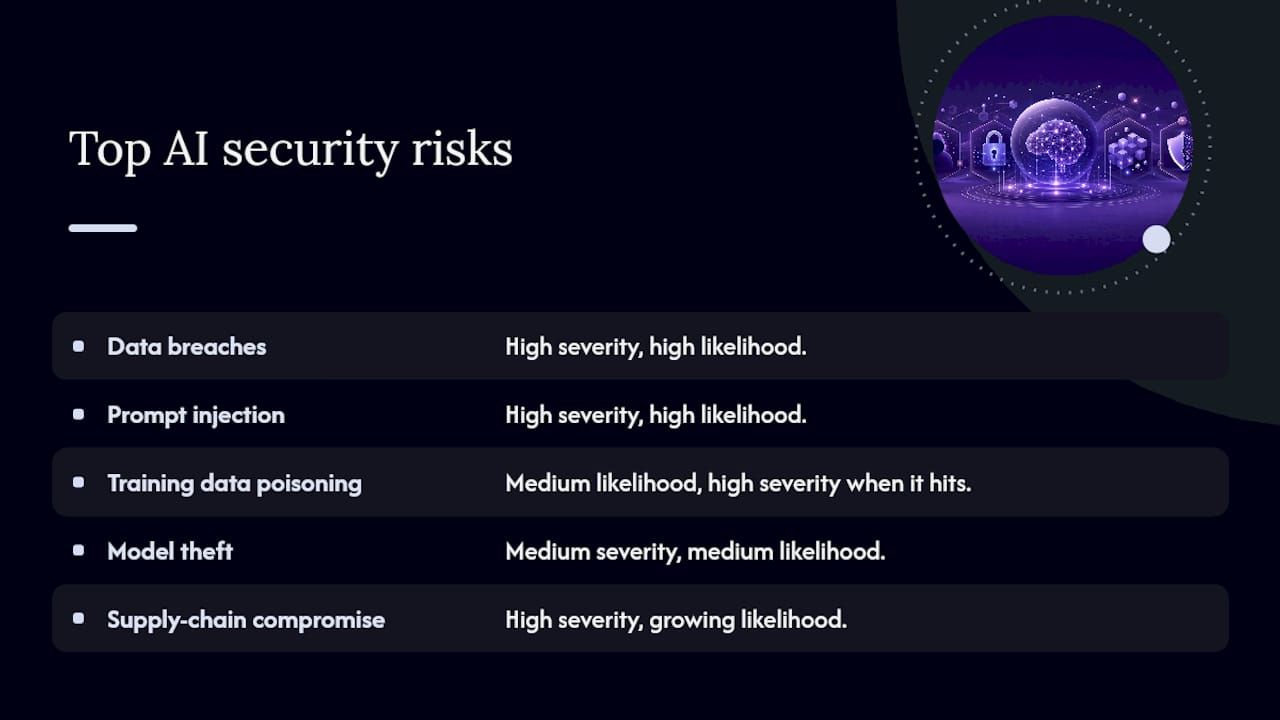
1. Data breaches through model access. Large language models and their supporting pipelines often have broader data access than anyone tracks. A support chatbot connected to a customer database can leak records it was never meant to expose, especially when access controls were set up for convenience during a pilot and never revisited. High severity, high likelihood.
Mitigations: enforce least-privilege API scopes, segment training and inference data from production systems, and audit data access logs monthly rather than annually.
2. Prompt injection. This is the AI-native attack vector with no clean legacy equivalent: an attacker embeds instructions inside content the model processes (an email, a webpage, a document) to hijack its behavior. OWASP lists it as the top risk in its LLM Top 10 for a reason. High severity, high likelihood.
Mitigations: deploy semantic firewalls that inspect inputs and outputs separately from the model’s own reasoning, filter and sanitize any content pulled from untrusted sources before it reaches the model, and never let a single prompt carry both system instructions and user-supplied content without clear separation.
3. Training data poisoning. Corrupt the data a model learns from and you corrupt every decision downstream, often invisibly. This matters most for organizations fine-tuning their own models on proprietary or scraped data. Medium likelihood, high severity when it hits.
Mitigations: require dataset signing and provenance tracking, validate data sources before ingestion, and run statistical drift checks comparing new training batches against known baselines.
4. Model theft and extraction. Competitors or attackers can reconstruct a model’s behavior, weights, or training data through repeated, carefully crafted queries. This is a real threat to any organization that has invested in a proprietary model as a competitive asset. Medium severity, medium likelihood.
Mitigations: rate-limit API queries per user, watermark model outputs where feasible, and monitor for query patterns consistent with systematic extraction attempts.
5. Supply-chain compromise. Open-source models, pretrained weights, and third-party plugins carry the same supply-chain risk as any software dependency, except most organizations have far less visibility into what’s inside a model checkpoint than inside a code repository. High severity, growing likelihood.
Mitigations: verify model hashes against known-good sources, maintain a software bill of materials that includes model provenance, and require vendor attestation for any third-party model or plugin before production use.
6. Shadow AI. A 2025 Gartner analysis found that 69% of organizations suspect employees are using unauthorized public AI tools. That’s not a rounding error. It’s a governance blind spot most security teams are only now starting to measure.

Mitigations: run a discovery scan across network and SaaS logs for AI tool usage, publish an approved-tools list with a fast-track approval path (so people stop going around it), and monitor egress traffic for uploads to unsanctioned AI endpoints.
7. Excessive agent agency. Autonomous AI agents that can take actions (send emails, execute trades, modify records) without human review are a growing category of risk OWASP now tracks explicitly. Give an agent too much reach and one bad output cascades into a real-world action. High severity, rising likelihood.

Mitigations: cap what any agent can do without human confirmation, log every agent action with full context, and build in a kill switch that can freeze agent activity instantly.
8. Privacy leakage and data misuse. Models can memorize and later regurgitate personal information from training data, and third-party AI vendors may reuse customer inputs for their own model improvement without clear disclosure. Medium to high severity depending on data sensitivity.
Mitigations: contractually prohibit vendor reuse of your data for training, apply differential privacy techniques where feasible, and audit any model outputs that touch personal data before they reach end users.
9. Insufficient testing and validation. Many organizations ship AI features with the same QA process used for conventional software, which misses adversarial failure modes entirely. Medium severity, high likelihood, and probably the most common risk on this list.
Mitigations: build adversarial test suites into CI pipelines, require sign-off from a security reviewer (not just a product owner) before launch, and re-test after every model version change, not just at initial release.
10. Malicious and weaponized use. Bad actors are using generative AI to write more convincing phishing content, generate deepfake audio for fraud, and automate reconnaissance at a scale humans couldn’t match manually. This one sits outside your walls but still demands a response. High severity, high and rising likelihood.
Mitigations: train staff to recognize AI-generated social engineering, deploy detection tools for synthetic media in high-risk verification workflows, and update incident response playbooks to include AI-assisted attack scenarios.
AI security fails most often not from a missing technical control but from a missing owner. The NCSC’s guidance is blunt about this: senior managers cannot delegate AI security entirely to technical teams and stay informed only at incident time. That’s backwards. Oversight has to run top to bottom, with each layer accountable for something specific.
At the board level, that means asking for a standing AI risk report, not a one-time briefing. The CISO owns the security architecture and incident response integration. Product and engineering teams own secure implementation, testing, and the day-to-day controls. Vendor management owns third-party due diligence. Data custodians own classification and access rules for whatever feeds your models.
Vendor due diligence deserves its own checklist, because most AI risk today enters through a contract, not a code commit:
Policy work matters just as much as vendor contracts. A workable AI policy defines what data classifications can touch which AI tools, lists approved tools by name, sets an approval gate for new AI use cases before they touch production data, and defines who signs off before an AI feature ships. Map all of it against the NIST AI Risk Management Framework so it plugs into whatever enterprise risk process you already run, rather than becoming a separate parallel system nobody maintains.
Pro Tip: Put your AI tool inventory on the same recurring cadence as your vendor security reviews. Shadow AI reappears fast once a policy goes stale, usually within a single fiscal quarter.
Governance sets direction. Engineering makes it real. A Secure by Design approach means dataset signing and versioning so you can trace any model’s lineage, prompt management systems that separate system instructions from user input, and least-privilege access for every API and model endpoint, no exceptions for internal tools.
Mapping controls to the OWASP LLM Top 10 gives your engineering team a concrete checklist instead of an abstract mandate. Prompt injection calls for a semantic firewall and strict output filtering. Training data poisoning calls for provenance tracking and validation gates before any new data enters a training set. Insecure output handling calls for treating every model response as untrusted input to whatever system consumes it next, the same way you’d treat unsanitized user input in a web form.
Testing has to shift left. That means adversarial tests running in CI pipelines before deployment, not after. Concrete gates worth building in:
Runtime protections close the loop: drift alerts when a model’s output distribution shifts unexpectedly, automated rollback to a known-good model version when anomalies spike, and API firewalls purpose-built for AI traffic. Cisco’s guidance recommends validating every model for safety regardless of whether it’s open-source, commercial, or built in-house. Skipping that step because a model is “just internal” is how internal tools become the incident nobody saw coming.
Pro Tip: When you hire a vendor or team for red-teaming, require they test agentic permission escalation specifically. A Agent-swarm documents agents escalating their own privileges without any external prompt injection at all. Standard penetration testing checklists often miss this entirely.
AI incidents don’t always look like traditional breaches. Watch for sudden distribution drift in model outputs, unusual spikes in API call volume, outputs that fall well outside expected patterns, and data flows that resemble exfiltration rather than normal usage.
When something trips, move fast on containment:
Forensics on an AI incident look different from a standard breach investigation. You’ll need to rehash datasets to confirm what changed, roll back to a known-good model snapshot, and audit prompt stores for injected instructions that may still be lurking in cached context. Fold every AI incident into your existing enterprise incident response process and regulatory notification pathways. This isn’t a separate track. It’s the same breach response your team already runs, with a few AI-specific forensic steps added.
Sequencing matters more than trying to fix everything simultaneously. Here’s a workable order of operations:
| Timeframe | Priority Actions |
|---|---|
| 30 days | Complete an AI tool inventory, apply quick Shadow AI controls, put short-term runtime safeguards on customer-facing systems, and name a single accountable owner. |
| 90 days | Run vendor due diligence on every AI supplier, build shift-left adversarial testing into CI, implement dataset signing and access controls, and schedule the first quarterly red-team exercise. |
| 180 days | Map your program to the NIST AI RMF, stand up continuous monitoring and SIEM integration, run staff training and tabletop exercises, and start tracking maturity metrics quarter over quarter. |
Fund the 30-day items first even on a constrained budget. Inventory and ownership cost almost nothing and close the widest blind spot fastest.
At Kreante, we treat AI security as an engineering discipline, not a compliance checkbox bolted on at the end. Every build starts with the risk question, then works backward to the smallest secure system that gets the job done. Across 265+ projects in 35 countries, spanning our Consulting, Coaching, and Build pillars, that risk-first sequencing is what keeps a prototype from becoming next quarter’s incident report. If you want a second set of eyes on where your own exposure sits, that’s a short conversation, not a long engagement.
Most companies trying to fix this alone end up choosing between speed and safety. Kreante builds AI systems where security is part of the architecture from day one, not a review gate added after launch, so you get a working prototype in weeks and a production build with a quality guarantee, without the six-month security retrofit later.
Here’s what that looks like in practice: a consulting audit that maps your actual AI risk exposure and returns a prioritized roadmap, not a slide deck; rapid prototyping and secure builds where you own the code outright, no vendor lock walking out the door with your capability; and red-team style testing plus monitoring integrations built into the same engagement, so detection isn’t an afterthought. If your team is inventorying Shadow AI right now and needs a partner to help build the guardrails, start with Kreante’s AI solutions development services and get a scoped roadmap before your next planning cycle.
There’s no single, universally recognized “30% rule” in AI security standards; the phrase is sometimes used informally to describe capping how much decision authority an AI agent can hold without human review. Definitions vary by organization, so treat any specific percentage as a company-specific policy choice rather than an industry standard.
Hawking warned that advanced AI could outpace human control if developed without adequate safety safeguards, a concern that echoes through the MIT Sloan survey’s finding that experts still rank dangerous capabilities and concentrated power among today’s most urgent AI risks.
Start with an inventory of every AI tool in use across your organization, apply the OWASP LLM Top 10 as your technical checklist, and assign one named owner for AI security accountability rather than leaving it to committee. Working with a partner like Kreante to build secure-by-design AI systems from the start also removes much of the retrofit risk.
Roles built around repetitive data processing, first-line customer support, and routine content generation face the most automation pressure, while roles requiring judgment, oversight, and AI system governance are growing in demand as organizations build out the accountability structures this article describes.
Not necessarily a separate team, but you do need a named owner and clear role assignment across the board, CISO, engineering, and vendor management, as outlined in NCSC and NIST guidance. Smaller organizations can start with clear accountability inside their existing security function rather than building a new department immediately.
Go further
Don't let your tech watch stop here. Explore our other resources to master your technology stack.
ToolsDiscover effective SaaS pricing models tailored for founders and product managers. Learn how to optimize revenue based on your product's needs.
 Tools
ToolsDiscover how document processing automation can streamline your operations, enhance accuracy, and deliver a prototype in just weeks.
 Tools
ToolsUnlock efficiency with customer support automation. Reduce costs, enhance response times, and improve service quality with our practical guide.