
 Development
RAG vs Fine-Tuning: The Enterprise Decision Playbook
Discover how to choose effectively between RAG and fine-tuning for your enterprise AI needs, ensuring rapid results and compliance.
KreanteAugust 15, 2026Read the article
Discover the true costs of AI integration in 2026, including key factors that affect pricing and strategies to minimize spending.

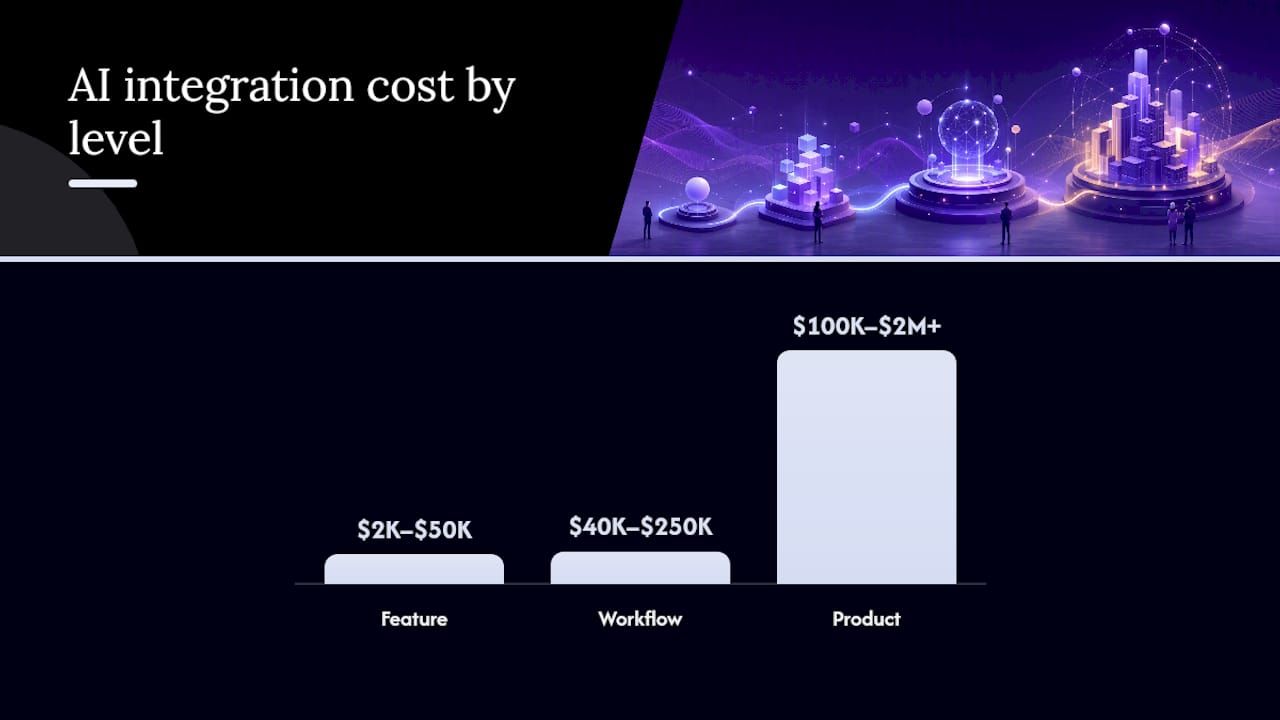
Expect $5,000 to $50,000 for a single API feature, $40,000 to $250,000 for a workflow automation or internal AI tool, and $250,000 to $2 million or more for a custom enterprise platform. Most companies spend between $40,000 and $400,000 on their first real AI project, and the number that lands depends almost entirely on data readiness, integration complexity, and whether you need a custom model or can lean on an existing one.
Here’s the one-line verdict: start with a scoped pilot or an API-level integration, not a full platform build. The lowest-risk path into AI is proving value on a narrow use case before you commit six figures to something bigger. The most expensive mistake business leaders make isn’t overpaying for AI. It’s building a custom enterprise system before they’ve confirmed the use case actually works at a smaller scale.
Four things push a project from the cheap end of that range to the expensive end:
AI integration cost depends far more on data readiness, integration depth, and compliance needs than on which AI model you choose.
| Point | Details |
|---|---|
| Match tier to need | Feature-level work runs $2K–$50K, workflow automation $40,000 to $250,000, full platforms $100K–$2M+. |
| Buy before you build | Vendor purchases succeed roughly approximately two-thirds of the time versus approximately one-third for internal builds; reserve custom development for proprietary data or regulatory needs. |
| Budget the hidden 30-60% | Data cleanup, integration testing, and retraining routinely push mid-market projects well over the initial quote. |
| Start with a fixed-scope pilot | Written acceptance criteria and staged payments tied to milestones limit downside before a full build begins. |
| Use a phased partner model | Kreante’s consulting, coaching, and build sequence lets you validate ROI with a prototype before committing to full-platform spend. |
The single biggest variable in any AI integration cost estimate is scope, and scope breaks down into three fairly distinct tiers. Knowing which one you’re actually building is the fastest way to stop guessing and start budgeting.
Level 1: Feature-level integration. This is a single AI capability bolted onto something that already exists. A chat widget on your website, an auto-classification tool for support tickets, an enrichment API that tags incoming leads. These typically run $2,000 to $8,000 for simple SaaS-based additions, though a more involved feature with custom prompts and testing can reach $50,000. Timeline: two to six weeks.
Level 2: Workflow-level integration. This is where most mid-market companies land. Think retrieval-augmented generation (RAG) knowledge assistants that search your internal documents, end-to-end document processing pipelines, or automations that move data across three or four systems without a human touching it — all examples of AI Inventory Software: Features, Benefits & Top Solutions that illustrate practical use cases in workflow automation. Mid-market deployments in this tier typically run mid-market range typically in the tens of thousands for year one. Timeline: six weeks to four months.
Level 3: Product-level integration. This is a domain-specific model, a multi-model pipeline, or an AI capability embedded so deeply into your platform that it becomes a core product feature rather than an add-on. Enterprise integrations in this bracket run $100,000 to hundreds of thousands of dollars, and fully custom enterprise platforms exceed hundreds of thousands of dollars, sometimes reaching $2 million or more. Timeline: four months to over a year.
| Level | Price Range | Typical Timeline | Complexity / Scope | Best For |
|---|---|---|---|---|
| Feature | $2K–$50K | 2–6 weeks | Single capability, minimal integration | Adding AI to an existing product without changing core architecture |
| Workflow | $40,000 to $250,000 | 6 weeks–4 months | Cross-system automation, RAG, document pipelines | Automating a specific business process end to end |
| Product | $100K–$2M+ | 4 months–1+ year | Custom models, multi-system platform, regulatory scope | Building AI into your core product or competitive differentiation |
A customer support team adding an FAQ chatbot is Level 1. A legal team building a contract review assistant that pulls from thousands of internal documents is Level 2. A fintech company building proprietary fraud detection trained on its own transaction history is Level 3. The tier you’re in determines almost everything else in this article, from staffing to timeline to which vendor pricing model makes sense.
Most of what determines your final bill has nothing to do with the AI model itself. It’s the plumbing around it.
Data readiness and labeling is usually the single largest hidden line item. Gartner has flagged the lack of AI-ready data as a top risk factor for enterprise AI projects, and for good reason: if your data lives in six disconnected systems with inconsistent formatting, someone has to clean and structure it before a model can use it reliably. That work often costs more than the model integration itself.

Model selection and fine-tuning is the second driver. Calling an existing large language model through an API is cheap and fast. Fine-tuning a model on your proprietary data, or training one from scratch, adds specialized engineering time and compute costs that can multiply your budget several times over.
Integration engineering connects the AI layer to your actual systems, your CRM, your ERP, your internal databases, and this is where estimates most often go wrong. Vendors quote the model work accurately and underestimate the integration work badly.
Other cost categories to budget separately:
The Harvard Business School framework groups these into four categories: infrastructure, system integration, maintenance and iteration, and human capital. Budgeting each one separately, rather than lumping everything into “the AI cost,” is what keeps a project from blowing past its original number.
Pro Tip: Before you fine-tune anything, try retrieval-augmented generation instead. RAG lets a model pull answers from your existing documents without retraining it, and it’s usually a fraction of the cost of a custom model with comparable accuracy for most business use cases.
The sticker price of building an AI feature is only half the budget conversation. The other half is what you pay every month after launch, and this is the number that catches leaders off guard because it doesn’t show up in the initial project quote.
You have three basic infrastructure paths. A hosted API (calling a provider’s model directly) has low upfront cost and scales with usage, but per-request fees add up fast at volume. Cloud compute (running your own models on rented infrastructure like AWS or Azure) gives you more control and can be cheaper at scale, but requires dedicated engineering to manage. On-premise hardware is the most expensive upfront option: enterprise-grade GPU clusters can push capital costs near $1 million even for a small setup, and it’s rarely justified unless you have strict data residency or compliance requirements.
Whichever path you choose, expect these recurring categories to show up on your monthly bill:
CloudZero’s benchmarks put monthly operating costs anywhere from $500 for light workloads to tens of thousands to very high costs at scale for high-volume deployments, with inference (the actual cost of running queries) dominating that spend. A CFO reviewing this on a P&L should expect to see it split across “cloud infrastructure,” “software licensing,” and “IT operations,” not as one lump AI line item.
Vendor pricing models vary in who bears the risk:
| Pricing Model | How It Works | Favors |
|---|---|---|
| Subscription (flat fee) | Fixed monthly cost regardless of usage | Buyer, if usage is predictable |
| Per-request / usage-based | Pay per query or API call | Vendor, since costs scale with your growth |
| Committed usage discount | Lower rate in exchange for a usage commitment | Buyer, if volume is stable and forecastable |
| Seat-based | Priced per user with access | Vendor, in high-headcount organizations |
Well-engineered systems using compression and batching can cut inference costs by two to six times compared to a naive setup, which is exactly why the integration engineering quality matters as much as the model choice.
The data on this is clearer than most vendors want you to know: companies that buy AI solutions from specialized vendors succeed about approximately two-thirds of the time, compared to roughly approximately one-third for internal builds from scratch. Buy first is the right default for most companies, most of the time.
Custom development earns its higher price tag only under specific conditions:
If none of those four apply, buying or integrating an existing solution is very likely the better financial decision. A practical step-by-step approach to implementing AI in a business walks through exactly this kind of scoping decision before a single line of code gets written.
Run through this checklist before choosing a path:
A simple decision flow: if an off-the-shelf tool solves 80% of the problem, buy it and customize the remaining 20%. If your data is your competitive moat, build. If you’re not sure yet, run a pilot with the buy option first. It’s cheaper to learn you were wrong at $10,000 than at $200,000.
Every AI integration cost conversation eventually turns into an ROI conversation, and this is where a lot of pitches fall apart under scrutiny. Here’s a worked example using a mid-market document processing workflow.
Conservative scenario: A workflow automation costs $50,000 upfront plus $1,500/month in inference and hosting. It saves three employees eight hours a week each on manual document review, at a blended cost of $35/hour. That’s $8,400 in weekly labor savings, or roughly $33,600/month. Payback on the initial $50,000 investment: under two months, even after accounting for the recurring $1,500 monthly cost.
Optimistic scenario: The same system also reduces processing errors that previously cost the company $15,000/month in rework and customer credits. Combined with labor savings, monthly value jumps past $48,000, and the project pays for itself in roughly six weeks.
The KPIs that matter for this kind of calculation:
Before you approve a budget, run through a readiness checklist:
That last point matters more than most leaders expect going in. No-code and low-code approaches to early ROI measurement can help you validate the business case before committing to a larger contingency-heavy budget.
AI projects move through five fairly predictable phases, and the leaders who plan cash flow around these phases have a much easier time than those who expect a single go-live date.
Discovery (one to three weeks): scoping the use case, auditing data quality, defining success metrics. Prototype or MVP (two to six weeks): a working proof of concept, often built with existing APIs to move fast. Pilot (four to eight weeks): testing with real users in a limited environment, gathering accuracy and adoption data. Production hardening (four to twelve weeks): security review, monitoring setup, edge-case handling. Scale and continuous improvement (ongoing): retraining, expanding scope, optimizing cost per query.
| Phase | Feature Tier | Workflow Tier | Product Tier | Key Deliverable |
|---|---|---|---|---|
| Discovery | 1 week | 2 weeks | 3–4 weeks | Scoping document, success metrics |
| Prototype/MVP | 1–2 weeks | 3–4 weeks | 6–10 weeks | Working demo |
| Pilot | 2–4 weeks | 4–8 weeks | 2–6 weeks | Usage and accuracy data |
| Production | 1–2 weeks | 4–6 weeks | 8–20 weeks | Hardened, monitored system |

The most common schedule risk isn’t technical. It’s scope creep during the pilot phase, when stakeholders see early results and start asking for “just one more feature.” Every added feature during a pilot resets part of the testing cycle and pushes the production date back, often by more than the feature itself would take to build in isolation.
The quote you get rarely matches the amount you end up spending, and it’s almost never because the vendor lied. It’s because certain costs are structurally hard to estimate until you’re already inside the project.
Costs that get missed most often:
Mid-market implementations regularly run 30 to 60% over initial estimates, almost always due to integration engineering and data prep that got underscoped at the proposal stage.
Watch for these red flags in vendor proposals before you sign anything:
Ask for these clauses before signing: usage caps that prevent surprise inference bills, performance-based payment milestones tied to accuracy or adoption benchmarks, and clear written acceptance criteria for every phase. If a vendor resists any of these, treat it as information. Budget your contingency reserve at 15 to 20% of the total project cost, and set a defined checkpoint, usually at the end of the pilot phase, where you can pause or de-scope if the numbers aren’t working.
Comparing AI vendor quotes is hard because most of them aren’t scoped the same way, which makes apples-to-apples comparison nearly impossible unless you force the structure yourself.
Ask every vendor these questions before you compare a single number:
A complete proposal should include a defined scope document, acceptance tests for each milestone, a risk register identifying what could go wrong and how it’s handled, maintenance pricing spelled out separately from build cost, and SLAs with measurable terms.
When comparing pricing structures, per-request pricing works best for unpredictable or low-volume use cases; committed usage discounts make sense once you have a reliable volume forecast; fixed-fee pricing protects you from overruns but only if the scope document is airtight. To verify a vendor’s estimate is realistic, ask for a time breakdown by role (how many hours of data engineering versus integration versus QA), the seniority profile of the team actually doing the work, and examples of similar projects with real before-and-after numbers. If the vendor pricing math doesn’t add up, choosing the right AI development agency is worth reading before you commit budget to anyone.
Kreante works in three stages, deliberately in that order, because it’s the sequence that de-risks spending rather than front-loading it.
Consulting comes first: an audit of where AI actually moves a number in your business, ROI-ranked, so you get a roadmap and an expected return per initiative instead of a slide deck full of possibilities. Coaching follows: workshops and hands-on enablement so your own team can work AI-native day to day, which matters because the capability stays in-house instead of leaving when the vendor contract ends. Build comes last, once the return is validated: web apps, mobile apps, AI agents, and automations, with a working prototype in weeks and a full build backed by a quality guarantee.
The projects that go over budget are almost always the ones that skipped straight to building without first confirming the ROI case. Phased pricing tied to milestones, prototype first, pilot second, full build third, means you’re never staking the full budget on an unproven assumption.
The DAVCO AI project shows what this looks like delivered: AI integrated into an existing business system with a defined scope and measurable outcome, not a speculative build. Across 265+ delivered projects in 35 countries, the pattern holds: senior team involvement from day one, staged payments tied to actual milestones, not calendar time.
Buyer protections worth confirming in any partner contract:
The biggest budgeting mistake isn’t underestimating the model cost. It’s assuming the AI portion of the project is the expensive part, when integration, data cleanup, and change management routinely cost two to three times more than the model work itself. Leaders price the visible thing (the AI) and treat the invisible things (data pipelines, testing, user adoption) as rounding errors, and that’s exactly backward.
Negotiating a fixed-scope pilot is the single most useful lever a business leader has. Push for a pilot with explicit acceptance criteria written down before work starts, not “we’ll know it when we see it.” A good acceptance criterion looks like “95% classification accuracy on a held-out test set of 500 real customer tickets,” not “the chatbot works well.” Vague criteria are how pilots quietly become unpaid production systems.
The trade-off that comes up in nearly every scoping conversation is time versus scope versus accuracy, and you can only really hold two of the three. A client wanting 99% accuracy on a document extraction tool in three weeks is asking for something that doesn’t exist at a reasonable price. The resolution that works most often: ship a narrower scope fast, prove the value, then invest the additional budget and time to push accuracy higher once the ROI case is already validated internally. Trying to nail all three from day one is how six-week pilots turn into six-month fire drills.
Kreante’s advantage over a typical vendor proposal is sequencing: you get a prototype in weeks, not months, and you only commit to the full build once the ROI case is proven, not before. That structure alone is what keeps first-time AI budgets from turning into the six-figure surprises this article just walked through.
A first engagement typically starts with discovery, mapping where AI actually pays off in your business, followed by a scoped pilot with a fixed price and clear acceptance criteria. You own the code outright when it’s done, and the senior team that scopes the project is the same one that builds it. If you’re weighing an AI integration cost estimate against your own budget right now, the next step is straightforward: request a scoped AI project quote and get a real number instead of a ballpark.
Bring these figures into vendor conversations directly. Asking a vendor to explain why their quote sits outside these published ranges is one of the fastest ways to separate a well-scoped proposal from a padded one.
There’s no single universally recognized “30% rule” in AI cost planning; the figure that shows up most consistently in project data is that mid-market implementations run 30 to 60% over their initial estimate, usually due to underscoped integration and data prep work. Budget a contingency reserve of at least that range rather than treating the initial quote as final.
A $900,000 figure fits within the custom enterprise platform tier, where fully custom builds with proprietary models and deep system integration run hundreds of thousands of dollars to $2 million or more. It’s not a typical starting budget. It reflects a large-scale, multi-system build, not a standard feature or workflow project.
Get a scoped proposal that breaks out data preparation, integration engineering, model costs, and ongoing infrastructure separately, then compare vendors against the same scope document. Fixed-scope pilots with written acceptance criteria produce far more reliable estimates than open-ended proposals, and Kreante’s approach prices phases separately for exactly this reason.
Buy first in most cases. Vendor-purchased solutions succeed about approximately two-thirds of the time compared to approximately one-third for internal builds, and custom development is only justified when you have a proprietary data advantage, strict regulatory constraints, or performance needs no off-the-shelf tool can meet.
Go further
Don't let your tech watch stop here. Explore our other resources to master your technology stack.
DevelopmentDiscover how to choose effectively between RAG and fine-tuning for your enterprise AI needs, ensuring rapid results and compliance.
 Development
Explore essential trade-offs in multi-tenant SaaS architecture to guide architects in designing efficient, scalable systems for diverse customers.
 Development
Understand the key differences between a prototype and an MVP. Learn how to choose the right approach to validate your product ideas effectively.