
 Development
What Does AI Integration Really Cost in 2026?
Discover the true costs of AI integration in 2026, including key factors that affect pricing and strategies to minimize spending.
JorgeAugust 17, 2026Read the article
Discover effective architecture planning to cut development costs by 30-50%. Learn about key documents and steps to streamline your project.

A complete architecture plan delivers four things: a functional design document (FDD), a technical design document (TDD), a prioritized backlog, and a milestone roadmap that shows what gets built first and why. Done right, proper scoping cuts total development costs by roughly 30 to 50 percent by catching integration gaps and scope creep before a single line of code gets written. It also makes vendor bids comparable, since everyone is quoting against the same spec instead of guessing at your requirements.
Here’s what that output looks like in practice:
Pro Tip: If you’re still deciding whether to commission a paid discovery phase or start with an AI-generated blueprint, do the AI draft first. It costs you almost nothing and gives your paid partner something concrete to critique instead of a blank page.
A complete architecture plan pairs an FDD and TDD with a prioritized roadmap, and proper scoping cuts development costs by roughly 30 to 50 percent by removing ambiguity before build starts.
| Point | Details |
|---|---|
| Two documents, one sign-off | Combine the FDD and TDD so business and engineering approve the same spec before development begins. |
| Scoping saves money | Detailed specs cut development costs by roughly 30 to 50 percent by preventing scope creep. |
| Budget by complexity tier | Simple MVPs run $25,000 to $60,000; complex AI platforms often reach $150,000 to $300,000. |
| AI-native needs specific architecture | Vector databases, model orchestration, and type-safe validation belong in the TDD from day one. |
| Hybrid validation wins | Kreante pairs a fast prototype with senior review, turning a draft blueprint into a validated build plan within weeks. |
Two documents anchor every serious architecture planning process: the functional design document and the technical design document. The FDD answers what the system does for the business. The TDD answers how engineers build it. Microsoft’s Dynamics guidance recommends combining them into a single design document that both business and technical stakeholders sign off on before development starts, which closes the gap where product owners and engineers interpret the same requirement differently.
A strong FDD covers:
A strong TDD covers:
Non-functional requirements deserve their own line item, not a footnote. Scoping guides recommend explicit targets for page load times, concurrent user limits, and compliance frameworks like SOC 2 or HIPAA where they apply. Vague language like “the system should be fast” gives every vendor room to interpret “fast” differently, and that gap shows up later as a change order.
Acceptance criteria close the loop. Instead of “users can search products,” write “search returns results in under 400 milliseconds for a catalog of 50,000 items, filtered by category and price.” That level of specificity removes the ambiguity that turns a fixed-price contract into a series of disputes.
Architecture planning runs in a sequence, and skipping steps is exactly where budgets blow up. Here’s the order that works, with rough ownership at each stage:
The fastest version of this sequence pairs an AI-generated first draft with human validation. AI-powered scoping tools can generate a development-ready specification in minutes by asking structured questions about your business and translating the answers into architecture decisions. That draft is not the final word. It is a starting point that a senior architect reviews, corrects, and stress-tests against real constraints in a matter of days rather than weeks.
Pro Tip: Reserve paid discovery for genuinely complex projects: multi-system integrations, regulated data, or AI features that touch customer records. For a straightforward MVP, an AI-first draft validated in a single working session with a technical partner is usually enough.
Budget bands vary by complexity, but the pattern holds across most software categories. A simple MVP with one core feature and no complex integrations typically runs $25,000 to $60,000 and takes 2 to 3 months. A medium MVP with several integrations and a multi-role permission system lands between $60,000 and $150,000 over 3 to 5 months. Complex platforms with AI features, regulated data, or multiple integrated systems often run $150,000 to $300,000 and take 4 to 6 months or longer.
A few things move those numbers up or down:
Add 20 to 30 percent contingency to whatever number your first estimate produces. When comparing bids, fixed-price proposals protect your budget but only work when the spec is detailed enough to remove ambiguity. Time-and-materials proposals flex better for AI or R&D-heavy work where scope is genuinely uncertain, but expect wider variance between vendor bids, sometimes two or three times apart, when the underlying spec is thin.
The technical checklist changes once AI enters the system, and this is where a lot of specs fall short. An AI feature bolted onto a legacy backend behaves differently than one built AI-native from the start, and the difference shows up in latency, reliability, and cost within the first few months of production use.

Integration architecture comes first. Decide early whether you’re going API-first, connecting new services to existing systems through clean interfaces, or consolidating data into a single source of truth. That decision shapes migration mapping: which fields move, which get transformed, and which get deprecated.
For AI-native features, the architecture needs to be engineered from the ground up with these components specified in the TDD:
| Component | What to specify in the TDD |
|---|---|
| Vector store | Chosen technology, index refresh frequency, retrieval latency target |
| Orchestration layer | Model routing rules, fallback behavior, timeout limits |
| Validation | Schema enforcement method, error handling path |
| Observability | Logging strategy, audit trail for AI decisions |
Security guardrails belong in acceptance criteria, not a separate document nobody reads during sign-off.
Ask any vendor for these FDD/TDD sections by name before signing a contract: project overview, organizational responsibilities, business process flows, architecture decisions, security model, reporting requirements, integration points, and data migration plan. This structure mirrors what Microsoft’s Dynamics implementation guidance recommends for aligning business and technical stakeholders before development starts, and it works whether you’re building on a low-code platform or from scratch.
For the prototype acceptance checklist, confirm:
| Checklist item | Waterfall spec | AI-assisted draft |
|---|---|---|
| Turnaround time | Weeks | Minutes to hours |
| Requires human validation | Throughout | At final review |
| Best fit | Regulated, complex builds | Fast-moving MVPs |
An AI-generated blueprint speeds up the first draft, but a human still needs to validate cost assumptions, security requirements, and any claim about system behavior under real load. Treat the AI output as a strong starting point, not a signed contract.
Most teams treat architecture planning as a paperwork step before the “real work” of building. That’s backwards. Architecture is the structural lever that determines whether automation compounds value or compounds noise, and the order you make decisions in matters more than which vector database or framework you pick.
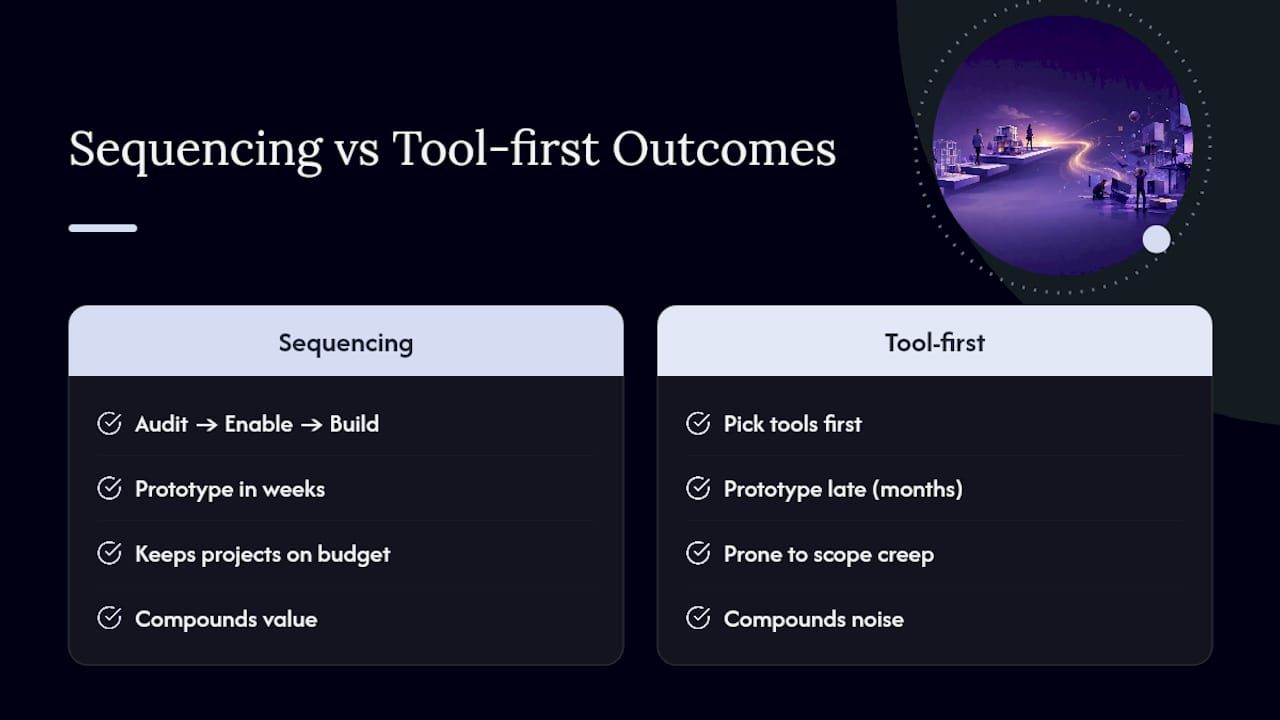
Kreante works outcome-first: audit where AI actually pays off, enable your team to run it, then build the smallest system that gets you there. That sequencing, paired with a prototype in weeks rather than months, is what keeps 265+ delivered projects on budget instead of drifting into scope creep.
A short scoping engagement with Kreante produces the same core deliverables this article walks through: an audit of where the system needs to work harder, a prioritized roadmap tied to expected return, and a clickable prototype, usually within a few weeks rather than months. You keep the code outright, and support continues after launch instead of ending at handoff.
The AI solutions development services page walks through how that engagement runs, and the DAVCO AI project shows what the output looks like once it ships. If you’re weighing an internal build against bringing in a partner, teams handling CRM-heavy integrations often lean on specialists like CRM implementation partners for that specific layer while Kreante handles the broader architecture. Either way, the next move is the same: get a scoping call on the calendar and walk in with your business outcome defined, not your tech stack.
The functional design document (FDD) describes what the system does for the business, including user roles and process flows. The technical design document (TDD) describes how engineers build it, covering architecture, security, and integrations.
A validated spec typically takes a few days to a few weeks, depending on complexity, especially when an AI-generated first draft speeds up the initial round before human review.
Weak scoping is a major driver of budget overruns and rework, while detailed specs cut total development costs by roughly 30 to 50 percent by catching gaps before development starts.
Start with an AI-generated draft to move fast and cheap, then validate it with a technical partner. Kreante uses this hybrid approach to turn a rough blueprint into a build-ready plan and working prototype within weeks.
Ask for a combined FDD/TDD covering project overview, architecture decisions, security, integrations, and data migration, plus clear acceptance criteria tied to measurable performance targets.
Go further
Don't let your tech watch stop here. Explore our other resources to master your technology stack.
DevelopmentDiscover the true costs of AI integration in 2026, including key factors that affect pricing and strategies to minimize spending.
 Development
Discover how to choose effectively between RAG and fine-tuning for your enterprise AI needs, ensuring rapid results and compliance.
 Development
Explore essential trade-offs in multi-tenant SaaS architecture to guide architects in designing efficient, scalable systems for diverse customers.