A two-sided marketplace is a platform that connects two distinct groups, usually buyers and sellers, and makes money by facilitating their transactions rather than owning inventory. The one thing that determines whether yours survives: liquidity, meaning enough active supply and demand that a typical visitor finds a match fast. Get that sequencing wrong and no amount of funding or polish saves you.
The Harvard Business School framework on multi-sided platforms explains why: platforms exist to cut search costs and shared transaction costs between two groups that would otherwise struggle to find each other. Stripe’s own marketplace strategy guide backs this with the same operational lesson, seed the harder side first and use manual matching before automating anything. Kreante has watched this play out directly building projects like Hoopsquad and Shareleads, where the first fifty transactions mattered more than any feature roadmap.
A two-sided marketplace connects two distinct user groups and profits from facilitating their exchange.
Liquidity, not user count, is the metric that predicts survival.
Seed the harder-to-recruit side first, then use concierge tactics to fake the other side until real demand shows up.
Key Takeaways
A two-sided marketplace survives on liquidity, not sign-ups, and that liquidity comes from deliberate sequencing, manual seeding, and price structure decisions made early, not from feature volume.
Point
Details
Liquidity beats vanity metrics
Track search-to-booking and time-to-match from week one instead of counting sign-ups.
Seed the harder side first
Recruit supply manually and fake demand with concierge orders until matches happen without you.
Price structure decides volume
Subsidize the side with higher price sensitivity rather than splitting fees evenly.
Use existing payment rails
Stripe Connect handles KYC, payouts, and split payments so you don’t build custody infrastructure early.
Kreante fits every stage
Consulting maps the roadmap, coaching builds in-house AI-native skills, and the build service ships a working prototype in weeks.
What Is a Two-Sided Marketplace, and How Does It Work?
A two-sided marketplace, sometimes called a multi-sided platform, sits between two groups who need each other but can’t easily transact alone. Airbnb connects hosts and travelers. DoorDash connects restaurants and diners. Upwork connects freelancers and clients. None of these companies own what gets sold. They own the connection, and they charge for making it happen.
That distinction matters more than it sounds. A one-sided model like a retailer buys inventory, marks it up, and sells it. A platform marketplace model never touches the product. It builds the matching layer, the trust layer, and the payment rails, then takes a cut. Margins run higher once volume exists, because the marginal cost of one more match is close to zero.
Most real-world platforms fall into a handful of categories:
Goods resale and reselling — peer-to-peer sales of physical items, from furniture to fashion.
Services and on-demand labor — ride-hailing, freelance work, home repair.
Rental and space — short-term lodging, equipment rental, parking.
Attention and advertising — platforms that match advertisers with audiences.
Financial rails and lending — marketplaces that connect capital with borrowers or investors.
Two-sided platform examples across these categories share one mechanic: network effects. When more sellers join, buyers get better selection, and that pulls in more buyers, which in turn attracts more sellers. That’s the cross-side effect, and it’s the entire reason venture investors chase these models. The economics literature on two-sided markets also flags a same-side effect that cuts the other way: too many sellers competing for the same buyers can lower each seller’s odds of a sale, which is why ranking and curation policies exist from day one, not as an afterthought.
Why Build a Two-Sided Marketplace? The Business Case
The appeal isn’t abstract. Once a marketplace reaches liquidity, its gross margins tend to run higher than an inventory-based business, because it isn’t carrying the cost of goods, storage, or logistics risk. It’s selling access to a matched transaction. That’s a fundamentally different cost structure, and it’s why marketplace businesses can scale revenue faster than headcount.
The benefits of a two-sided marketplace show up in three places. First, monetization flexibility: you can charge a transaction fee, a subscription, a listing fee, or some blend, and you can change that mix as the business matures. Second, defensibility: once both sides have invested time building profiles, reviews, and history on your platform, switching costs rise for both groups simultaneously, not just one. Third, compounding data: every transaction improves your matching, which improves conversion, which attracts more of both sides.
Statistic callout: According to the Rochet and Tirole framework, platform volume depends less on the total fee charged and more on how that fee is split between the two sides, meaning the exact same revenue target can produce wildly different transaction volumes depending on who pays what.
Higher margin potential once liquidity is reached, since there’s no inventory to carry.
Multiple monetization levers that can shift as the business matures.
Defensibility built from switching costs on both sides, not just one.
Compounding data advantage: more transactions mean sharper matching over time.
How Does Two-Sided Market Pricing Actually Work?
This is the part most founders skip, and it’s the part that decides whether a marketplace ever reaches liquidity. The foundational insight, laid out by Jean-Charles Rochet and Jean Tirole, is that two-sidedness isn’t about the platform’s total fee. It’s about price structure, meaning which side pays, how much, and in what form.
That single idea explains why so many marketplaces subsidize one side almost entirely. Credit card networks charge merchants and give cardholders rewards. Free-to-use apps monetize advertisers while users pay nothing. In marketplace terms, you generally have two fee structures to choose between:
Membership or subscription fees — a flat charge for access, independent of usage, common when transaction value is unpredictable or hard to track.
Usage or transaction fees — a per-transaction cut, common when each transaction has a clear, trackable value.
The practical takeaway for a founder pricing a new platform: subsidize the side with the highest price sensitivity, or the side whose presence unlocks transactions for the other. If suppliers are scarce and hard to recruit, waive their fees or pay them directly for early listings while charging buyers a modest transaction fee. If buyers are the scarce resource, flip it. This isn’t guesswork if you treat it as a genuine pricing experiment: Stripe’s guidance on marketplace pricing recommends testing which side absorbs a fee change while holding total platform revenue steady, so you can isolate real elasticity differences fast rather than debating them in a conference room.
How Do You Solve the Chicken-and-Egg Problem?
Every two-sided marketplace faces the same paradox at launch: buyers won’t show up without sellers, and sellers won’t show up without buyers. Solving it is less about clever code and more about founder legwork, and it’s the single biggest predictor of which startups in this category actually make it past year one.
Liquidity, not sign-up count, is the metric that matters here. A thousand registered users who never transact tell you nothing. A platform where a search reliably turns into a booking within minutes tells you everything. Stripe’s operational research on marketplace sequencing recommends instrumenting search-to-booking rates from the very first week, because that ratio predicts survival far better than raw traffic.
Here’s the sequence that tends to work:
Pick the harder side to recruit and seed it manually. In most categories that’s supply. Recruit 50 to 200 suppliers directly, by phone or in person, before writing a line of matching logic.
Fake the other side if you have to. Place concierge orders yourself, manually match requests by text or email, and don’t apologize for the friction. Founders often waste weeks polishing features that only matter once real liquidity exists.
Borrow supply from adjacent platforms or existing communities where your target sellers already gather, rather than building a following from zero.
Deliver single-player value where possible, so the first side gets something useful even before the second side shows up (a scheduling tool, a storefront, a portfolio page).
Switch to productized flows only once matches happen consistently without your intervention.
Pro Tip:Track how many transactions you personally had to broker by hand each week. The week that number hits zero without you noticing is the week you’ve actually found liquidity, not before.
What Product and Payment Features Do You Need at Launch?
The MVP for a two-sided marketplace is smaller than most founders think, and the temptation to add “just one more feature” before launch is the fastest way to delay your first real transaction. Strip it down to what actually moves a match from search to completed transaction.
On the product side, you need profiles for both sides, searchable listings, a messaging layer, and a checkout flow that doesn’t require a phone call to complete. That’s genuinely most of it. Reviews and verification badges matter, but they matter after transactions start happening, not before.
Profiles and listings that are searchable and filterable by the criteria buyers actually use.
In-platform messaging, so negotiation and coordination don’t leak to text or email immediately.
A checkout flow that handles the full transaction without manual intervention.
Review and rating systems that build trust signals after the first transactions land.
Light-touch verification (identity checks, background checks where relevant) scaled to transaction risk.
Payments are where founders most often overbuild. Stripe Connect is the standard integration path for a reason: it handles seller onboarding, identity verification (KYC), split payments between platform and seller, and payout scheduling, all without you building custody infrastructure from scratch. Trying to build your own escrow and payout system before you’ve proven demand is one of the most common ways early-stage marketplace budgets get burned.
Statistic callout: Platforms that route payouts through an established rail like Stripe Connect typically launch their payment flow quickly, because the KYC, compliance, and payout logic already exist as a managed service rather than custom code you own and maintain.
Kreante’s PayEwe case study shows this pattern in practice: building the trust and payment layer with no-code tooling first, then hardening it once transaction volume justified the investment.
Which Monetization Model Should You Choose?
The transaction fee is the default starting point for most marketplaces, and for good reason: it only charges when value actually changes hands, which keeps early adoption friction low. The take rate, meaning the percentage the platform keeps, directly shapes participant behavior. Set it too high early and you push transactions off-platform; set it too low and you can’t fund growth.
Transaction fees fit almost every early-stage marketplace because they align platform revenue with actual value delivered.
Subscriptions or listing fees make sense once supply has predictable, repeat usage patterns worth paying for access to, not per transaction.
Advertising works once you have enough traffic that sellers will pay for placement above organic results.
Financial or managed services (lending, insurance, logistics) tend to arrive later, once transaction data lets you underwrite risk confidently.
Stripe’s practitioner notes on marketplace monetization point out that mature platforms rarely rely on transaction fees alone. They layer in financial tools or managed services precisely because a single take rate has a ceiling, and diversifying revenue reduces dependence on any one fee staying politically acceptable to your user base.
The guardrail: never raise fees in a way that makes going around your platform cheaper than staying on it. Test fee changes on a small cohort first, and watch for a drop in repeat bookings before rolling anything out platform-wide.
How Do You Get Your First 100 Transactions?
Growth in a two-sided marketplace isn’t a single funnel, it’s two funnels that have to stay roughly in balance. Get too far ahead on one side and you waste acquisition spend on people who bounce because there’s nothing to match with.
Start by deciding which side to prioritize, and that decision should follow directly from your chicken-and-egg analysis: whichever side was harder to seed initially usually needs continued hands-on attention longer, while the easier side can often be acquired through more scalable channels.
Direct outreach for supply. Cold calls, in-person visits, or founder-led sales for your first cohort of sellers or providers, because no ad budget replaces a founder closing the first 50 accounts personally.
Partnerships for distribution. Existing communities, trade associations, or complementary platforms can hand you a warm audience faster than paid channels. If you’re targeting a B2B audience specifically, understanding how enterprise buying committees actually evaluate vendors changes how you pitch supply-side partnerships.
Paid acquisition for demand, once your supply density in a given geography or category is strong enough that a paid visitor’s first search actually returns a good match.
Referral loops that reward both sides, structured so the incentive cost doesn’t erode your take rate faster than the new transactions it generates justify.
Localization and density before breadth. Win one city, one category, or one niche completely before expanding, because a marketplace that’s 20% liquid in ten markets is weaker than one that’s 90% liquid in one.
Pro Tip:Cap your referral incentive at a fraction of your average take rate per transaction, and track whether referred users actually transact more than once. A referral program that only produces one-time users is a discount program wearing a growth hat.
If you’re weighing whether to build this growth engine with an in-house hire, a co-founder, or an outside team, the trade-offs are laid out clearly in this look at the early-stage founder’s build decision.
What Metrics Actually Show a Marketplace Is Working?
Vanity metrics kill marketplaces slowly, because they look like progress right up until the day they don’t. Sign-ups, downloads, and page views tell you almost nothing about whether your platform actually works. What matters is whether a search on one side reliably becomes a completed transaction, and how fast.
Liquidity (search-to-booking rate) is the single most important number, because it directly measures whether supply meets demand.
Time-to-match shows how long a buyer waits between searching and getting a response, a proxy for how “alive” your supply side feels.
Repeat rate on both sides indicates whether the marketplace delivers ongoing value or just a one-time novelty.
Take rate versus off-platform rate tells you whether your fee structure is sustainable or pushing users to transact around you.
CAC per completed transaction, not per sign-up, is the number that actually determines unit economics.
Metric
What it tells you
Search-to-booking rate
Whether demand can actually find and close with available supply
Time-to-match
How responsive your supply side is in practice
Repeat transaction rate
Whether users come back without new acquisition spend
Off-platform rate
Whether your fees are pushing transactions around the platform
Supply churn
Whether sellers are staying active or dropping off after onboarding
Instrument these funnels from week one, not after your first funding round. Stripe’s operational research recommends setting intervention thresholds early, meaning a specific search-to-booking rate below which you pause growth spend and go fix liquidity manually before spending another dollar on acquisition.
What Risks Threaten a Marketplace as It Scales?
Growth exposes problems that low volume hides. The most common failure mode is liquidity fragmentation, where a platform that worked in one city or category can’t replicate that density elsewhere, leaving pockets of strong supply next to dead zones of none. Ranking rules and curation policies exist specifically to manage this, surfacing the best matches instead of drowning users in undifferentiated listings.
Disintermediation is the second major risk: once two parties meet through your platform, nothing stops them from transacting directly next time and skipping your fee entirely. The network effects literature frames this as a same-side and cross-side balancing act, where the value you add (trust, payments, dispute resolution, discovery) has to stay worth more than the fee you charge, or users route around you.
Liquidity fragments across geographies or categories faster than most founders expect; solve it with ranking and curation, not just more supply.
Disintermediation risk rises with transaction value and repeat frequency, since high-value repeat relationships have the most incentive to go direct.
Regulatory exposure grows with scale, particularly around worker classification, payments licensing, and tax reporting obligations tied to marketplace facilitator rules.
Same-side competition among suppliers can turn toxic if left unmanaged, discouraging the very sellers you worked hardest to recruit.
Monitor these before they become existential. A platform that ignores fragmentation until churn spikes, or ignores regulation until a state agency sends a letter, is reacting instead of managing.
How Has Kreante Helped Founders Build Marketplaces?
Theory only gets a founder so far. What actually separates marketplaces that reach liquidity from ones that stall is execution speed on the unglamorous parts: onboarding flows, payment wiring, and the first hundred manually brokered matches.
Kreante’s work on Shareleads focused on exactly that gap. The project needed a matching and referral mechanism that created real value for both sides of the exchange before either side would trust the platform with volume, and the build prioritized that trust layer over cosmetic features.
Hoopsquad presented a different problem: connecting groups around a shared activity, where the product had to work for organizers and participants simultaneously. Kreante’s approach there mirrored the seed-one-side-first playbook, building the tooling that made it easy for organizers to list and manage groups before layering on discovery for participants.
Founders consistently underestimate how much of the first ninety days is manual operations disguised as product work. The platforms that survive are the ones whose builders treat that manual phase as data collection, not as a failure to automate fast enough.
Projects like CartelOne, Amazoni, and Davco AI followed the same discipline: start from the specific business outcome, whether that’s transaction volume, conversion, or hours saved on manual matching, and build backward to the smallest system that produces it, rather than shipping every feature a roadmap could theoretically support.
Legal and Regulatory Considerations for Marketplace Founders
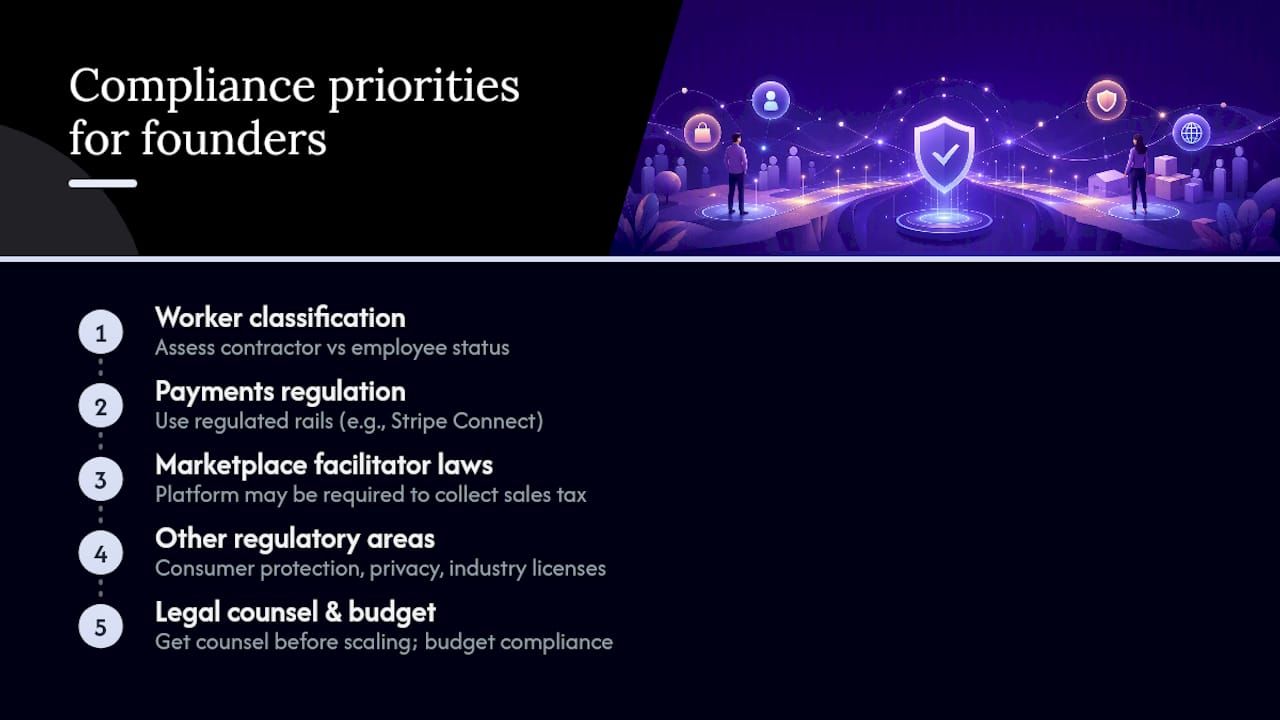
Two-sided marketplaces sit at the intersection of several regulatory regimes at once, and the exposure grows with transaction volume, not with intent. Worker classification is the most common trip wire in service marketplaces: whether the people fulfilling demand are treated as independent contractors or employees carries real payroll tax and benefits consequences that vary by jurisdiction and by how much control the platform exercises over how work gets done.
Payments regulation is the second area to watch closely. Handling money between two parties, even briefly, can trigger money transmitter licensing requirements in some states unless the platform routes payments through a regulated intermediary. That’s a core reason platforms lean on rails like Stripe Connect rather than building custody infrastructure themselves, since the payment processor absorbs much of that licensing burden as part of its service.
Marketplace facilitator laws add a third layer, particularly for platforms that touch sales tax. Many states now require the platform itself, not the individual seller, to collect and remit sales tax on transactions above certain thresholds. Consumer protection rules, data privacy obligations, and, in some categories, industry-specific licensing (transportation, lodging, financial services) round out the list.
None of this should stop a founder from building. It should shape the order in which you tackle compliance: get a qualified attorney’s read on worker classification and payments licensing before you scale past your first market, not after a regulator flags it. Treat this as a real line item in your launch budget, not an afterthought bolted on once growth creates the exposure.
How Do You Build Trust and Handle Disputes on a Marketplace?
Trust is the actual product in a two-sided marketplace. Buyers and sellers who don’t know each other need a reason to believe the other side will show up, deliver as promised, and behave reasonably if something goes wrong. Every design decision, from verification to dispute resolution, exists to manufacture that confidence at scale.
Start with layered verification scaled to transaction risk. A marketplace for used furniture needs less identity verification than one for in-home services or high-value rentals. Reviews and ratings, visible transaction history, and response-time badges all signal reliability before a transaction even begins, and they matter more than any single feature you could build.
Disputes are inevitable, and how you handle the first few sets the tone for your entire community. A clear, published policy for refunds, cancellations, and quality complaints, enforced consistently, does more for trust than an elaborate insurance product ever will. Many marketplaces hold funds briefly (an escrow pattern) until the buyer confirms satisfaction, which gives you a natural intervention point before money changes hands irreversibly.
Set clear escalation paths: a self-service resolution flow for minor issues, backed by human review for anything involving money above a set threshold or repeated complaints against the same account. Track dispute frequency per seller and per category as an operational metric, not just a support ticket count, because a spike there usually signals a supply-quality problem before it shows up anywhere else in your dashboard.
What Technology Choices Support Marketplace Scalability?
Most two-sided marketplaces don’t need custom infrastructure at launch, and building it prematurely is one of the more expensive mistakes founders make. The core technical challenge is a matching engine, search and filtering, real-time messaging, and payment processing, and each of those has mature tooling available rather than requiring a ground-up build.
Search and matching logic should start simple: filterable listings with clear categories often outperform an elaborate recommendation engine in the early months, because you don’t yet have enough transaction data to train anything meaningful. AI-driven matching and recommendations become genuinely valuable once you have enough volume to learn from, not before.
Scalability challenges tend to show up in three places as volume grows: database performance under concurrent search load, messaging infrastructure that needs to handle real-time notification at scale, and payment reconciliation across a growing number of sellers with different payout schedules. Architecting for horizontal scaling from day one, using managed cloud infrastructure rather than a single server, avoids a painful mid-growth migration.
The bigger technical risk isn’t choosing the wrong database. It’s over-engineering before liquidity exists. A marketplace that spends its first six months building a proprietary matching algorithm instead of manually brokering its first fifty transactions has usually optimized the wrong problem.
What Can Failed Marketplaces Teach New Founders?
Marketplace failures share a small number of root causes, and almost none of them are “the technology didn’t work.” The most common one is never reaching liquidity: platforms that launched broad, across many cities or categories at once, and ended up thin everywhere instead of dense somewhere. Spreading supply and demand acquisition budget across ten weak markets almost always loses to concentrating it in one strong one.
A second pattern is pricing that killed the very liquidity it was meant to fund. Marketplaces that charged a high take rate before proving repeat value gave both sides a reason to meet once and then transact directly afterward, which is the disintermediation risk in its purest form. By the time the founders noticed the off-platform rate climbing, the trust and habit that would have justified the fee had already eroded.
A third pattern is trust failure at the wrong moment: a marketplace that scaled transaction volume faster than its dispute resolution and verification systems could handle. A handful of bad early experiences, unresolved publicly or handled inconsistently, can undo months of acquisition spend, because trust in a two-sided platform is fragile precisely because neither side has an independent way to verify the other.
The lesson underneath all three: liquidity, pricing discipline, and trust infrastructure aren’t sequential nice-to-haves you add once you’re big. They’re the actual product, and skipping any one of them to move faster on growth tends to catch up with a marketplace exactly when it can least afford it.
A Founder’s Honest Take on What Actually Works
Most founders fail at this not because they picked the wrong idea, but because they tried to build the whole platform before proving one match could happen reliably. The economics literature is right that price structure and network effects decide long-term outcomes, but in the first ninety days, none of that matters if you haven’t manually brokered a single transaction yourself.
The experiment worth running first: recruit 20 to 50 suppliers by hand, in your target category, and personally fake the demand side through concierge orders or direct outreach for a month. Measure only one thing: how many of those interactions become a real transaction without your intervention by week four. That number tells you more than any deck.
Kreante typically engages in that order too: consult on where the leverage actually is, coach the founding team to run that experiment themselves, and only bring in a build partner once the liquidity signal is real and the system needs to scale past what manual matching can handle.
Which Kreante Service Fits Your Marketplace Stage?
If you’re still validating whether your idea can reach liquidity, Kreante’s consulting engagement maps where the highest-leverage build actually is, before you spend a dollar on development, so you get a prioritized roadmap instead of a guess. Once you know your MVP scope, from matching logic to payment wiring, the build service moves fast: a working prototype in weeks using the same senior team and lowcode/AI tooling behind the AI solutions development work Kreante has delivered across 265+ projects in 35 countries.
What separates this from a traditional dev shop is what happens after launch. You own the code outright, and the team stays engaged post-launch instead of disappearing after the invoice clears, which matters enormously for a marketplace where your matching logic and payment flows need continuous tuning as liquidity grows. The Davco AI project shows what that AI-driven build work looks like in practice, tracking outcomes in revenue uplift, margin, and hours saved rather than feature counts.
If you’ve got a marketplace concept and you’re deciding between hiring a founding engineer or bringing in a build partner for the first version, start with a scoping conversation. Reach out through Kreante to map your specific liquidity bottleneck and get a build estimate for the smallest system that gets your first hundred transactions done.
On the operational side, Stripe’s marketplace strategy guide remains the clearest practitioner reference for sequencing, payments integration, and KPI instrumentation.
Ride-hailing apps, short-term rental platforms, and freelance work platforms are all two-sided marketplaces because they connect two distinct groups (drivers and riders, hosts and guests, freelancers and clients) and earn revenue from facilitating the transaction rather than owning the underlying product or service.
Amazon’s marketplace business, where third-party sellers list products for buyers, functions as a two-sided market, though Amazon also operates a traditional retail arm where it buys and resells inventory directly, making it a hybrid model rather than a pure marketplace.
The core theory, developed by Jean-Charles Rochet and Jean Tirole, holds that a platform’s price structure (who pays and how much) determines transaction volume more than the total price charged, and that platforms often need to subsidize the side whose participation unlocks value for the other.
Recruit whichever side is harder to acquire, which is usually supply, and seed it manually before building automated matching, since a marketplace with strong supply and weak demand can fake demand temporarily, but a marketplace with no supply has nothing to show early users at all.
There’s no fixed timeline, but founders should treat the initial period as a manual-matching experiment, tracking whether search-to-booking rates improve without direct intervention, and adjusting supply-side incentives until that ratio holds on its own.



 Industry