Subscription Billing Platforms: The 2026 Shortlist
Compare Chargebee, Recurly, Stripe Billing, Zuora and Maxio, and pick the subscription billing platform that fits your biggest operational risk.
Tools
KreanteAugust 7, 20262 months ago
The right subscription billing platform depends almost entirely on one question: what is your biggest operational risk right now? Here is the short answer before you read further.
Best overall (pricing flexibility + scale): Chargebee. Complex B2B catalogs, hybrid billing, and multi-entity support in one package. Best for revenue recovery: Recurly. If involuntary churn is costing you sleep, Recurly’s dunning engine is the strongest on this list. Best for a fast start: Stripe Billing. Payments and billing on one platform, zero extra vendor to manage. Start here if your plans are straightforward. Best for enterprise quote-to-cash: Maxio (formerly Chargify). Contract-level billing, product catalogs, and finance-ready reporting built for complex B2B. Best for custom or compliance-driven needs: Kreante custom implementation. When your pricing model, data-residency rules, or proprietary integrations do not fit a packaged platform, a purpose-built solution is the lower-risk path.
If you have fewer than three plan types and no usage-based pricing, go straight to Stripe Billing and skip the evaluation process below. Everyone else should work through the comparison and buying guide that follows.
How do the top subscription billing platforms compare?
The table below maps each platform across the dimensions that most directly affect your buying decision. Ratings are qualitative and drawn from vendor documentation, G2 user reviews, and Gartner’s recurring-billing market reviews.
Platform
Best for
Pricing model
Billing models
ASC 606 support
API/dev experience
Integrations
International
Security
Implementation time
Support
Stripe Billing
Simple subscriptions, fast start
Flat % + per-transaction
Fixed, usage-based, metered
Limited native; GL needed
Strong
Good (Stripe ecosystem)
Strong (100+ currencies)
PCI DSS, SOC 2
Days to weeks
Docs + email
Chargebee
Mid-market, complex catalogs
Tiered SaaS plans + %
Fixed, usage, hybrid, multi-entity
Good (RevRec module)
Strong
Strong (Salesforce, NetSuite, QuickBooks)
Strong (multi-currency, tax)
PCI DSS, SOC 2
2–8 weeks
CSM, professional services
Recurly
Consumer SaaS, churn-focused
% of revenue + base fee
Fixed, usage, hybrid
Moderate
Good
Good (Salesforce, HubSpot, Avalara)
Good
PCI DSS, SOC 2
2–6 weeks
CSM on higher tiers
Zuora
Enterprise, complex contracts
Quote-based
Fixed, usage, hybrid, multi-element
Strong (native RevRec)
Moderate
Strong (Salesforce, SAP, Oracle)
Strong
PCI DSS, SOC 2
3–6 months
Dedicated CSM, PS
Maxio
B2B SaaS, quote-to-cash
Quote-based
Fixed, usage, contract-level
Good
Moderate
Good (Salesforce, QuickBooks, Xero)
Moderate
PCI DSS, SOC 2
4–12 weeks
CSM, PS available
ChargeOver
SMB, accountant-friendly
Flat monthly fee
Fixed, usage
Limited
Moderate
Good (QuickBooks, Xero, Stripe)
Limited
PCI DSS
1–3 weeks
Email + phone
Zoho Billing
Zoho-stack users, SMB
Flat monthly fee
Fixed, usage
Limited
Moderate
Strong within Zoho; limited outside
Good
PCI DSS, SOC 2
1–3 weeks
Standard Zoho support
Sage Intacct
Finance-first, GL-native
Quote-based
Fixed, milestone
Strong (native GL)
Moderate
Strong (Salesforce, ADP, Avalara)
Good
PCI DSS, SOC 2
6 weeks
Dedicated support
Younium
Mid-market B2B SaaS
Quote-based
Fixed, usage, hybrid
Good
Good
Good (Salesforce, HubSpot, NetSuite)
Good
SOC 2
4–10 weeks
CSM
Kreante (custom)
Complex/proprietary needs
Project-based
Any model you define
Fully configurable
Full ownership
Any system
Any requirement
Configurable
8–20 weeks
Post-launch SLA
Key callouts:
Chargebee’s catalog flexibility is its clearest advantage; its published pricing tiers make TCO modeling easier than most competitors.
Stripe Billing reduces time-to-market because payments and billing live on the same platform, eliminating a separate vendor relationship at early scale.
Zuora’s native RevRec module is the most mature for multi-element contract accounting, but the implementation timeline reflects that depth.
Sage Intacct approaches billing from the GL side, not the billing side, which makes it the right anchor for finance-first organizations but a poor fit for product-led growth teams.
Kreante is the only option here where every architectural decision, data model, and integration is yours to own outright.
Platform profiles: what each option actually delivers
Stripe Billing
Stripe Billing is the default starting point for most early-stage and mid-size companies because payments and billing are unified on one platform. You do not need a separate billing vendor, a second API contract, or a migration plan for stored payment methods.
Revenue recognition: — Limited native ASC 606 support; most teams connect Stripe to a GL or a dedicated RevRec tool for audit-ready reporting.
Integrations: Deep within the Stripe ecosystem; connects to QuickBooks, Xero, and major ERPs via third-party connectors. The Stripe Atlas partnership also gives early-stage founders access to discounted tooling.
Best for: Companies with straightforward plans that want the fastest path to live billing. Watch out for: RevRec gaps at audit time and per-transaction costs that can exceed flat-fee platforms at scale.
Chargebee
Chargebee earns the “best overall” tag because it handles the widest range of billing complexity without requiring enterprise-level procurement. Its product catalog supports multi-entity, multi-currency, and hybrid billing models that most mid-market SaaS companies eventually need.
Revenue recognition: A dedicated RevRec module handles deferred revenue and contract modifications; still requires GL sync for full audit readiness per ASC 606 best practices.
Best for: Mid-market SaaS with complex pricing catalogs, multi-currency needs, or plans to add usage-based tiers. Watch out for: Dunning performance is solid but not Recurly’s equal; if failed-payment recovery is your primary concern, test both.
Recurly
Recurly’s reputation is built on one thing: getting money back that would otherwise be lost to failed payments. Its intelligent retry logic and dunning workflows are the most configurable on this list, and third-party comparisons credit it with recovering meaningfully more revenue than standard retry schedules.
Developer experience: — Good REST API; G2 reviewers note slightly less flexibility on plan changes and order history compared to Chargebee.
Integrations: — Salesforce, HubSpot, Avalara, Braintree, and Stripe as a gateway.
Best for: Consumer SaaS and subscription businesses where involuntary churn is the top financial risk. Watch out for: Catalog flexibility is narrower than Chargebee; complex hybrid pricing models may require workarounds.
Maxio (formerly Chargify)
Maxio targets B2B SaaS companies that have outgrown simple billing but are not yet at Zuora scale. Its quote-to-cash and product-catalog features cover pricing, quoting, billing, collections, and finance reporting in one platform.
Developer experience: — Moderate; functional API but less developer-centric than Stripe or Chargebee.
Best for: B2B SaaS companies with complex product catalogs, contract-level billing, and a need for finance-ready reporting without full enterprise overhead.
ChargeOver
ChargeOver is a straightforward, accountant-friendly platform built for SMBs that bill on recurring schedules and need clean QuickBooks or Xero sync. It does not try to be an enterprise platform, which is exactly why it works well for its target buyer.
Integrations: — QuickBooks, Xero, Stripe, and Authorize.Net.
Best for: SMBs with straightforward recurring billing and an existing QuickBooks or Xero workflow.
Zoho Billing
Zoho Billing makes the most sense if you are already running on the Zoho stack (CRM, Books, Inventory). Outside that ecosystem, its integration depth drops off sharply.
Developer experience: — Moderate; Zoho’s API ecosystem is functional but not best-in-class.
Best for: Zoho CRM and Books users who want billing without adding a new vendor.
Kreante (custom implementation)
When none of the packaged platforms fit, the alternative is not a compromise. Kreante builds custom billing systems, subscription portals, and GL-ready integrations from the ground up, with full code ownership and no vendor lock-in. This path makes sense for organizations with proprietary pricing models, data-residency constraints, or AI-driven metering requirements that packaged platforms cannot accommodate cleanly.
How do you choose the right billing platform?
Step-by-step evaluation criteria
Rank your requirements against these dimensions in order of business impact:
Revenue recognition depth. Can it produce auditor-ready ASC 606 reports, or will you need a separate RevRec tool and GL integration? Finance teams frequently underestimate this gap until an audit is in progress.
Global tax and local payment methods. If you sell in more than three countries, verify VAT/GST automation, local payment method support, and whether you need a merchant-of-record model. Paddle’s MoR approach handles tax and compliance across 300+ markets, which simplifies global selling at the cost of reduced control over payment flows.
Questions to ask every vendor on a demo call
Show me how you configure [your specific pricing model] in the product, live, with our data.
Demonstrate how your platform handles a mid-contract price change and the resulting deferred-revenue adjustment.
Walk me through your ASC 606 reporting: what does the deferred revenue schedule look like, and how does it sync to our GL?
Share your uptime SLA and the last 12 months of incident history.
Provide three customer references in our industry and revenue band.
Walk me through your migration approach: how do you handle stored payment method transfer, and what is your rollback plan?
What is included in implementation, and what triggers additional professional-services fees?
Red flags to watch for
Pricing that requires a sales call before any number is disclosed, with no published tier or range.
“RevRec support” that turns out to mean a revenue report, not a deferred-revenue schedule with contract-modification handling.
Single-gateway dependency with no documented path to add a second gateway.
API documentation that is incomplete, outdated, or requires a support ticket to access.
No documented migration support or a migration process that puts all data-transfer risk on your team.
Implementation timelines and cost signals
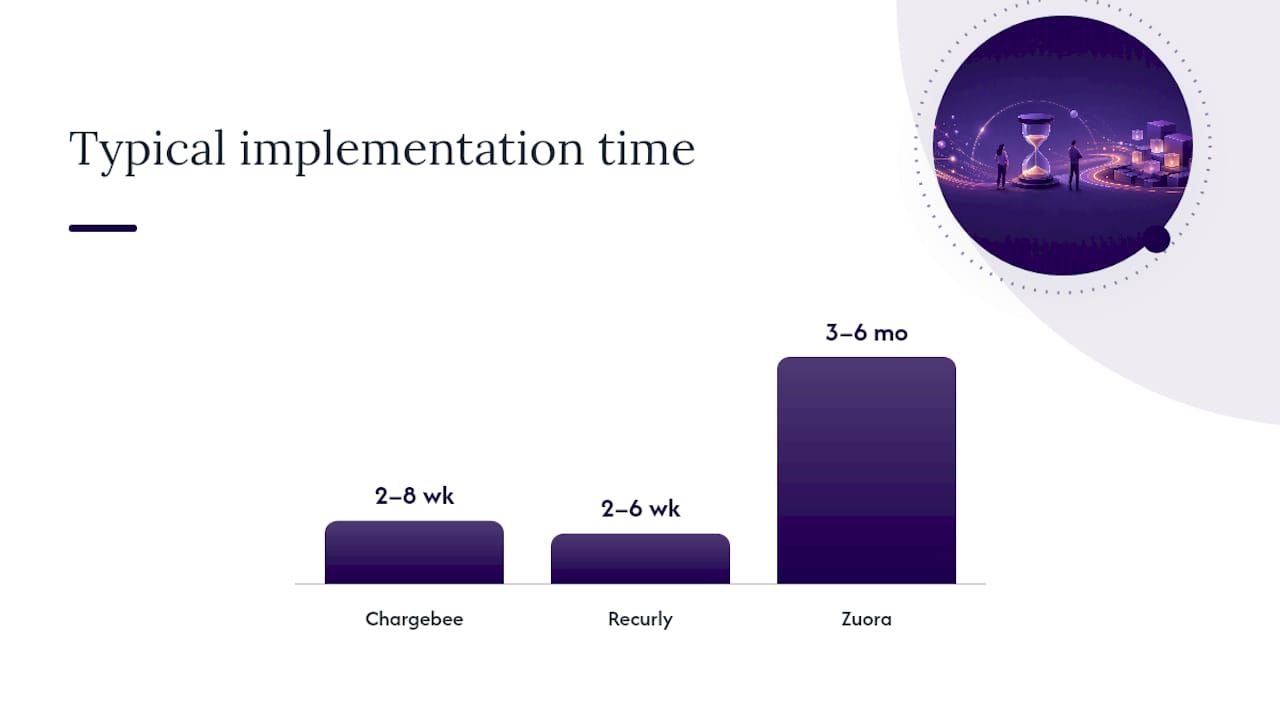
SMB implementations (ChargeOver, Zoho Billing, Stripe Billing) typically run 1–4 weeks with internal resources. Mid-market platforms (Chargebee, Recurly, Younium) run 2–8 weeks and often include a professional-services engagement. Enterprise platforms (Zuora, Sage Intacct) regularly run 3–6 months and carry implementation fees that can match or exceed the first year of platform licensing.
Hidden costs to model: onboarding fees, migration support, add-on modules (RevRec, tax automation, advanced dunning), per-transaction fees at scale, and the engineering time to maintain custom integrations.
Pro Tip:Build a 24-month TCO model before you commit. Include platform fees, transaction fees at projected volume, implementation costs, add-on modules, and the internal engineering hours to maintain integrations. The platform with the lowest headline price is rarely the lowest total cost.
ASC 606 readiness checklist
Before signing, verify these with your finance team and auditor:
Does the platform produce a deferred revenue schedule that ties to your GL?
How does it handle contract modifications (upgrades, downgrades, cancellations mid-period)?
Is the GL sync real-time or batch, and what is the reconciliation process?
Does the platform support multi-element arrangement accounting (bundled products)?
Has the vendor provided references from customers who have completed an ASC 606 audit using the platform’s native reporting?
How we evaluated these platforms
Every platform in this comparison was assessed against the same set of sources: vendor documentation and API references, published pricing pages, Gartner’s recurring-billing application reviews, G2 user-review scores and feature comparisons, third-party analyst comparisons, and publicly available compliance certifications (PCI DSS, SOC 2).
Primary trust signals used:
PCI DSS Level 1 and SOC 2 Type II certifications, verified from vendor security pages.
G2 feature scores for API quality, plan-change flexibility, revenue forecasting, dunning, and churn tracking.
Gartner peer review consensus for market positioning and enterprise readiness.
Published customer case studies for revenue-recovery and implementation claims.
Pricing pages and published fee schedules where available; quote-based pricing is noted explicitly.
Pricing and feature sets change. Verify current terms directly with each vendor before procurement, and re-check this comparison if your evaluation extends beyond 90 days.
When does a custom implementation beat a packaged platform?
Packaged platforms cover the majority of subscription billing use cases well. But there is a real category of organizations for whom the fit is poor enough that buying a platform creates more problems than it solves.
Decision checklist: when to build
Your pricing model involves proprietary entitlements, AI token metering, or consumption logic that no packaged platform supports without significant workarounds.
Data-residency or regulatory requirements (HIPAA, FedRAMP, sector-specific rules) constrain where billing data can live and how it can be processed.
You need deep integration with a proprietary ERP, legacy GL, or internal data warehouse that packaged platforms do not support natively.
Your revenue recognition rules are complex enough that you would need to build custom logic on top of any platform’s native RevRec module anyway.
You are building a platform product where billing is a core feature, not an operational tool, and vendor lock-in is a strategic risk.
What Kreante provides for custom billing projects
Kreante delivers full-stack custom billing systems, subscription portals, and GL-ready integrations, including AI-driven metering for token-based or consumption-based pricing models. The process starts with a business scoping session to map your pricing logic, data flows, and integration requirements, followed by a proof-of-concept to validate the architecture before full build.
Recommended first steps if you are considering a custom path:
Document your pricing model in full, including every edge case and exception.
Map the data flow from billing event to GL entry and identify every system that needs to receive billing data.
Run a proof-of-concept on the highest-risk integration (typically the GL or the payment gateway).
Build a phased migration plan that keeps the existing system live until the new one is validated in production.
Pro Tip:Before committing to a custom build, run the same 24-month TCO model you would for a packaged platform. Include build cost, ongoing maintenance, and the value of features you would not need to build yourself on a SaaS platform. The decision is often closer than it looks.
Key Takeaways
The best subscription billing platform is the one that matches your primary operational risk, not the one with the longest feature list.
Point
Details
Match platform to your top risk
Pricing complexity points to Chargebee; involuntary churn points to Recurly; fast start points to Stripe Billing.
ASC 606 is rarely plug-and-play
Even platforms with native RevRec modules typically require a GL integration for full audit readiness.
Model 24-month TCO before signing
Transaction fees, add-on modules, and implementation costs routinely exceed headline platform pricing at scale.
Enterprise timelines are long
Zuora and Sage Intacct implementations regularly run 3–6 months; plan procurement and go-live dates accordingly.
Kreante for custom needs
When proprietary pricing models, data-residency rules, or AI metering requirements do not fit a packaged platform, a custom build is the lower-risk path.
The gap between billing platform promises and what actually matters
Most subscription billing platform evaluations go wrong in the same place: teams spend 80% of their time comparing feature checklists and 20% on the two questions that actually determine whether the implementation succeeds. Those questions are: how does this platform handle our specific pricing edge cases, and what does our auditor need to see from the revenue recognition output?
The feature checklist problem is real. Every platform on this list claims to support usage-based billing, multi-currency, and ASC 606. What that means in practice varies enormously. One platform’s “usage-based billing” is a metered counter with a flat rate. Another’s is a full consumption-based pricing engine with tiered rates, minimum commitments, and mid-period adjustments. The only way to know which you are buying is to configure your actual pricing model in a sandbox before you sign.
The RevRec gap is where finance teams get surprised. Platforms advertise RevRec support, but what they often mean is a revenue report, not a deferred-revenue schedule with contract-modification handling that an auditor can trace to journal entries. The gap between those two things can cost months of remediation work after go-live. Ask for a live demo of the deferred revenue schedule with a mid-contract modification before procurement, not after.
One observation from projects where the platform choice went well: the teams that succeeded treated the billing platform selection as a finance and engineering decision jointly, not a product decision with finance consulted at the end. The organizations that struggled almost always had a product or engineering team pick the platform based on API quality and developer experience, then handed it to finance to make the RevRec work. That sequence produces avoidable problems.
Kreante builds what packaged platforms cannot
Off-the-shelf billing platforms cover most use cases well. But if your pricing model involves AI token metering, proprietary entitlements, or data-residency requirements that no SaaS platform handles cleanly, you are not choosing between platforms. You are choosing between a series of workarounds and a system built to fit your actual requirements.
Kreante’s custom web and mobile development services cover the full scope of a billing implementation: pricing logic, subscription portal, payment gateway integration, GL-ready revenue recognition, and AI-driven metering for consumption-based models. With more than 265 projects delivered across 35 countries, the team has handled the edge cases that packaged platforms paper over. If you need AI solutions integrated into your billing or metering layer, that capability is part of the same engagement, not a separate workstream.
The starting point is a scoping session to map your pricing model, integration requirements, and audit needs. From there, Kreante delivers a proof-of-concept before full build, so you validate the architecture before committing to production. Get in touch at kreante.co to start the conversation.
Chargebee is the strongest all-round choice for mid-market companies: it handles complex B2B catalogs, hybrid and usage-based pricing, multi-currency and multi-entity setups without enterprise-level procurement, and its published pricing tiers make TCO modeling easier than quote-based competitors.
Recurly. Its intelligent retry logic and dunning workflows are the most configurable on this list, and third-party comparisons credit it with recovering roughly 5-10% more failed revenue than standard retry schedules. If involuntary churn is your top financial risk, start there.
Rarely. Most platforms advertise RevRec support but deliver a revenue report rather than a deferred-revenue schedule with contract-modification handling that an auditor can trace to journal entries. Even platforms with native RevRec modules typically need a GL integration for full audit readiness, so ask for a live demo of a mid-contract modification before signing.
SMB implementations (ChargeOver, Zoho Billing, Stripe Billing) usually run 1-4 weeks with internal resources. Mid-market platforms such as Chargebee, Recurly and Younium run 2-8 weeks and often include professional services. Enterprise platforms like Zuora and Sage Intacct regularly run 3-6 months, with implementation fees that can match the first year of licensing.
When your pricing model relies on proprietary entitlements, AI token metering or consumption logic no platform supports cleanly; when data-residency or regulatory rules (HIPAA, FedRAMP) constrain where billing data can live; when you need deep integration with a proprietary ERP or legacy GL; or when billing is a core product feature and vendor lock-in is a strategic risk.
Conclusion
There is no single best subscription billing platform, only the one that neutralizes your biggest operational risk. If pricing complexity is what slows you down, Chargebee gives you catalog flexibility without enterprise procurement. If involuntary churn is eating your revenue, Recurly's dunning engine pays for itself. If you simply need to bill customers next week, Stripe Billing removes a vendor from the equation. Enterprise contract accounting points to Zuora or Sage Intacct, and B2B quote-to-cash points to Maxio.
Whatever shortlist you end up with, do two things before you sign: configure your actual pricing model in a sandbox, and ask to see a deferred revenue schedule with a mid-contract modification. Those two checks catch the failures that feature checklists never surface. Then build a 24-month TCO model that includes transaction fees at projected volume, add-on modules, implementation costs, and the engineering hours to maintain integrations.
And if the honest answer is that no packaged platform fits, that is a valid outcome rather than a compromise. Proprietary pricing logic, data-residency constraints, or AI-driven metering are exactly the cases where a purpose-built system is the lower-risk path. Kreante builds custom billing systems, subscription portals and GL-ready integrations with full code ownership, starting with a scoping session and a proof-of-concept before full build. Get in touch at kreante.co to start that conversation.


 Tools
Tools