
 Development
Multi-Tenant SaaS Architecture: A Practical Guide
Explore essential trade-offs in multi-tenant SaaS architecture to guide architects in designing efficient, scalable systems for diverse customers.
KreanteAugust 14, 2026Read the article
Discover how to choose effectively between RAG and fine-tuning for your enterprise AI needs, ensuring rapid results and compliance.

Start with RAG. That’s the short answer for most enterprise AI projects. RAG (Retrieval-Augmented Generation) gets you to a working, auditable system in days rather than months, and AWS recommends it as the starting point for question-answering over custom documents precisely because it can incorporate new documents in minutes. Fine-tuning earns its place when you need consistent output format, lower inference latency at scale, or domain-specific behavior that prompt engineering simply cannot produce reliably.
The hybrid pattern is increasingly the production standard. Databricks frames it plainly: RAG provides currency, fine-tuning provides consistency, and many enterprise deployments need both.
RAG is the right starting point for most enterprise AI projects; fine-tuning earns its place only when prompted and retrieval-based approaches hit a ceiling that labeled data and training cost can justify crossing.
| Point | Details |
|---|---|
| Start with RAG | RAG updates knowledge in minutes and requires no labeled data, making it the lower-risk first move. |
| Fine-tune for format and volume | Fine-tuning adds a meaningful improvement in domain accuracy and lowers per-call cost at high inference volume. |
| Combine for best results | Hybrid systems outperform either approach alone; fine-tune behavior, use RAG for fresh facts and citations. |
| Governance favors RAG | RAG supports permissioned retrieval per user; fine-tuned models bake data into weights with no access control post-training. |
| Kreante’s playbook | Kreante applies a three-step sequence (baseline, RAG pilot, selective PEFT) across AI projects to minimize cost and maximize measurable ROI. |
Retrieval-Augmented Generation (RAG) connects a language model to an external knowledge base at inference time. When a user asks a question, the system retrieves relevant document chunks, injects them into the prompt, and the model generates an answer grounded in that retrieved context. The model’s weights never change. You can swap the knowledge base, update documents, or add new sources without touching the model itself.
Fine-tuning modifies the model’s weights by training on a curated dataset of input-output pairs. The domain knowledge gets baked into the model. A fine-tuned GPT-4 variant or a Llama 2 model trained on your internal documentation will answer differently than the base model, because the training changed what the model “knows” at the parameter level.
The one-line technical distinction: RAG is inference-time retrieval; fine-tuning is weight modification at training time.
Parameter-Efficient Fine-Tuning (PEFT) methods like LoRA (Low-Rank Adaptation) make fine-tuning far more accessible. Instead of updating all model parameters, LoRA injects small trainable matrices into the model’s attention layers, cutting GPU memory requirements dramatically while preserving most of the performance gain. LangChain, meanwhile, is the orchestration layer most teams use to wire together retrievers, vector databases, and LLMs in a RAG pipeline.
Three micro-use-cases that make the distinction concrete:
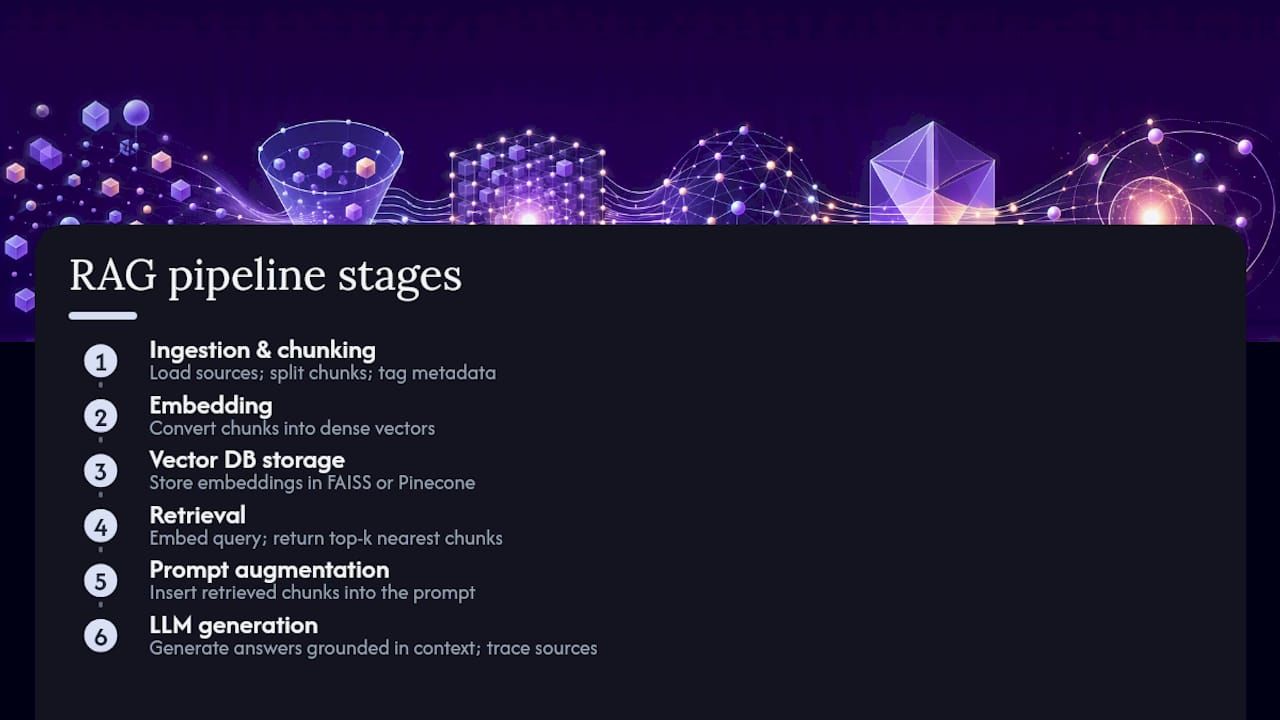
The RAG pipeline has six distinct stages, each with its own engineering decisions.
1. Ingestion and chunking. Source documents (PDFs, wikis, databases, web pages) are loaded and split into chunks. Chunk size matters more than most teams expect: chunks that are too large dilute relevance; chunks that are too small lose context.
2. Embedding. Each chunk is converted into a dense vector representation using an embedding model. The choice of embedding model determines how well semantic similarity maps to retrieval relevance. Models like OpenAI’s text-embedding-3-small or open-source alternatives from the MTEB leaderboard are common starting points.
3. Vector database storage. Embeddings are stored in a vector database. FAISS (Facebook AI Similarity Search) is the standard open-source option for teams that want local control and low latency on smaller corpora. Pinecone is the managed cloud alternative, handling index scaling and real-time updates without infrastructure overhead.
4. Retrieval. At query time, the user’s question is embedded and compared against stored vectors using approximate nearest-neighbor search. The top-k most similar chunks are returned. Retrieval quality is measured by precision@k: how many of the top-k retrieved chunks are actually relevant.
5. Prompt augmentation. Retrieved chunks are injected into the prompt alongside the user’s question. LangChain is the most widely used framework for this orchestration step, handling retriever configuration, prompt templating, and LLM routing in a single pipeline.
6. LLM generation. The augmented prompt goes to the language model (GPT-4, Llama 2, or another hosted model), which generates an answer grounded in the retrieved context.
Pro Tip: Metadata is the most underused lever in RAG. Tag every chunk with document date, source type, and access tier at ingestion time. Filtering by metadata before vector search reduces noise dramatically and lets you enforce access control at the retrieval layer, not just at the UI.
The auditability advantage of RAG is real and often decisive in regulated industries. Because each answer traces back to specific retrieved chunks, you can show auditors exactly which document drove a given response. AWS highlights this traceability as one of RAG’s core enterprise advantages over fine-tuning, where the source of a model’s “knowledge” is opaque once training is complete.
Fine-tuning a model is a three-phase project: data preparation, training, and evaluation. Most teams underestimate the first phase and overestimate the third.
Start by running your prompted baseline model on a representative sample of production inputs. Collect the outputs that fail: wrong format, hallucinated values, incorrect tone, missed fields. These failure cases become your training examples. Label each one with the correct output.
Dataset size guidance:
Three options, each with a different cost-performance profile:
Research on agricultural domain adaptation found fine-tuning produced an accuracy increase on domain-specific tasks, with LoRA and PEFT approaches making that gain accessible without full training runs.
Track three metrics after training: accuracy on your holdout set, format robustness (does the model produce valid JSON/structured output on edge-case inputs?), and regression performance on a general capability suite to confirm you haven’t degraded base model quality. Run these on every checkpoint, not just the final model.
Pro Tip: Build your training set from failure modes, not random samples. A dataset of 300 carefully selected failure cases will outperform 3,000 randomly sampled examples. Failure-mode sampling is the single highest-leverage data decision in a fine-tuning project.
| Dimension | RAG | Fine-tuning |
|---|---|---|
| Best for (use case) | Dynamic knowledge QA, citation-required answers, multi-domain retrieval | Consistent format/tone, structured extraction, high-volume inference |
| Knowledge freshness | Updates in minutes; no retraining needed | Locked to training snapshot; requires retraining to update |
| Control over behavior/tone | Limited; depends on prompt and retrieved context | High; training shapes output style and format directly |
| Inference latency | Higher; retrieval adds 100–300ms per call depending on index size | Lower; no retrieval step; faster at scale |
| Inference cost | Higher per call (retrieval + LLM tokens for context) | Lower per call once trained; upfront training cost amortizes over volume |
| Engineering complexity | Moderate upfront; ongoing index maintenance and refresh pipelines | High upfront (data labeling, training runs); lower ongoing if knowledge is stable |
| Data required | No labeled pairs; only source documents | Labeled input-output pairs; minimum ~200 for simple tasks |
| Traceability / citations | Native; each answer traces to source chunks | None; knowledge is opaque in model weights |
A few rule-of-thumb decisions from this table: if your knowledge base updates more than weekly, RAG is almost always the right call. If you’re running very high-volume structured extraction calls, the per-inference cost savings from a fine-tuned model may offset the training investment over time. If you need to show an auditor which document produced a given answer, fine-tuning alone cannot do that.
The arXiv case study on agricultural LLMs makes the combined case empirically: fine-tuning added a significant accuracy improvement, RAG added a further notable accuracy improvement, and the combination outperformed either approach alone.
The decision comes down to four production signals: how often your knowledge changes, how much labeled data you have, what your latency budget is, and whether you need auditable citations.
Choose RAG when:
Choose fine-tuning when:
Choose a hybrid when:
Google Cloud’s guidance adds a governance dimension that often gets overlooked: RAG supports permissioned retrieval, so different users see answers based only on documents they’re authorized to access. Fine-tuned models bake training data into weights, making per-document access control effectively impossible post-deployment. In any regulated environment where data segregation matters, that distinction can be the deciding factor.
Warning: If your training data contains PII or confidential information, fine-tuning bakes it into the model permanently. There is no “delete” operation on a trained weight. RAG keeps sensitive data in the document store, where standard access controls and deletion policies apply.
Practitioner guides consistently show that prompt engineering handles the majority of cases; fine-tuning should target the persistent, systematic failure modes that remain after prompt optimization and RAG have been applied.
Three hybrid architectures appear repeatedly in production deployments, each solving a different combination of problems.
Fine-tune the base model (using LoRA on Llama 2, for example) on your domain’s reasoning patterns, output format, and tone. Then deploy RAG on top to supply current facts. The fine-tuned model handles “how to think and respond”; the retriever handles “what to say about today’s data.” This pattern works well for financial analysis tools where the analytical framework is stable but market data changes daily.
Train multiple small fine-tuned models, each specialized for a narrow task (invoice extraction, contract summarization, support ticket classification). A lightweight classifier routes each query to the right specialist. Each specialist then calls a RAG layer for domain-specific facts it needs to complete the task. This pattern reduces inference cost significantly compared to routing everything through a large general model, and each specialist is small enough to run on modest hardware.
Use a LoRA adapter to enforce output structure (valid JSON, consistent field names, correct date formats) while RAG supplies the factual content that fills those fields. This is the right pattern for structured document generation in regulated industries: the adapter guarantees the format auditors expect; the retriever guarantees the content is sourced and traceable.
The RAFT paper from Berkeley formalizes this kind of supervised fine-tuning combined with RAG for domain adaptation, providing engineering patterns for orchestrating both systems together.
A practical scenario: a mid-size insurance carrier needed to generate policy summaries that cited specific policy clauses. A prompted GPT-4 baseline produced inconsistent formats and occasionally hallucinated clause numbers. After fine-tuning a Llama 2 variant with LoRA on labeled examples (format and tone only) and adding a Pinecone-backed RAG layer over the policy document corpus, format errors dropped to near zero and every clause reference traced to a retrievable source chunk. The retrieval step added some latency, which was acceptable for the batch generation use case.
Pro Tip: Gate RAG content with a retrieval confidence score before injecting it into the prompt. If the top retrieved chunk scores below your similarity threshold (typically 0.75–0.80 cosine similarity), treat the query as out-of-scope rather than injecting low-confidence content. A model confidently answering from a weakly relevant chunk is worse than a model saying “I don’t have enough information.”
Deploying either approach to production requires more than a working prototype. These are the infrastructure, monitoring, and governance items that separate a demo from a system you can trust.
Google Cloud’s analysis makes the access control difference explicit: RAG permissioning happens at retrieval time, so you can enforce row-level or document-level access controls dynamically. Fine-tuned models have no equivalent mechanism. If a document was in the training set, its information is in the weights, accessible to any user who can query the model.
For PII handling: filter sensitive fields before embedding documents into your RAG index. For fine-tuning datasets, anonymize training examples before labeling. Both steps are easier to implement before training than after.
Empirical research on structured tasks at inference scale found that smaller fine-tuned models sometimes outperformed prompted larger models on code and extraction tasks while running at significantly lower cost per call. That cost gap compounds at production volume.
Pro Tip: Before committing to a fine-tuning run, calculate the break-even point: divide the total training cost (compute + data labeling) by the per-call cost savings versus your current prompted model. If you’re running fewer than 500,000 calls per month, the break-even often exceeds 12 months, and RAG with prompt optimization is the better economic choice.
The practical sequence that produces the best results with the lowest upfront risk follows three steps.
Step 1: Assess via prompted baseline. Before writing a single line of training code, run your best prompt against a representative sample of production inputs. Measure accuracy, format compliance, and latency. This baseline tells you exactly where the model fails and whether those failures are systematic (a fine-tuning candidate) or knowledge gaps (a RAG candidate).
Step 2: RAG pilot with metrics. Build a minimal RAG pipeline: ingest your core documents, embed them, stand up a FAISS or Pinecone index, wire it through LangChain, and measure precision@k and faithfulness on your test set. Most teams see meaningful improvement here without any training. If the RAG pilot closes your accuracy gap, you’re done. If specific failure modes persist, you have your fine-tuning dataset.
Step 3: Selective PEFT on failure modes. Take the cases where RAG still fails, label the correct outputs, and fine-tune with LoRA on that targeted dataset. You’re not trying to teach the model everything; you’re fixing the specific, repeatable failures that the retrieval layer couldn’t resolve.
This sequence minimizes upfront cost and produces better training data because your fine-tuning examples come from real production failures, not synthetic examples. Kreante has applied this playbook across 265+ AI projects in 35 countries, and the pattern holds: teams that skip the RAG pilot and go straight to fine-tuning consistently spend more and get less.
For a concrete example of this approach in practice, the DAVCO AI project illustrates how a structured AI engagement moves from scoping through prototype to production with measurable outcomes at each stage.
If you’re mapping out which approach fits your specific use case, Kreante’s AI solutions team can scope a pilot and give you a roadmap with expected return per initiative, not a generic recommendation.
The RAG vs fine-tuning debate gets framed as a technical question. It’s actually a resource allocation question dressed in technical language.
The real tradeoff isn’t retrieval versus weights. It’s time-to-value versus long-term unit economics. RAG gets you to a measurable result in days. Fine-tuning gets you to a lower per-call cost and more consistent outputs, but only after weeks of data work and training. Most teams that jump straight to fine-tuning do so because it feels more “serious” or “AI-native,” not because the economics justify it at their current call volume.
The other thing practitioners understate: fine-tuning debt. A fine-tuned model is a snapshot. Every time your domain shifts, your product changes, or regulations update, that snapshot ages. The maintenance cost of keeping a fine-tuned model current is real and ongoing. RAG externalizes that cost into document management, which most organizations already know how to do.
Measure ROI on three axes before choosing: accuracy improvement (does it actually solve the problem?), cost per correct answer (not just per call), and time-to-market (how long before this system moves a business number?). The approach that wins on all three is rarely the one that sounds most impressive in a technical review.
Choosing between RAG and fine-tuning is the right question. Getting to a working, production-grade system that actually moves a business number is where most teams stall.
Kreante works as an AI partner for companies that measure success in revenue, margin, and hours saved. The engagement follows the same sequence described in this article: consulting to map where AI pays off and build a roadmap with expected return per initiative, then a working prototype in weeks, then a full production build with a quality guarantee. You own the code outright. Kreante stays after launch.
With 265+ projects delivered across 35 countries, the team has run this playbook on RAG pipelines, fine-tuned specialist models, and hybrid architectures across industries from financial services to logistics. If you want a scoped pilot with measurable KPI targets rather than a slide deck, contact Kreante’s AI solutions team to get started.
For most teams, yes. Prompt engineering and RAG resolve the majority of production failures faster and at lower cost. Fine-tuning is the right tool for persistent, systematic failures that retrieval cannot fix, not a default first step.
A hybrid system that combines fine-tuning with RAG consistently outperforms either approach alone.
Avoid fine-tuning when your knowledge base changes frequently, when you have fewer than 200 high-quality labeled examples, or when your data contains PII that cannot be safely included in a training set. In those cases, RAG with strong prompt engineering is the better path.
Prompt engineering shapes how you ask the model a question without changing anything else. RAG adds external documents to the context at inference time. Fine-tuning changes the model’s weights through training. They operate at different layers: prompt is the input, RAG is the context, fine-tuning is the model itself.
Go further
Don't let your tech watch stop here. Explore our other resources to master your technology stack.
DevelopmentExplore essential trade-offs in multi-tenant SaaS architecture to guide architects in designing efficient, scalable systems for diverse customers.
 Development
Understand the key differences between a prototype and an MVP. Learn how to choose the right approach to validate your product ideas effectively.
 Development
Master software project estimation with proven methods. Use a practical guide to create accurate, defensible estimates and improve team efficiency.