
 Tools
ToolsSoftware Requirements Document: A Practical Guide to the SRS
Unlock software success with a solid requirements document. This practical guide shows you how to create clear, testable specifications.
KreanteAugust 24, 2026Read the article
Discover an effective app growth strategy to boost user retention. Focus on optimizing listings, testing creatives, and improving onboarding.

Prioritize three things this month, in this order: fix your store listing, run one paid creative test tied directly to an onboarding checkpoint, and watch Day-7 retention before you spend another dollar on scale. Everything else, including the channel mix and the referral loop, comes after that sequence proves itself.
Three experiments to run this week:
Global app marketing spend reached a very large amount recently, and a significant portion now goes to remarketing existing users rather than chasing new ones. That split alone tells you where the smart money already moved, and it is not toward blind acquisition, according to Marketing For Apps’ 2026 playbook.
Sustainable app growth comes from sequencing positioning, ASO, and onboarding before paid spend, then scaling only what proven cohort data supports.
| Point | Details |
|---|---|
| Fix the store listing first | ASO changes often convert cheaper installs than early paid spend, so sequence it before scaling ads. |
| Test one paid variant at a time | Isolate a single creative variable and measure it against a holdout group tied to activation, not clicks. |
| Instrument the first meaningful action | Define and measure the one behavior that predicts retention, then strip every step that delays it. |
| Segment by behavior, not demographics | Build lifecycle messaging around product state and drop-off triggers instead of calendar days. |
| Scale on CPRU and cohort LTV | Shift budget from exploration to exploitation only after retained-user data confirms payback. |
Growth compounds when you work the flywheel in order instead of jumping to the flashiest tactic first. Positioning comes first because it decides everything downstream: your ASO keywords, your ad creative angles, and the promise your onboarding has to deliver on. Skip it, and you are optimizing a message nobody asked for.
The sequence looks like this in practice:
Early-stage apps should put most of their budget into the first two stages, since a listing fix or positioning shift can outperform a paid campaign at a fraction of the cost. Store conversion changes often produce larger and cheaper volume than early paid spend for apps still building their install base. Scaling apps flip that ratio, shifting spend toward creative testing and controlled acquisition once retention curves stabilize.
AI changes the pace here more than the substance. It shortens the time between hypothesis and result: faster creative variants, faster audience segmentation, faster A/B read-outs. But the angle, the positioning bet, the actual insight about why a user should care, that still comes from a person who understands the product and its market.
Pro Tip: Run your first paid test before your ASO is finished, and you will misread the data. A weak listing tanks conversion regardless of how good the ad creative is, so fix the storefront first.
Choosing a channel isn’t about where the cheapest installs live. It’s about matching channel intent to what you’re testing.
A paid experiment only means something if you design it like one. Start with a hypothesis (this creative angle will lift Day-1 activation by targeting a specific frustration), build two or three variants that isolate one variable each, and always run a holdout group so you know what would have happened anyway. Set your signal threshold on retained users, not installs. A campaign that generates cheap installs who churn in 48 hours has failed the test, no matter what the CPI dashboard says.
Referral loops deliver some of the best return in the entire growth stack when the reward matches the product’s actual value. A well-built, double-sided referral mechanic beats a generic “invite a friend, get $5” gimmick because the incentive feels native to the experience rather than bolted on. Build the mechanics right:
Your store listing is the highest-leverage asset you own, because it converts intent you already paid to generate or earned organically. ASO drives a large share of organic installs and behaves less like a one-time setup task and more like an ongoing testing program, the same way you’d treat a landing page.
Start with keyword architecture. Pick one primary keyword that matches your core positioning and put it in the title, since that field carries the most ranking weight. Fill the subtitle and short description with long-tail variants that capture specific use cases your primary keyword misses.
Creative assets decide the conversion rate once someone lands on your page:
Run a testing cadence, not a one-off audit. Apple’s custom product pages and Google’s store listing experiments let you A/B test screenshots, icons, and descriptions against live traffic. Mine your one and two star reviews every month. Users tell you exactly what confused them or what they expected and did not get, and that feedback becomes your next headline test.
Pro Tip: Your highest-converting screenshot is rarely your most polished one. It’s the one that answers “what do I actually get” in under two seconds.
Define your first meaningful action (FMA) before you touch a single onboarding screen. The FMA is the specific behavior that correlates with a user sticking around, not just opening the app once. For a fitness app it might be logging one workout. For a marketplace it might be saving one item. Instrument it, then map every step between install and that action, cutting anything that does not serve it directly.
Push notifications that arrive early and deliver immediate, behavior-triggered value measurably lift retention, but only when the opt-in comes after the user has a reason to want them. Blanket permission prompts at launch tend to get denied and rarely get asked for twice.
Segmentation by demographic alone misses most of the signal. Segment by behavior and product state instead: users who completed the FMA but never returned, users who hit a specific feature once and stopped, users on a free trial three days from expiration. Each of those groups needs a different message, and lumping them into one lifecycle campaign wastes the send.
Build your cadence around known drop-off points rather than arbitrary calendar days:
In-app nudges do quieter work than push notifications but often carry more weight, since the user is already inside the product when they see them. A progress bar toward a milestone, a streak counter, a small unlock for consistent use, these mechanics work because they tap into a habit loop rather than interrupting one. Personalization matters here too: a nudge that references what the user actually did (not a generic “come back!”) converts at a noticeably higher rate.
Pro Tip: Build your retention segments around what a user did in their last session, not who they are demographically. Behavior predicts churn far better than age or location ever will.
Pick your monetization lever based on what your usage pattern actually supports, not what’s trendy. A subscription gate works when the app delivers recurring value over months. A feature-based paywall works when one segment of users needs functionality the free tier doesn’t justify building for everyone. A hybrid model, ads for free users and a subscription to remove them, works when your audience skews price-sensitive but your engaged core will pay to upgrade the experience.
The real test of a monetization change is cohort LTV and payback period, not the conversion rate on the paywall screen. Track how long it takes each acquisition cohort to pay back its own acquisition cost, and treat that number as the actual scoreboard.
Scale decisions live or die on post-install behavior. Cost per install alone tells you almost nothing about whether that user sticks around long enough to matter. The metrics that actually predict a healthy scale-up:
| Metric | What it tells you |
|---|---|
| LTV by cohort | Whether a specific acquisition source produces users worth keeping |
| Day-30 retention by channel | Whether cheap installs from a channel are actually sticking |
| CPRU | The true cost of growth once churn is factored in |
| ROAS at Day-90 | Whether ad spend pays itself back within a reasonable window |
Run holdout experiments for at least two to four weeks before calling a winner, long enough to see past the initial novelty spike that inflates early numbers. Shift budget from exploration to exploitation only once a channel or creative proves its contribution to retained users across at least one full cohort cycle, not a single week of encouraging data.
Kreante runs this exact sequence with clients: audit the current funnel, build a roadmap ranked by expected return, ship a working prototype in weeks, then move to full build with post-launch support. The outcome focus stays fixed on revenue, margin, and hours saved rather than vanity metrics.
The apps that grow sustainably are the ones where the team treats measurement as the product, not an afterthought bolted on after launch.
Kreante’s web and mobile app development work and AI solutions sit behind this framework, with case studies like Class2Class and SmartCab showing the audit-to-build path in practice.
Every strong app growth strategy starts with knowing exactly who you’re building for, and “everyone who might want this” is not a segment. Break your addressable market into groups defined by behavior and need, not just demographics: power users who’d pay for depth, casual users who need convenience, and price-sensitive users who churn at the first paywall.

Map each segment against the problem your app solves best. A budgeting app aimed at freelancers with irregular income needs different messaging, different onboarding, and a different pricing model than the same app pitched to salaried employees on a fixed schedule. Trying to serve both with one funnel dilutes your positioning and confuses your ASO keyword strategy, since you end up optimizing for a generic term instead of the specific phrase your best segment actually searches.
Use your existing user data before you guess. Look at which segment has the highest Day-30 retention and the strongest LTV, then double down on acquisition channels and creative angles that reach more people like them. It’s tempting to chase the biggest possible market, but a narrower segment with strong product fit compounds faster than a broad one with mediocre fit.
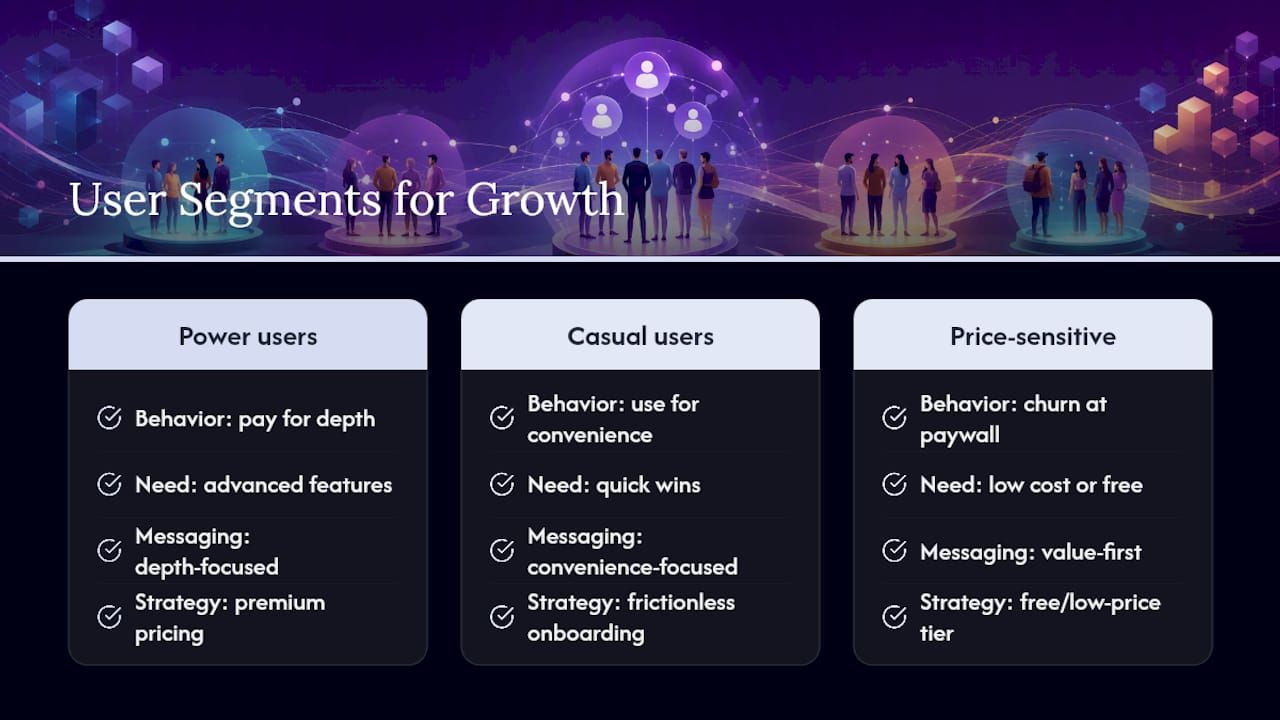
Revisit segmentation quarterly, not once at launch. User bases shift as an app matures, and the segment that got you your first ten thousand installs is rarely identical to the one that will get you your next hundred thousand.
Competitive analysis isn’t about copying a rival’s feature list. It’s about finding the gap they’ve left open. Pull the top five apps competing for your keywords, then read their negative reviews specifically. That’s where you’ll find the friction points and unmet needs your positioning should target directly.
Track their ASO choices too. What primary keyword sits in their title, what their screenshots lead with, whether they emphasize speed, price, or simplicity. If three competitors all lead with “the easiest way to,” there’s likely an opening for a positioning built around depth, control, or a specific use case they’ve ignored.
Positioning is a claim you can defend, not a slogan. “The fastest way to log expenses” only works if your onboarding actually gets a user to their first logged expense faster than the alternative. Test that claim against your own activation data before you put it in a headline.
Watch competitor pricing moves and monetization shifts as leading indicators. A rival dropping their subscription price or adding an ad-supported tier signals something about their retention or acquisition costs; that’s useful intelligence for your own monetization experiments, even if you don’t react immediately.
In-app surveys triggered right after the first meaningful action tend to get better response rates than a generic feedback button buried in settings, because the user’s experience is fresh and specific. Keep the survey to one or two questions. A five-question form after a single session will get ignored or abandoned.
Store reviews double as a feedback channel and an ASO asset. Read every one and tag common complaints so patterns become visible instead of anecdotal, then feed those directly into your product roadmap and your next round of store listing copy.
Set up a lightweight loop: collect feedback weekly, triage it against your retention and activation data monthly, and ship at least one iteration per cycle that directly addresses the top complaint. Users notice when feedback disappears into a black hole, and they notice even more when it visibly changes the product.
Cross-promotion works best between apps that share an audience but don’t compete for the same use case, a fitness tracker and a meal-planning app, for instance, rather than two apps solving the same problem. Swap in-app placements or bundle a feature reference, and both sides get exposure to a pre-qualified audience at close to zero acquisition cost.
Partnerships with creators function similarly but at a different scale. A creator with an engaged, relevant audience delivers a kind of social proof paid ads can’t replicate, since the recommendation comes from someone the audience already trusts. Structure these deals around a specific action (a trackable link, a promo code) so you can measure actual installs and activation, not just impressions.
Brand partnerships and co-marketing campaigns work when both parties’ users overlap meaningfully. Before committing budget or engineering time to an integration, check whether the partner’s audience actually matches the segment you identified earlier. A partnership with impressive reach but the wrong audience is a distraction dressed up as an opportunity.
Localization that stops at translating strings leaves most of the growth opportunity on the table. Currency formatting, date conventions, payment methods, and even color associations shift by market, and getting these wrong signals to a user that the app wasn’t built with them in mind.
Your ASO keyword strategy has to be rebuilt per market, not translated. The term users search for a given category rarely translates literally. Research the actual local search terms rather than running your primary keyword through a translator.
Payment methods matter more than most teams expect. A market where mobile wallets or carrier billing dominate will see weak conversion from an app that only supports credit cards. Check which payment rails matter in each market before you localize a single screenshot.
Prioritize markets using the same cohort data driving your other decisions: look at where organic installs already cluster and where retention holds up best among existing users. Localization is expensive to do well, so sequence it toward markets already showing product fit rather than spreading thin across every language your app store supports.
Most app growth advice treats acquisition and retention as separate departments, one team chasing installs, another team chasing churn. That split is the single biggest reason budgets get wasted. The research backs a different conclusion: ad creative, store listing, and onboarding function as one system, and optimizing any piece in isolation just moves the bottleneck somewhere else.
The conventional wisdom oversells paid acquisition as the growth lever and undersells the store listing. Teams reach for a bigger ad budget when a weak screenshot or a vague app title is quietly capping their conversion rate at half of what it could be. Fix the cheaper problem first.
AI’s role here gets misread in both directions. It’s not a positioning engine, and treating it like one produces generic, forgettable messaging. But dismissing it as a gimmick misses what it’s actually good for: running ten creative variants in the time it used to take to run two, and surfacing segmentation patterns a human would take weeks to spot manually. Use it to widen the funnel of ideas you test, not to write the strategy itself.
If you take one thing from this, take the sequencing: positioning, then store conversion, then a tightly designed paid test, then onboarding, then retention. Referral and monetization experiments only pay off once that foundation holds.
— Jorge Del Carpio
For deeper reference, Marketing For Apps’ 2026 playbook covers channel spend trends. AppsFlyer’s download guide breaks down social proof tactics. Expo’s retention guide details ongoing ASO testing. Airship’s mobile marketing explainer covers push timing. Vmobify’s referral breakdown explains double-sided reward design.
Valuation depends far more on retention, revenue per user, and monetization model than raw user count. An app with a high number of highly engaged, monetizing users can be worth several times more than one with the same install count but weak Day-30 retention, since buyers value cohort LTV over headline numbers.
Growth strategy frameworks vary by source, but the version most relevant to app growth breaks down into market penetration, product expansion, market expansion, and diversification. In practice, most app teams focus first on penetration (winning more of their existing market) before pursuing the other three.
Stages typically include discovery and positioning, prototyping, design, development, testing, launch, and post-launch iteration. The growth work described in this article, ASO, onboarding, retention, largely begins once the app reaches the testing and launch stages, though positioning decisions should start much earlier.
App growth refers to the sustained increase in active users, engagement, and revenue, not just install counts. A true app growth strategy ties acquisition to retention and monetization so that new users convert into long-term value rather than one-time downloads.
Run holdout experiments for at least two to four weeks so early novelty spikes don’t distort the read, then judge the result on retained users and cohort LTV rather than the first week’s cost per install.
Go further
Don't let your tech watch stop here. Explore our other resources to master your technology stack.
ToolsUnlock software success with a solid requirements document. This practical guide shows you how to create clear, testable specifications.
 Tools
ToolsDiscover key AI security risks leaders must address now. Learn to protect data and models from prompt attacks and vulnerabilities.
 Tools
ToolsDiscover effective SaaS pricing models tailored for founders and product managers. Learn how to optimize revenue based on your product's needs.