
 Tools
ToolsWhat Internal Tools Development Actually Requires in 2026
Unlock the secrets of effective internal tools development in 2026. Learn when to build or buy tools for your team's success.
ChristiamAugust 27, 2026Read the article
Learn how to build a mobile app MVP that effectively validates your core idea, ensuring you gather valuable user data without overspending.

A mobile app MVP is the smallest working app that validates one core hypothesis, not a slick mockup or a half-baked feature dump. Pick the single core workflow your first users need, ship it with real functioning code and production polish, and measure whether people actually complete that workflow. If they don’t, you pivot before spending six figures finding out the hard way.
TL;DR:
Most MVPs focus on a single core workflow that solves a specific user problem, avoiding overcomplicating the scope with unnecessary features.
Using no-code or cross-platform frameworks like Flutter can enable fast, production-quality MVPs within 2 to 8 weeks, depending on complexity.
Pre-launch instrumentation, such as tracking activation, retention, and crash rates, is essential for making data-driven decisions on whether to pivot or scale.
Avoid overbuilding or under-scoping, and explicitly define features to exclude early on to prevent scope creep and build an effective MVP.
Focusing on speed and validated learning reduces wasted effort and provides honest feedback, enabling quicker iteration and better product-market fit.
The term gets thrown around loosely, but the original definition still holds up. Eric Ries coined “minimum viable product” in The Lean Startup to describe the version of a product that lets a team collect the maximum validated learning with the least effort. That framing matters more than most founders realize: the goal isn’t a small app, it’s fast, honest data about whether anyone wants what you’re building.
Here’s where people get tripped up. A prototype and an MVP solve different problems, and confusing them wastes months. A prototype is built to test a concept internally or show investors a vision, often using fake or mocked data and a handful of screens that don’t connect to a real backend. An MVP is a working product released to real users, connected to real data, doing a real job. The Wikipedia entry on minimum viable products draws this distinction clearly: an MVP has to survive contact with actual customers, not just a design review.
Quality still matters, even at minimum scope. A buggy MVP doesn’t produce clean signal, it produces noise. That’s a different kind of feedback, and it’s much less useful. “Minimum” refers to feature count, not engineering rigor.
So when do you actually build an MVP instead of a prototype or a full product? Build a prototype when you need to test a concept with stakeholders or raise early capital and don’t yet have a testable hypothesis about user behavior. Build a full product when you already have validated demand and are scaling a proven workflow. Build an MVP everywhere in between, which is where most founders with a real idea and no data actually sit.
Scoping is where most MVPs die before they’re even built, usually from too much ambition and not enough discipline. The fix starts with a question most founders skip: who is your first customer, specifically, and what is the one job they’re hiring your app to do?
Not “young professionals who care about fitness.” Something closer to “a runner training for their first half marathon who currently tracks mileage in a notes app and hates it.” The narrower the first customer, the easier it is to identify their single most painful moment, and that moment is what your MVP needs to fix.
From there, map the core workflow, the exact sequence of taps that gets a user from problem to solved problem. This is often called the “aha moment,” and product teams generally agree it’s the one journey worth obsessing over before anything else gets built. As Aha!'s guide to Agile and Lean methodology puts it, every early product decision should serve that single user journey. Everything that doesn’t directly support it gets deferred, no matter how obvious or “quick” it seems.
A simple prioritization framework keeps this honest. Sort every feature idea into must-have, should-have, could-have, or won’t-have for version one:
When a feature debate drags on, run it through a three-question filter: Does removing this make the hypothesis untestable? Can the core workflow finish without it? Could you fake it manually for your first ten to a hundred users instead of building it? If the answers are no, yes, and yes, cut it.
Applied to real categories, this looks different depending on what you’re building. A marketplace MVP might skip in-app payments entirely and handle transactions over text or email for the first cohort. A utility app might skip user accounts and store data locally until retention proves people come back. A simple SaaS tool might ship with one hardcoded pricing tier and no self-serve billing, because the question you’re answering is “will anyone use this,” not “can we process payments.”
Pro Tip: Write your MVP’s won’t-have list before you write the must-have list. It’s far easier to defend scope when the excluded features are already named and agreed on, instead of relitigated every time someone has a new idea.
The build decision comes down to one honest question: how much of your app’s value depends on complex native functionality, versus how much of it is standard forms, lists, and workflows that a dozen other apps already handle well?
If it’s mostly standard patterns, no-code and low-code platforms are a legitimate first choice, not a compromise. Tools like FlutterFlow, Glide, and Bubble let non-technical founders ship a production-usable MVP without hiring a development team, and platform guides on MVP development confirm these tools can support real, launchable products when the platform matches your required workflows. The catch is exportability. Some platforms lock your app into their ecosystem permanently, which is fine for a fast validation test and a real problem if you succeed and need to scale or migrate later.
For apps that need to run on both iOS and Android without duplicating engineering effort, cross-platform frameworks like Flutter hit a sweet spot for MVPs. One codebase, native-feeling performance, and a large enough component ecosystem that most standard app patterns are already solved. Full native development in Swift or Kotlin still wins when you need deep platform integration, like custom camera pipelines, complex background processing, or hardware-specific features. For a first validation build, that level of investment is rarely justified.
On the backend side, resist the urge to design your own infrastructure before you have users. Managed backends like Firebase and Supabase handle authentication, databases, and file storage out of the box, and cloud adoption guidance from providers like Microsoft’s Azure innovate framework explicitly recommends managed services during early-stage innovation to avoid premature custom infrastructure. You can migrate to a custom API later, once you know which parts of your product actually need it.
Security still needs baseline attention even at MVP scale. Encrypted data storage, secure authentication, and a basic privacy policy aren’t optional extras you add before scaling, they’re expected from day one, especially if you’re collecting any personal data.
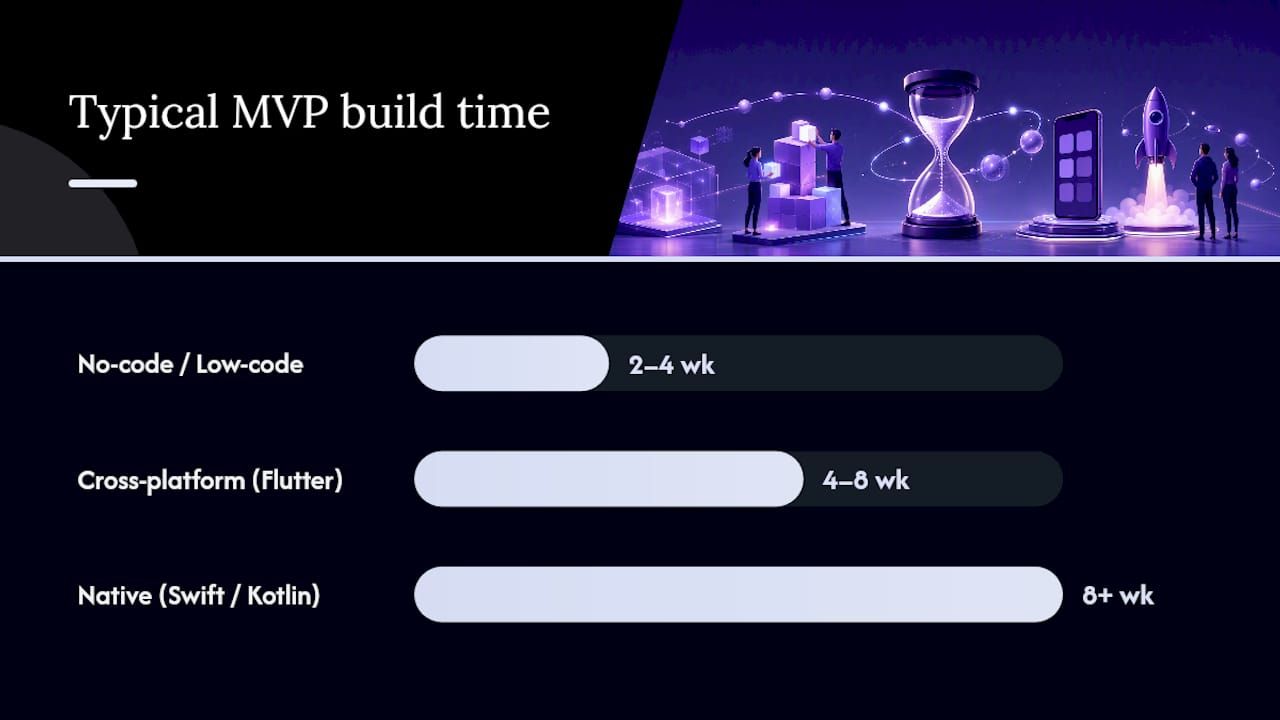
Timelines vary by ambition, not by magic:
Playbooks focused on speed show that a disciplined 2 to 4 week build is achievable when the scope stays genuinely minimal, but that timeline collapses the moment scope creeps. The 4 to 8 week range is where most funded startups actually land, since it allows for real design polish without stretching into full-product territory.
Launching an MVP without instrumentation is just guessing with extra steps. You need a short pre-launch checklist and a small set of numbers that tell you, unambiguously, whether to keep going.
On benchmarks: activation rate (the percentage of new users who complete your core workflow at least once) and D1/D7 retention are the two numbers that matter most early on, alongside crash-free session rate as a basic quality gate. Product guides on early-stage mobile metrics point to these three as the core signals for deciding whether to pivot, persevere, or scale. A strong activation rate paired with a crash-free rate near 100% and stable D7 retention tells you the workflow works and the product is stable enough to trust the data. Weak activation despite a stable app usually means the workflow itself doesn’t solve the problem you thought it did, not that you need more features. And skipping instrumentation entirely, as guides on defining an MVP point out, means you launch and learn nothing concrete either way.
Most MVP failures don’t come from bad ideas. They come from bad execution decisions that were entirely avoidable, and they tend to repeat across founders who never talk to each other.
Building the wrong product tops the list of documented failure causes, often the result of skipping the scoping step entirely and building what sounds impressive instead of what tests the hypothesis. Research on app development failure patterns points to over-scoping and lack of validated market need as the most common threads, and both are scoping failures, not engineering ones.
Watch for these warning signs as you build:
Fixing sample bias takes real effort. Recruit early users from the actual segment you defined when you scoped the app, not from your existing network, using targeted outreach in relevant online communities, direct cold outreach, or a small paid acquisition test. It’s slower than asking your group chat, but the data is worth trusting.
Pro Tip: Keep a running “known issues” doc from day one of testing. When early users hit the same bug three separate people already reported, you fix it fast instead of letting it quietly poison a week of retention data.
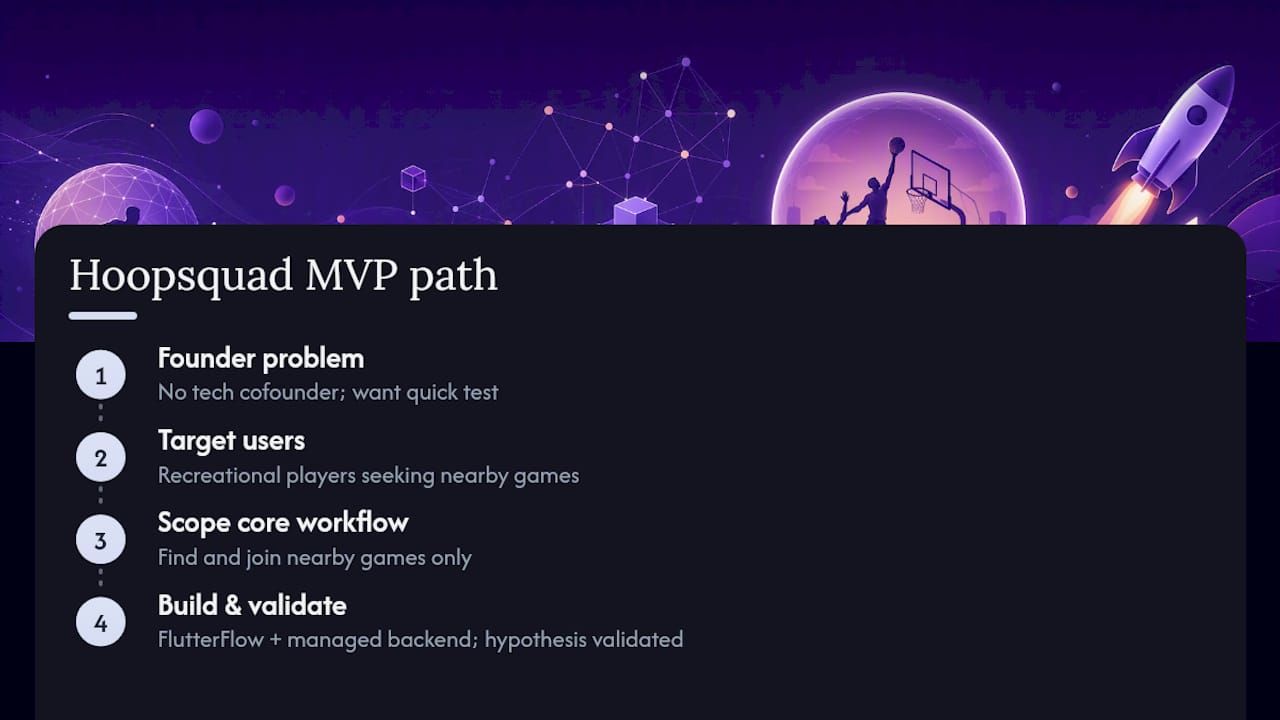
A founder came to Kreante with a clear but common problem: an idea for a basketball community app, no technical cofounder, and no appetite for a six-month build before knowing if anyone would use it. The target user was straightforward: recreational basketball players who wanted to find pickup games and teammates nearby without relying on scattered group chats.
Scoping started the same way it should for any founder in this position: identifying the single core workflow. For this app, that meant finding and joining a nearby game, not messaging, not player profiles, not tournament brackets. Everything else got pushed to the won’t-have list for version one.
The build used FlutterFlow paired with a managed backend, letting the team move from concept to a functioning cross-platform app without a custom-coded infrastructure layer slowing the timeline down. That build path is documented in full in the Hoopsquad case study, including the specific screens and workflow decisions that kept scope tight.
The outcome validated the core assumption: real users could find and join games through the app without friction, which was the entire hypothesis worth testing before investing further… The lesson that carried into later projects: a tightly scoped core workflow, built with production-quality tools instead of throwaway prototyping shortcuts, gets you honest answers in weeks instead of months…
Founders overvalue features and undervalue speed to learning, and it’s the single most consistent mistake in early-stage product work. The instinct to add “just one more thing” before launch feels responsible. It’s usually the opposite: every week spent polishing a feature nobody has validated is a week you’re not spending finding out if your core idea holds up.
My honest read, after watching this pattern play out across dozens of projects, is that founders don’t fail because they build too little. They fail because they build the wrong things with real conviction, then take months to notice nobody’s using them. The fix isn’t more planning. It’s picking one metric, one workflow, and one deadline, then letting real users tell you if you’re right.
So here’s the challenge: pick your single activation metric today, name the workflow that has to prove it, and set a launch date inside the next month. Not “soon.” A date.
— Jorge Del Carpio
Most founders reading this now know exactly what their MVP should test. The harder part is finding a team that scopes ruthlessly instead of upselling every feature you didn’t ask for, and that’s where a lot of agency relationships go sideways. Kreante starts every engagement the way this article recommends starting your own project: mapping the single workflow worth testing, then building only that.
Kreante’s process runs consulting first, so the roadmap and expected return are clear before a line of code gets written, then a working prototype in weeks using the same FlutterFlow and managed-backend patterns covered above, then a full build once your metrics say it’s worth scaling. You own the code outright when it’s done, there’s no vendor lock-in, and the team stays available after launch instead of disappearing the day the app ships. That combination, senior technical judgment plus AI-assisted build speed, is how a working prototype gets delivered in weeks instead of quarters.
If you’ve got a workflow worth testing and a deadline in mind, look at Kreante’s AI and app development services and get a scoped plan back before you commit a single development hour to the wrong feature.
An MVP version of a mobile app is the smallest working release that lets real users complete one core action, tested with actual data rather than mockups, so you can measure whether the idea holds up before building anything more.
Start by naming your first customer and their single most painful problem, map the one workflow that solves it, cut every feature that isn’t required for that workflow to function, then build it using a no-code tool, Flutter, or native code depending on complexity, paired with a managed backend like Firebase or Supabase.
Instrument your core activation event and funnel before launch, release through TestFlight or Google Play’s internal testing track, and track activation rate alongside D1 and D7 retention and crash-free session rate to decide whether to pivot, persevere, or scale.
MVP stands for minimum viable product, meaning the version of an app with just enough real functionality to test a specific hypothesis with actual users, not a mockup or a stripped-down demo.
Tight, single-workflow builds typically take 2 to 4 weeks, standard MVPs with custom design and a few integrations run 4 to 8 weeks, and extended builds with native components or complex logic take longer depending on scope.
Go further
Don't let your tech watch stop here. Explore our other resources to master your technology stack.
ToolsUnlock the secrets of effective internal tools development in 2026. Learn when to build or buy tools for your team's success.
 Tools
ToolsDiscover when content moderation AI excels and when it falters. Learn how automation enhances spam detection while lacking in nuanced judgments.
 Tools
ToolsDiscover an effective app growth strategy to boost user retention. Focus on optimizing listings, testing creatives, and improving onboarding.