
 Tools
ToolsThe App Growth Strategy That Actually Moves Retained Users
Discover an effective app growth strategy to boost user retention. Focus on optimizing listings, testing creatives, and improving onboarding.
ChristiamAugust 25, 2026Read the article
Discover when content moderation AI excels and when it falters. Learn how automation enhances spam detection while lacking in nuanced judgments.

AI earns its place in content moderation on high-volume, low-ambiguity decisions, but it has no business making the final call on anything that hinges on context. That’s the whole verdict. Spam detection, known CSAM hash matching, and basic image classification are jobs where automated content moderation now outperforms manual review on both speed and consistency. Contextual hate speech, political content, and fair-use judgment calls are a different animal entirely: they require cultural fluency and reasoning that current models don’t reliably have.
Reliable automation zones:
High-risk zones that still need a human:
The NTU research on content-filtering systems frames this as a “context-gap” problem, and it’s the single best reason to keep AI moderation inside a policy-aligned, auditable, human-in-loop workflow rather than letting it act alone.
Content moderation AI succeeds when it automates high-volume, low-ambiguity decisions inside a policy-aligned, auditable, human-in-loop workflow, and fails when it operates alone on contextual judgment calls.
| Point | Details |
|---|---|
| Match automation to ambiguity | Automate spam and known-hash categories; route contextual and political content to human reviewers. |
| Separate policy from model | Keep taxonomies and rubrics external so policy updates don’t require full retraining. |
| Use rationale outputs | Chain-of-thought explanations speed up appeals and build reviewer trust in flagged decisions. |
| Track five core metrics | Precision, recall, false positive rate, time-to-review, and reviewer throughput together, not alone. |
| Pilot with Kreante’s approach | Kreante’s consulting-coaching-build sequence maps ROI before automating any moderation category. |
Content moderation AI performs four distinct jobs, and most vendors blur the lines between them in a way that confuses buyers. Detection flags that something might violate policy. Classification labels what kind of violation it might be (harassment, graphic violence, sexual content, and so on). Triage ranks flagged items by severity and routes them to the right queue. Automated action actually does something, removes, blocks, or downranks content without a person in the loop.
That last one is where most of the risk lives. A system that only flags for a human (“assistive flagging”) carries far less downside than one that auto-removes at scale.
There’s also a split most people outside trust and safety teams never think about: prompt filtering versus completion filtering. Prompt filtering screens what a user types into a system before it gets processed. Completion filtering screens what a model generates in response. Microsoft’s Foundry documentation treats these as separate configuration layers with their own severity thresholds, because a jailbreak attempt in a prompt and a harmful line in a generated response call for different responses.
Here’s roughly how a moderation pipeline handles a typical piece of flagged content:
Azure’s own platform documentation confirms this configurability is standard practice now, not a custom build: harm categories, severity levels, and prompt/completion distinctions are exposed as settings, not hardcoded behavior, according to Azure’s Content Moderator overview.

The context gap isn’t a minor edge case. It’s the defining limitation of every AI content filtering system on the market, and it shows up in four distinct ways.
Cultural and political nuance trips up even sophisticated models. A phrase that reads as hate speech in one dialect reads as in-group humor in another. Sarcasm, code-switching, and reclaimed language all sit in the same blind spot. The NTU analysis points directly at training-data bias as the root cause: models learn patterns from whatever text they were fed, and most large-scale datasets skew toward a handful of languages and dominant cultural frames.
That bias compounds with label sparsity. Rare violation types (a niche form of harassment, an obscure scam pattern) simply don’t have enough labeled examples for a model to learn them well. Language coverage gaps make this worse in non-English markets, where moderation datasets are thinner across the board.
Then there’s the asymmetry of getting it wrong. False positives mean legitimate speech gets censored, sometimes at real cost to the person or business behind it. False negatives mean genuine harm slips through. Neither failure mode is rare enough to ignore, and civil-society researchers have flagged the censorship risk specifically. New America’s analysis argues that platforms leaning too hard on automated tools risk unjustified takedowns without the transparency or appeal process users need.
The core tension in automated content moderation isn’t accuracy versus speed. It’s that a model can be highly accurate on average and still be systematically wrong for the exact minority contexts where the stakes of getting it wrong are highest.
This is why explainability matters more than raw accuracy scores. A system that outputs why it flagged something, a rationale, an evidence snippet, a policy citation, gives human reviewers something to check and appeal against. A black-box score gives them nothing.
Four approaches show up repeatedly in current research, and each solves a different piece of the accuracy and auditability problem.
Policy-aligned reasoning with rationale outputs. Instead of returning a bare label, the model produces a chain-of-thought trace explaining which policy clause applies and why. Research on this approach found it directly improves how much reviewers trust and act on automated decisions, according to Hi-Guard’s policy-aligned framework. When a reviewer can see the reasoning, appeals get resolved faster because they’re arguing with a stated rationale instead of a mystery score.
RLVR (reinforcement learning with verifiable rewards). This is the training technique behind some of the most significant recent accuracy gains. Rather than fine-tuning on static labeled examples alone, RLVR rewards the model for outputs that hold up against verifiable policy criteria. A 2025 arXiv study on scaling RL for content moderation found this approach meaningfully improves both policy-grounded reasoning and data efficiency compared with standard supervised fine-tuning, meaning teams need less labeled data to hit the same accuracy bar.
Hierarchical, cascaded pipelines. Instead of one model trying to do everything, a fast binary safe/unsafe filter runs first, and only flagged content passes to a slower, more detailed classifier. The Hi-Guard research demonstrates this cascade structure improves interpretability and cuts down on costly misclassifications, because each stage has a narrower, easier job.
Small task-adaptive models. Not every moderation task needs a frontier-scale LLM. Research on cross-task fine-tuning shows that smaller models tuned specifically for moderation can match large LLM performance on binary classification tasks like spam or explicit-content detection, per STAND-Guard’s findings, at a fraction of the inference cost.
Watch for two specific failure modes when training or fine-tuning any of these systems:
Mitigating both requires combining verifiable signals with rubric-based evaluators rather than a single reward metric, a point the same RLVR scaling research emphasizes directly.
Pro Tip: Pilot a hierarchical pipeline on your highest-volume, lowest-ambiguity category first, spam or known hash matches, before touching anything contextual. You get a working audit trail and reviewer workflow in place before the harder categories force you to build one under pressure.
Responsible deployment comes down to five decisions, made in this order, as detailed in the AI Content Optimization Audit to ensure your content is AI-friendly.
Pro Tip: Start automation with STAND-Guard-style small models on your highest-volume, most unambiguous category, then expand only after your reviewer tooling and audit trail are proven, a sequencing STAND-Guard’s own research on cost-effective deployment recommends. Teams that automate the hard categories first almost always end up rebuilding their audit infrastructure under fire.
Five numbers tell you whether a content moderation AI system is doing its job: precision (how many flags were correct), recall (how many actual violations got caught), false positive rate, time-to-review, and reviewer throughput. Track all five together, because optimizing any single one in isolation creates blind spots elsewhere.
Severity thresholds should be set through sample-based QA, not guesswork. Pull a random sample of borderline decisions weekly, have calibrated reviewers score them blind, and adjust thresholds based on where the model and human judgment diverge. This is slower than trusting a default threshold out of the box, but it’s the only way to know your system matches your actual policy rather than a vendor’s generic one.
Cost and latency trade-offs shape the LLM-versus-small-model decision more than accuracy alone does. Large models generally handle nuanced, low-volume categories better. Small, task-adaptive models handle high-volume, well-defined categories at a fraction of the inference cost, a trade-off STAND-Guard’s research quantifies directly for binary classification tasks. Running a frontier LLM on every spam comment is expensive overkill; running a lightweight classifier on nuanced political speech is a liability.
Explainability outputs pay for themselves in reviewer time. When a system returns a rationale or evidence snippet alongside a flag, reviewers spend less time re-investigating from scratch and more time verifying a specific claim, exactly the trust and speed gain Hi-Guard’s research found when policy-aligned rationale traces were added to the pipeline.
Key things to check on a recurring basis:
Kreante works through moderation projects the same way it works through any AI build: consulting first to map where automation actually pays off, coaching to get your policy and trust and safety teams fluent in how the system reasons, then build to ship the working pipeline.
That order matters here more than in most AI projects. A moderation system with the wrong risk threshold doesn’t just underperform, it censors real users or lets real harm through, so the roadmap and expected-return work in the consulting phase has to happen before any code gets written.
Kreante has delivered more than 265 AI projects across 35 countries, and the same build principles apply to moderation pipelines: policy engineering that keeps your taxonomy separate from the model, small task-adaptive models where volume justifies the cost savings, RLVR-style training when a category needs deeper policy alignment, and reviewer tooling that surfaces rationale, not just a score.
| Point | Details |
|---|---|
| Automate the easy tier first | Spam, hash-matched CSAM, and basic image classification are safe to automate now. |
| Keep humans on nuance | Political speech, contextual hate speech, and fair-use calls need mandatory human review. |
| Kreante’s approach | Kreante pilots moderation AI through consulting, coaching, and build, prototype in weeks, full system after. |
The conventional advice in this space still frames AI moderation as an accuracy problem: get the model good enough and the risk disappears. That’s wrong, and the research backs a different read. The RLVR scaling work and Hi-Guard’s hierarchical framework both point at the same conclusion: interpretability and policy alignment matter more than raw classifier accuracy, because a highly accurate model that can’t explain itself is unauditable, and an unauditable moderation system is a liability regardless of its score.
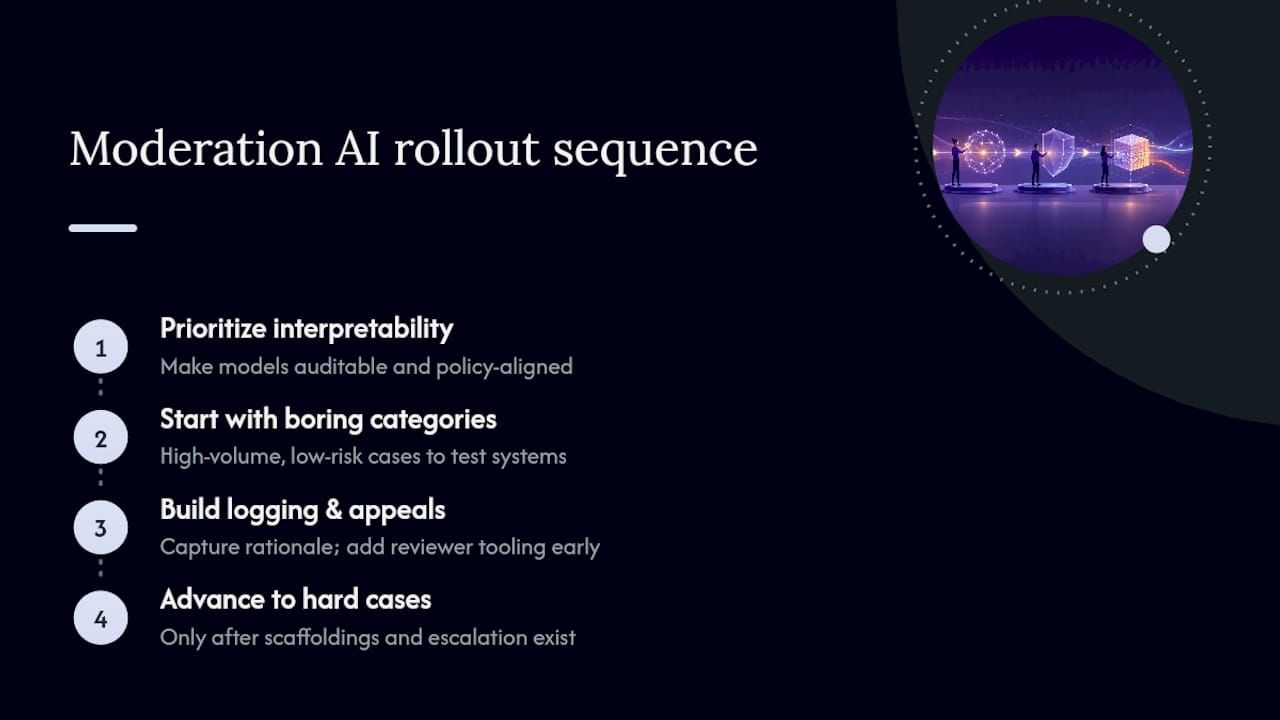
What gets underrated is sequencing. Teams that try to automate contextual, high-stakes categories first almost always end up retrofitting the audit trail and reviewer tooling they should have built from day one. Start with the boring, high-volume categories. Build the logging and appeals infrastructure there, where mistakes are cheap, then earn your way into harder categories once that scaffolding exists.
If there’s one thing worth prioritizing above model selection, it’s this: build the rationale output and human escalation path before you scale volume. Everything else is a much smaller decision by comparison.
— Jorge Del Carpio
Most teams weighing content moderation AI end up choosing between an expensive enterprise platform contract or a slow internal build that eats months of engineering time before producing anything testable. Kreante offers a third path: a working prototype in weeks, built by a senior team using low-code and AI-native tooling, followed by a full production build with a quality guarantee and code you own outright.

That speed matters specifically for moderation projects, where the riskiest categories need real testing against real edge cases before you commit to a threshold or an escalation rule. Kreante’s AI solutions development services cover exactly this kind of build: policy-aligned classifiers, hierarchical pipelines, and reviewer tooling designed around your actual content categories, not a generic vendor template. Browse Kreante’s case studies to see how past AI builds moved from prototype to production, then start a scoping conversation to map where automation pays off in your own moderation stack.
Yes. AI reliably handles high-volume, low-ambiguity tasks like spam detection and known illegal content matching, but contextual decisions like political speech or nuanced hate speech still need human review inside a policy-aligned workflow.
Content moderation is the process of reviewing user-generated content against a platform’s policies and taking action, removal, labeling, or escalation, on anything that violates them. Modern systems combine automated detection with human judgment for ambiguous cases.
A human content moderator reviews flagged content that automated systems escalate, applies policy judgment to ambiguous or high-severity cases, and provides the calibration data that keeps AI classifiers accurate over time.
Go further
Don't let your tech watch stop here. Explore our other resources to master your technology stack.
ToolsDiscover an effective app growth strategy to boost user retention. Focus on optimizing listings, testing creatives, and improving onboarding.
 Tools
ToolsUnlock software success with a solid requirements document. This practical guide shows you how to create clear, testable specifications.
 Tools
ToolsDiscover key AI security risks leaders must address now. Learn to protect data and models from prompt attacks and vulnerabilities.