Start with LangChain paired with the LangGraph runtime if you need to prototype fast and iterate on tool-calling logic. Move to Microsoft Agent Framework once durability, structured workflows, and governance matter more than iteration speed. Pick provider SDKs like OpenAI’s Agents SDK or Google’s ADK only when you need tight access to a single provider’s native features. The rest of this piece breaks down why, and what the trade-offs actually cost you.
TL;DR:
Framework selection should prioritize durability and observability features if long-term stability and failure handling are critical for your project. Graph-based workflows provide deterministic state management ideal for compliance-driven tasks, while model-driven loops suit open-ended, research, or drafting applications. Adequate testing involves deliberately inducing failures to ensure agents can resume or recover, with clear success criteria for handling real-world interruptions. Compatibility with your existing infrastructure, security policies, and support community often outweigh the specific feature set when choosing frameworks. Starting with a focused prototype based on your core business needs allows you to validate the model’s effectiveness before committing to full-scale deployment.
What Are the Best AI Agent Frameworks Right Now?
An AI agent framework is the software layer that lets a large language model plan, call tools, remember context, and hand off work, instead of just answering a single prompt. The distinction that trips people up: a chatbot answers questions, but an agent executes multi step actions across real business systems with limited human intervention, a point Slack’s engineering blog makes bluntly. That difference is why “agentic workflows” get their own vocabulary. Neo4j describes them as a loop of planning, tool use, reflection, and orchestration, where the execution path adapts at runtime rather than following a fixed script.
That adaptability is exactly what makes agent frameworks harder to evaluate than a typical library. You are not just picking an API wrapper. You are picking an orchestration model, a debugging story, and, often, a long-term commitment to a runtime that will sit underneath production traffic. Here is the landscape as it actually stands.
LangChain, LangGraph, and LangSmith
LangChain is the MIT-licensed framework most developers meet first. It is open-source, Python and JavaScript friendly, and built for breadth: hundreds of model and tool integrations, a huge community, and a low barrier to a working prototype. On its own, LangChain handles chains and tool calling well but leaves durability and state management thin.
That is where LangGraph comes in. It layers a graph-based runtime on top, giving you explicit nodes, edges, and checkpoints so an agent can pause, resume, and recover from failure instead of restarting from scratch. LangSmith adds the observability half: tracing, evaluation, and replay for debugging agent runs that would otherwise be a black box. Together the three form a stack that scales from weekend prototype to something closer to production, though teams still bolt on their own governance layer.
Microsoft Agent Framework
Microsoft Agent Framework is an open, multi-language framework built specifically for production-grade agents and graph-based workflows, with both Python and .NET support. It ships with observability hooks and hosting patterns baked in rather than added later, which matters if your team is already living inside the Microsoft ecosystem or needs a durable workflow engine with less DIY plumbing.
Its workflow model treats state, retries, and human checkpoints as first-class concepts, not afterthoughts. That is a deliberate trade against raw prototyping speed, and it shows in how the framework’s own documentation frames the graph builder: you are meant to design the workflow before you run it, not discover it live.
OpenAI Agents SDK and Google ADK
OpenAI’s Agents SDK gives you the tightest integration with OpenAI’s own models, function calling, and hosted tools. If your entire stack is already committed to a single provider and you want minimal friction between model capability and agent behavior, this is the shortest path. Google’s Agent Development Kit (ADK) plays a similar role for teams standardizing on Gemini and Google Cloud infrastructure.
Neither SDK is meant to be provider-agnostic. That is the point and the limitation in the same breath: less abstraction overhead, less portability if you ever want to swap models.
CrewAI, Mastra, and LlamaIndex/DeepAgents
CrewAI organizes agents around roles, like a planner, a researcher, and a writer, cooperating on a shared task. It is open-source, Python-native, and popular for multi-agent demos where role separation is the whole point of the design.
Mastra is a TypeScript-first framework aimed at JavaScript teams who want agent orchestration without leaving the Node ecosystem, useful if your existing product is a JS/TS stack.
LlamaIndex, and its DeepAgents extension, leans on its strength in retrieval and indexing, making it a natural fit when the agent’s core job is answering questions grounded in a large private document set.
GitHub Agentic Workflows
GitHub Agentic Workflows is a narrower but instructive case: it lets you define repository automations in markdown with frontmatter guardrails, running agents with constrained permissions and “safe outputs” that limit what the agent can write back to your repo. It is not a general-purpose framework for building customer-facing agents, but its permission model is worth studying regardless of what you build with, because it is one of the cleanest public examples of least-privilege agent design.
For official reference material, Microsoft Learn and the microsoft/agent-framework GitHub repository carry runnable samples; LangChain’s own docs site does the same for its stack, and both are worth cloning before you write a line of production code.
What Should You Check Before Running Agents in Production?
Most frameworks look fine in a demo. Production is where the gaps show up, and they show up in the same six places every time.
Durability comes first. Can the agent checkpoint mid-task and resume after a crash, or does a dropped connection mean starting over? Long-running sessions, multi-step approvals, and anything involving a human waiting on a response all require restartability as a baseline, not a nice-to-have. This is precisely where graph-based frameworks earn their complexity: deterministic state makes checkpointing tractable in a way that a freewheeling reasoning loop does not.
Orchestration is next. Sequential handoffs are simple to reason about; concurrent agents working the same task are harder to debug when two branches disagree. Know which pattern your use case actually needs before you pick a framework that only does one well.
Observability decides whether you can debug a failure at 2 a.m. or just shrug. Distributed tracing, structured logs, and the ability to replay a specific agent run step by step separate a maintainable system from a liability. Microsoft Agent Framework ships OpenTelemetry integration out of the box; LangSmith fills the same role for the LangChain stack. If your candidate framework has neither a telemetry story nor an easy way to bolt one on, that is disqualifying for anything customer-facing.
Security and governance need to be architectural decisions, not bolt-ons after an incident. Sandbox agent execution, restrict write permissions to the minimum the task requires, and keep credentials out of the agent’s working memory entirely rather than trusting the model not to leak them.
Testing and evaluation for agents look different from typical unit tests, since the same prompt can produce different tool call sequences on different runs. You need regression suites that check outcomes and guardrail behavior, not just exact output matching.
Hosting and cost round it out. Graph-based frameworks with checkpointing tend to carry more infrastructure (state stores, message queues) than a stateless loop calling an API. Budget accordingly before you commit.
Checkpointing and restartability for long-running or interrupted sessions
A defined orchestration pattern (sequential, concurrent, or graph-based handoffs)
Tracing and replay, ideally via OpenTelemetry or an equivalent
Sandboxed execution with least-privilege credentials
A regression testing strategy built for non-deterministic outputs
A realistic infrastructure and cost estimate before committing to a stack
Pro Tip:Before you evaluate a single framework feature, write down what “restart from failure” needs to look like for your specific workflow. Most framework comparisons skip this, and it’s the requirement that eliminates half the candidates fastest.
Guardrail design deserves its own line item. Neo4j’s breakdown of agentic workflow risk points to validated tool schemas, timeouts, retries, and human escalation paths as the baseline, not an advanced feature. Skip these and you are one bad tool call away from an agent doing something expensive and irreversible.
How Do You Choose the Right Framework for Your Project?
Start by defining the job to be done before you touch a framework comparison chart. How autonomous does this agent actually need to be? Is it a long-lived assistant that persists state across days, or a single-shot task that completes in seconds? What systems does it need to touch, and what SLA do you owe the business once it’s live?
Once that’s clear, run through a concrete checklist:
Language and runtime fit. Does your team already run Python, .NET, TypeScript, or Go in production, and does the framework support it natively rather than through a community wrapper?
Model portability. Are you locked to one provider, or do you need to swap models without rewriting the agent logic? LangChain and Microsoft Agent Framework both support multiple providers; the OpenAI and Google SDKs do not.
Orchestration model. Graph-based or loop-based? Match this to the durability answer from the previous section, not the other way around.
Observability out of the box. Can you trace a failed run in under ten minutes, or are you building a logging layer from scratch?
Governance and licensing. Is the license compatible with your commercial use case, and does the framework support the permission and sandboxing model your security team will actually sign off on?
Community and support depth. Check the GitHub issue response time and the last commit date. A framework with a six-month-old open critical bug is a red flag regardless of its feature list.
Watch for a specific red flag in example repos: demos that only show the happy path, with no error handling, no retry logic, and no mention of what happens when a tool call fails. That gap almost always means the production story is thinner than the marketing.
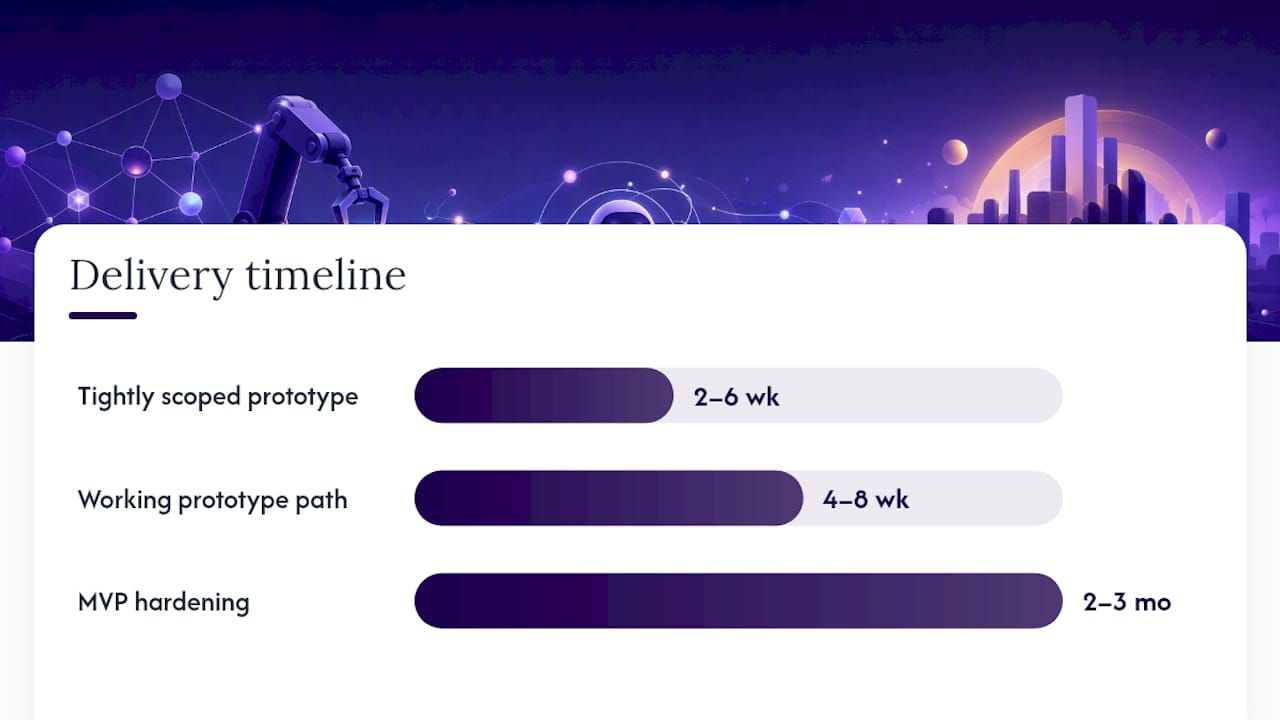
Scope your pilot tightly. A two to six week prototype should validate exactly one thing: can this framework handle your hardest real workflow end to end, including at least one failure case, not just the easy demo? Define success criteria up front, such as “resumes correctly after a mid-task crash” or “completes the multi-tool handoff without human intervention,” rather than “the demo worked.” From there, a realistic path runs roughly four to eight weeks for a working prototype, another two to three months to harden it into an MVP with proper observability and testing, and a longer tail for full production governance depending on your compliance requirements.
Pro Tip:If your pilot never triggers a single failure path in six weeks, you haven’t tested hard enough. Deliberately break a tool call, kill the process mid-run, and see what actually happens before you trust the framework with real users.
Which Architecture Pattern Fits Your Agent System?
Two patterns dominate real deployments, and picking wrong is the single most common source of pain teams report six months in.
Graph-based workflows model the agent’s steps as an explicit state machine: defined nodes, defined transitions, and checkpoints at each stage. This is the pattern Microsoft’s own workflow documentation builds around, and it is the right call whenever you need deterministic state, idempotent retries, or a human approval gate before a step executes. Financial approvals, medical intake triage, anything with a compliance officer in the loop, all point toward a graph.
Model-driven loops let the LLM decide the next step dynamically at each turn, planning, calling a tool, reflecting on the result, and deciding what comes next without a predefined path. This is faster to prototype and better suited to open-ended research or drafting tasks where the “correct” sequence of steps genuinely varies case by case. It is also harder to certify for anything regulated, because the execution path isn’t fixed enough to audit in advance.
A few structural tools show up across both patterns:
Model Context Protocol (MCP) standardizes how an agent discovers and calls external tools, which matters most when you’re exposing tools across multiple agents or teams and don’t want every integration hand-rolled.
Knowledge graphs and GraphRAG give agents connected, traceable context instead of flat vector search results, which helps when an answer needs to show its reasoning chain, not just cite a source.
Role-based orchestration, structuring a system around planner, retriever, executor, validator, and reporter roles, is a pattern Neo4j documents as a way to keep multi-agent systems legible instead of a tangle of ad hoc handoffs.
Guardrails need to be explicit regardless of pattern: validated tool schemas, timeouts, idempotent calls, and a defined escalation path when the agent hits something it can’t resolve alone.
Integration with existing systems, CRMs, ticketing queues, internal databases, and your observability stack, tends to determine the real winner more than any feature comparison. A framework with elegant agent logic but no clean way to hook into your CRM will cost you more in custom glue code than a slightly less elegant framework with a mature integration ecosystem.
The Kreante Approach to Building Production Agents
We start every agent engagement with an audit, not a framework decision. The goal is finding where an agent actually moves a business number, revenue, margin, or hours saved, before anyone touches code. That gets you a roadmap ordered by expected return, and it usually rules out half the “agent ideas” a team walks in with.
From there we prototype fast, often in weeks, using low-code and AI tooling to validate the workflow, then move to a full build once the pattern is proven. We lean toward graph-based frameworks like Microsoft Agent Framework when a client needs durability, audit trails, or human approval gates, and toward lighter loop-based stacks when speed and flexibility matter more than certification.
Across 265+ projects in 35 countries, the pattern holds: clients get a working prototype, then a production build they own outright, with support after launch instead of a vendor relationship that ends at handoff.
— Jorge Del Carpio
Where to Read the Official Documentation
Start with primary sources, not blog summaries. Microsoft Agent Framework’s overview and its GitHub repository cover workflow design and observability with runnable samples. LangChain’s site documents the LangGraph runtime and LangSmith tracing for teams building on that stack. For governance patterns worth studying regardless of framework, read GitHub’s Agentic Workflows documentation on safe-outputs and permission scoping, and Neo4j’s explainer on agentic workflows for the planning-to-orchestration loop that underlies most of these frameworks.
Microsoft Agent Framework docs and GitHub samples, for durability and .NET/Python workflow patterns
LangChain, LangGraph, and LangSmith docs, for rapid prototyping and tracing
GitHub Agentic Workflows docs, for permission and safe-output guardrail design
Neo4j’s agentic workflows explainer, for the planning/tool-use/reflection loop model
Get a Working Agent Prototype Instead of Another Framework Debate
Kreante builds the custom AI agent your team has been evaluating frameworks for, minus the months spent picking one. Where a lot of teams stall out comparing LangChain against Microsoft Agent Framework in the abstract, we start from the business number you’re trying to move and pick the architecture that gets there fastest, whether that means a graph-based workflow with checkpoints or a lighter loop-based build.
Our senior team pairs with low-code and AI tooling to hand you a working prototype in weeks, then builds it out fully with a quality guarantee and code you own outright. That includes web and mobile builds when the agent needs a proper interface, not just an API endpoint, similar to projects like Class2Class and SmartCab. If you’re weighing custom AI agent development against another quarter of internal framework testing, start with an AI implementation scoped to a specific outcome and see what a prototype looks like in your own systems within weeks.
The leading options include LangChain with LangGraph and LangSmith, Microsoft Agent Framework, OpenAI’s Agents SDK, Google’s ADK, CrewAI, Mastra, and LlamaIndex/DeepAgents, each suited to different priorities like prototyping speed, durability, or provider-specific features.
Common categories include reactive agents that respond to immediate input, planning agents that decompose goals into sub-tasks, multi-agent systems with role-based orchestration (planner, retriever, executor, validator), tool-using agents that call external APIs, and retrieval-augmented agents grounded in a private knowledge base.
ChatGPT is built on a large language model, but its agentic features (browsing, code execution, tool calling) turn it into an agent when those capabilities are active; on its own, a base LLM only generates text and doesn’t independently execute multi-step actions.
CrewAI organizes agents around cooperative roles and is popular for fast, Python-native multi-agent prototypes, while Microsoft Agent Framework is built for production durability with graph-based workflows, checkpointing, and OpenTelemetry observability across Python and .NET.
If the task requires dynamic decision-making, tool selection that varies by context, or multi-step reasoning across systems, you need an agent; if the steps are fixed and repeatable, a simpler workflow automation will cost less and be easier to maintain.



 Development