
 Fundamentals
User Stories vs Use Cases: A Guide for Agile Teams
Discover when to use user stories vs use cases for agile projects. Enhance your team's productivity by choosing the right approach.
KreanteAugust 20, 2026Read the article
Discover how to effectively mitigate AI bias throughout the model lifecycle. Implement structured approaches for fairer outcomes today.

Effective AI bias mitigation starts before you write a single line of model code: audit your training data, define your fairness metrics, and establish governance gates before deployment. Teams that treat bias as purely a technical problem consistently underperform those that combine statistical diagnostics with organizational accountability. The short verdict: no single algorithm removes bias, but a structured socio-technical approach across the full ML lifecycle gets you as close as current methods allow.
Start this week:
Where to focus first by risk class: High-stakes systems (hiring, lending, medical triage, criminal justice) need pre-processing fixes, in-processing fairness constraints, independent audits, and human-in-the-loop review before any deployment. Lower-stakes systems can start with post-processing calibration and monitoring, then work backward into the data pipeline as evidence of disparity accumulates.
Effective AI bias mitigation requires a socio-technical lifecycle approach: technical fixes alone cannot sustain fairness without governance, TEVV checkpoints, and continuous monitoring.
| Point | Details |
|---|---|
| Start with data, not the model | Audit training data for representational gaps and non-random missingness before any model training begins. |
| Assign governance roles explicitly | Name a model owner, data steward, and compliance reviewer; fairness decisions without named owners revert. |
| No single metric is sufficient | Equalized odds and calibration are mathematically incompatible when base rates differ; document the trade-off and get sign-off. |
| Post-processing carries legal risk | Applying group-specific thresholds in hiring or lending may violate Title VII or ECOA; always get legal review first. |
| Kreante delivers auditable AI | Kreante builds AI systems with TEVV documentation, fairness constraints, and monitoring infrastructure as standard deliverables. |
Bias in artificial intelligence is not a single failure mode. For practitioners, it is useful to think of it as a chain: dataset-level problems propagate into model behavior, which then produces application-level harms. The operational definition that matters most is this: a system exhibits bias when its outputs systematically disadvantage or misrepresent a group in ways that cannot be justified by the task objective.
Common bias types worth distinguishing:
Two failure modes that illustrate why this matters in practice: a resume-screening model trained on a decade of hiring decisions at a tech company will encode the gender and educational-institution patterns of past hires, producing lower scores for candidates who don’t match that historical profile regardless of actual qualifications. A credit-scoring model that uses zip code as a feature will proxy for race in cities with historically segregated housing, producing disparate approval rates even after race is removed from the feature set. Removing protected attributes rarely removes their proxies, which is why feature selection alone is an insufficient fix.
The three-stage framework (pre-processing, in-processing, post-processing) gives teams a practical scaffold for assigning mitigation work. Each stage has distinct techniques, tooling, and governance checkpoints. NIST SP.1270 identifies datasets, TEVV, and human factors as the three broad challenge areas and explicitly calls for socio-technical approaches rather than purely automated fixes.
| Stage | What happens | Primary mitigation actions | Key tools | TEVV gate |
|---|---|---|---|---|
| Pre-processing | Data collection, labeling, curation | Stratified sampling, reweighting, dataset documentation | IBM AIF360 (data transforms), Appen guidance | Data validation review before training |
| In-processing | Model training and optimization | Fairness constraints, adversarial debiasing, regularization | Microsoft Fairlearn, IBM AIF360 (in-processing algorithms) | Model validation before staging |
| Post-processing | Output scoring and decision rules | Threshold adjustment, score calibration, equalized odds | Google What-If Tool, Fairness Indicators | Verification before production release |
| Governance/TEVV | Oversight across all stages | Audit trails, human review, stakeholder sign-off | NIST socio-technical framework | Release gate, incident review |
Where each tool fits:
A 2025 Frontiers review proposes coupling formal statistical diagnostics with governance mechanisms across the lifecycle, mapping technical mitigations directly onto regulatory obligations. That framing is more useful than treating each stage as a standalone fix.
Pre-processing is where you get the most leverage for the least model complexity cost. Fixing data before training avoids the need to compensate with constrained objectives or post-hoc patches.
Data collection and representativeness:
Annotation quality:
Synthetic augmentation:
Dataset documentation checklist:
Appen’s practical guidance on training data highlights structured sampling and annotator diversity as among the most effective early interventions available to teams before any model is trained.
Pro Tip: Non-random missingness is one of the most underdiagnosed sources of bias. If data is missing more often for one subgroup (e.g., minority patients with fewer clinical visits), imputing with population-level means will systematically underestimate that group’s true values. Test for missingness patterns by group before any imputation step.
In-processing techniques modify the training objective itself, which gives them more structural power than post-hoc fixes but also introduces accuracy trade-offs that need explicit documentation.
Fairness-aware objectives:
Reweighting and re-sampling:
Assigning higher loss weights to underrepresented or historically disadvantaged subgroups during training is computationally cheap and often effective as a first pass. Microsoft Fairlearn implements several reweighting approaches alongside its constraint-based methods. The limitation: reweighting helps with representation but does not address proxy features that encode group membership indirectly.
Adversarial debiasing:
Train a primary model alongside an adversary that tries to predict the protected attribute from the primary model’s representations. The primary model is penalized when the adversary succeeds. IBM AIF360 includes an adversarial debiasing implementation. This approach is more compute-intensive and requires careful tuning of the adversary’s learning rate relative to the primary model.
Regularization:
Adding a fairness penalty term to the loss function (e.g., penalizing the difference in false positive rates between groups) is a flexible approach that integrates with most standard training pipelines. The penalty weight is a hyperparameter that controls the accuracy-fairness trade-off directly.
Decision guidance for picking a strategy:
The accuracy-fairness trade-off is real and cannot be engineered away entirely. Document the Pareto frontier between your primary accuracy metric and each fairness metric, and get explicit sign-off from legal and product stakeholders on where the acceptable operating point sits.
Post-processing adjustments modify model outputs after training, which makes them fast to deploy and easy to iterate. They are the right starting point for prototypes, for systems where retraining is expensive, and for situations where a fairness problem is identified in production and needs an immediate response.
Core techniques:
When post-processing is appropriate:
When it is risky:
CMU’s Tepper Perspectives analysis is direct on this: post-processing can be computationally efficient but raises legal and ethical issues in regulated domains because it involves explicit use of sensitive group membership to change outputs. In hiring and lending, applying different thresholds by race or gender may violate Title VII or the Equal Credit Opportunity Act depending on how it is implemented and whether it can be defended as a business necessity. The legal exposure is not hypothetical.
Documentation requirements when you use post-processing:
Never apply group-based thresholds in a regulated domain without legal review. The technical fix may be straightforward; the legal exposure is not.
Measurement is where most teams underinvest. Picking a single fairness metric and reporting it without context is how organizations end up claiming fairness while a different metric shows clear disparity.
Core fairness metrics and when each applies:
| Metric | What it detects | Data access required | Key limitation |
|---|---|---|---|
| Statistical parity difference | Gap in positive prediction rates between groups | Model outputs only | Ignores base rate differences; can penalize accurate models |
| Equalized odds (TPR/FPR parity) | Differential error rates by group | Outputs + ground truth labels | Requires labeled ground truth; may conflict with calibration |
| Calibration by group | Whether predicted probabilities match actual rates per group | Predicted probabilities + outcomes | Does not capture rank-order disparities |
| Counterfactual fairness | Whether changing only the protected attribute changes the prediction | Model internals or access to counterfactual data | Hard to operationalize; requires causal model |
| Individual fairness score | Whether similar individuals get similar predictions | Similarity metric definition + model outputs | Similarity metric is normative, not objective |
A 2023 arXiv survey of LLM bias evaluation makes a point that applies beyond language models: the right metric depends on what access you have to the model. If you only have generated text, you cannot compute probability-based metrics. If you have embeddings, representation-level diagnostics become available. Match your metric choice to your actual model access before committing to a measurement plan.
TEVV testing checklist:
NIST SP.1270 is explicit that TEVV complements but does not replace scientific design thinking. Running a TEVV checklist on a poorly designed system produces a well-tested poorly designed system.
Pro Tip: Pick one primary fairness metric and one secondary metric before training begins, and document the trade-off you are accepting between them. Equalized odds and calibration are mathematically incompatible when base rates differ across groups (this is a proven impossibility result, not a tooling limitation). Deciding which one to prioritize is a policy decision, not a technical one, and it needs sign-off from legal and product leadership.
Technical fixes without governance revert. The Frontiers integrated framework is explicit that coupling formal statistical diagnostics with governance mechanisms is what actually sustains bias reduction across the AI lifecycle. NIST’s socio-technical framing reinforces this: governance, human-in-the-loop practices, and participatory design are not optional add-ons to the engineering work.
Governance checklist:
Participatory design and stakeholder engagement:
Human-in-the-loop patterns:
Human review should override model outputs when: the model’s confidence is below a defined threshold, the decision affects a protected class in a regulated domain, or the outcome is irreversible (termination, loan denial, medical triage). For AI implementation in business contexts, the human-in-the-loop design is often the difference between a defensible system and a liability.
Operationalizing TEVV outputs into governance actions:
Deployment is not the finish line. Bias can emerge or re-emerge as the real-world data distribution shifts away from the training distribution, as user behavior changes, or as the system’s outputs feed back into the data it will be trained on next.
Monitoring checklist:
User-facing feedback channels:
A 2025 Nature study recommends continuous end-user feedback loops as a critical component for long-term bias detection. In practice, most corporate deployments skip this entirely. A minimal implementation: a “flag this result” button on model-driven decisions, routed to a triage queue reviewed weekly by the data steward. More sophisticated implementations use structured reporting forms that capture the user’s description of the disparity, the affected group, and the decision context.
Incident response steps:
Measuring remediation effectiveness means re-running your primary fairness metrics on the post-fix production window and comparing them to both the pre-incident baseline and the pre-deployment TEVV results. A fix that restores the metric to baseline is not necessarily a fix that addresses the root cause.
You can also use tools like an AI search visibility test to monitor how your AI-driven outputs are surfaced and ranked across different platforms, which can surface user-facing disparities that internal metrics miss.
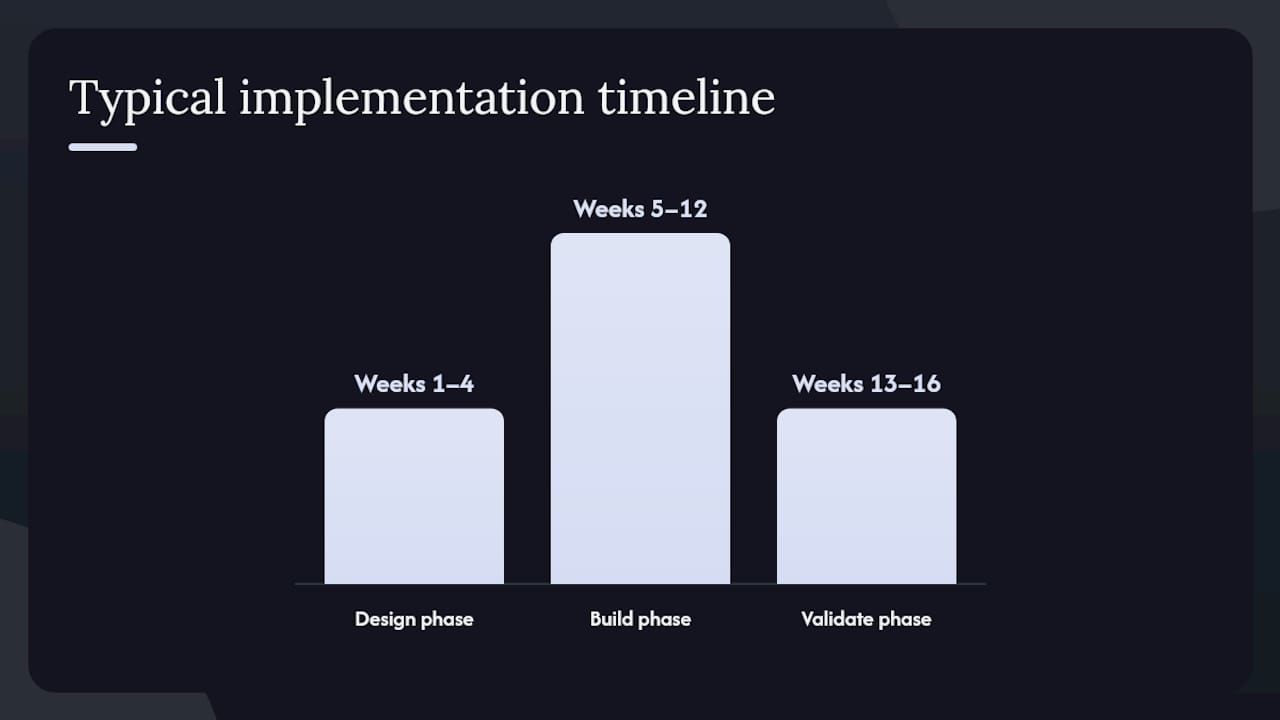
A bias mitigation program is a phased engineering and governance effort, not a one-time audit. The timeline below reflects typical ranges for a mid-size team building or retrofitting a production ML system.
Role matrix:
Budget drivers: Data collection and annotation are usually the largest cost for teams starting from scratch. Independent audits for high-stakes systems (hiring, lending, healthcare) run from tens of thousands to over $100,000 depending on scope. Compute costs for adversarial debiasing are roughly double standard training runs. For MVPs, scope down by starting with post-processing calibration and monitoring, then investing in pre-processing and in-processing fixes as evidence of disparity accumulates.
When choosing an AI development agency, verify that the vendor can demonstrate TEVV documentation and has experience with fairness-constrained training, not just standard model delivery.
Pro Tip: For an independent audit on a tight budget, a structured red-team exercise with external ML practitioners costs far less than a formal third-party audit and catches most of the same failure modes. Document the red-team methodology and findings in the model card to demonstrate due diligence.
The ecosystem has matured enough that most teams can get started without building custom tooling. The choice of library depends on where you are in the lifecycle and what model access you have.
Datasets and benchmarks: For NLP and LLM evaluation, the WinoBias and WinoGender datasets test gender coreference bias; StereoSet and CrowS-Pairs test stereotypical associations. For tabular data, the Adult Income, COMPAS recidivism, and German Credit datasets are standard benchmarks, though all carry their own historical biases and should not be treated as ground truth for real-world deployment decisions.
Open-source vs. commercial: Open-source tools (AIF360, Fairlearn, What-If Tool) cover most use cases and are free. Commercial platforms add audit trails, role-based access, and compliance reporting that regulated industries often require. The arXiv LLM bias survey notes that for language models specifically, metric choice depends heavily on model access: if you only have API access to generated text, embedding-level diagnostics are unavailable, which narrows your toolkit significantly.
“Zero bias” is not an achievable outcome. This is not a tooling limitation; it is a mathematical one. The most cited impossibility result in machine learning fairness shows that calibration, equalized false positive rates, and equalized false negative rates cannot all be satisfied simultaneously when base rates differ across groups. Every fairness metric you optimize is implicitly a choice to accept worse performance on a different metric.
Common impossibility trade-offs teams encounter:
A PMC scholarly review argues that many biases remain unknown and residual bias presents genuine ethical challenges. The practical implication: teams must disclose uncertainty, adopt ethics-informed communication practices, and resist the temptation to claim a system is “fair” based on a single metric passing a threshold.
Communication templates for stakeholders:
Downstream risks to flag explicitly:
Pro Tip: When briefing executives on fairness limitations, lead with the business risk of overclaiming, not the technical complexity. A public claim that a system is “unbiased” that is later contradicted by a third-party audit creates legal and reputational exposure that dwarfs the cost of accurate, hedged disclosure upfront.
Supervised classification gets most of the attention in bias mitigation literature, but unsupervised and reinforcement learning systems carry their own distinct failure modes.
Unsupervised learning: Clustering and embedding models have no explicit labels, which means bias manifests differently. Word embeddings trained on large corpora encode occupational and gender stereotypes in their geometric structure (the classic example: “man is to doctor as woman is to nurse” in vector arithmetic). Dimensionality reduction methods like PCA or UMAP can compress away variance that is disproportionately important for minority subgroups, producing representations where those groups cluster poorly or are conflated with majority groups.
Mitigation approaches for unsupervised settings include: auditing embedding spaces for stereotypical associations using tools like the Word Embedding Association Test (WEAT); applying post-hoc debiasing to embedding spaces (e.g., the Bolukbasi et al. hard-debiasing method, though its effectiveness is debated); and evaluating cluster quality metrics disaggregated by subgroup to detect differential representation.
Reinforcement learning: RL systems learn from reward signals, which means bias enters through the reward function design and the environment dynamics. A recommendation system optimizing for engagement will amplify content that generates strong reactions, which tends to favor majority preferences and can systematically underserve minority users. A hiring RL agent optimizing for “successful hire” (defined by retention) will encode whatever biases exist in the historical retention data.
Mitigation in RL requires: auditing the reward function for proxy objectives that correlate with protected attributes; testing the learned policy across subgroup-stratified environment states; and applying fairness constraints to the policy optimization (analogous to in-processing constraints in supervised learning, but applied to the policy gradient). Human-in-the-loop oversight is especially important in RL because the feedback loop between model outputs and future training data is tighter and faster than in static supervised settings.
The most consistent failure pattern in bias mitigation is not a bad algorithm. It is a governance gap: teams run TEVV, produce a model card, and then deploy without the monitoring infrastructure to detect when the real-world population diverges from the test population.
The second most common failure is metric theater: selecting a fairness metric that the model already satisfies (or can easily satisfy with minimal adjustment) rather than the metric that actually captures the harm the system could cause. Demographic parity is easy to hit in many settings; equalized odds on a high-stakes outcome is much harder. The choice of metric is a policy decision, and when it is made by the ML team without legal or product input, it tends to optimize for what is technically convenient rather than what is ethically defensible.
Participatory design is the intervention that most consistently changes this dynamic. When affected communities are involved in defining what “fair” means for a specific use case, the metric selection process becomes a negotiation with real stakes rather than a technical exercise. That negotiation is uncomfortable, but it surfaces the trade-offs that would otherwise remain hidden until a third-party audit or a public failure makes them visible.
One practical observation worth stating plainly: the teams that do this well treat bias mitigation as a product requirement with an owner, a budget, and a roadmap, not as a compliance checkbox. The difference in outcomes between those two framings is large.
Deploying an AI feature that performs well on aggregate metrics but fails a fairness audit six months later is an expensive problem. Kreante’s AI solutions development services are built around measurable outcomes from the start: that means TEVV checkpoints baked into the delivery timeline, model cards produced as deliverables (not afterthoughts), and monitoring infrastructure shipped alongside the model.
For teams that need to move fast without skipping governance, Kreante delivers functional prototypes with fairness constraints documented and tested, not bolted on after the fact. With more than 265 projects delivered across 35 countries, the team has built production AI systems for regulated and high-stakes domains where a disparity finding post-launch is not an option. If you are scoping a new AI feature or need an independent TEVV review of an existing system, start with a project scoping call to define the fairness requirements, metric choices, and governance gates before any code is written.
Audit your training data for representational gaps and non-random missingness before training any model. Data-level fixes are the highest-leverage intervention because they address the root cause rather than compensating for it downstream.
No. Mathematical impossibility results show that common fairness metrics (calibration, equalized false positive rates, equalized false negative rates) cannot all be satisfied simultaneously when base rates differ across groups. The goal is documented, monitored, and stakeholder-approved trade-offs, not zero bias.
The socio-technical framework and mainstream fairness literature do not define a universal percentage threshold; representation requirements vary depending on the use case and affected populations.
Several studies have found that large language models including ChatGPT exhibit measurable political and cultural associations in their outputs, reflecting patterns in their training data. These are not fixed or uniform across all queries, and they vary by model version and prompt framing. The arXiv LLM bias survey classifies this as a form of representational bias addressable through prompt-level and fine-tuning interventions, though no intervention eliminates it entirely.
A 2025 Nature study recommends continuous end-user feedback channels as a critical post-deployment mechanism. Users interacting with model outputs daily often detect disparity patterns before aggregate metrics flag them, making structured feedback triage one of the most cost-effective monitoring tools available.
Go further
Don't let your tech watch stop here. Explore our other resources to master your technology stack.
FundamentalsDiscover when to use user stories vs use cases for agile projects. Enhance your team's productivity by choosing the right approach.
 Development
Understand the key differences between a prototype and an MVP. Learn how to choose the right approach to validate your product ideas effectively.
 Industry
Discover a practical roadmap for achieving SOC 2 compliance in your SaaS business, ensuring data security and trust with enterprise clients.